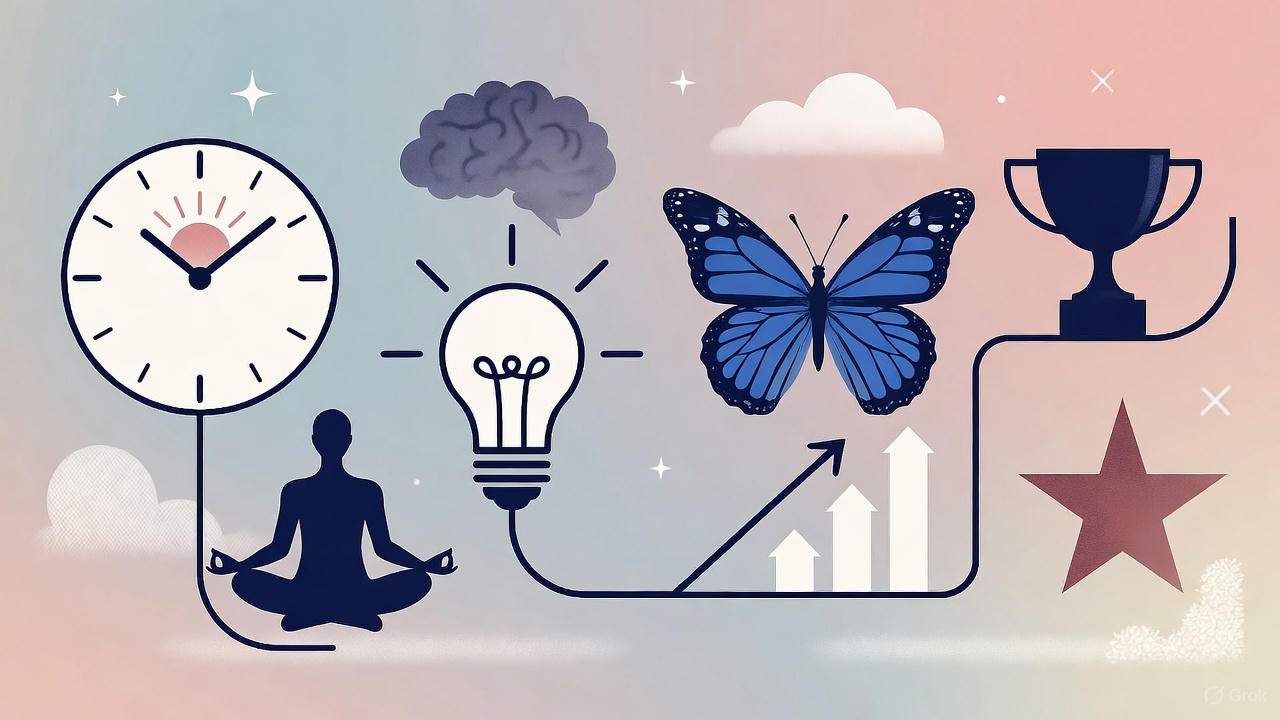
It’s Sunday evening, and the dread is already settling in. Not because Monday itself is terrible, but because Monday represents five days of waiting until you feel alive again. If this sounds familiar, you’re not alone. But here’s the uncomfortable truth: if your life is something you’re constantly trying to escape from, that’s not a vacation problem. That’s a design problem.
The good news is that you can redesign your life without quitting everything and moving to a remote island. Life design isn’t about dramatic overhauls. It’s about small, intentional shifts that align your daily reality with what actually matters to you. Bill Burnett and Dave Evans, Stanford professors who developed the concept of design thinking for life, argue that the same principles designers use to create products can help us create lives that work. The first step is acknowledging that your current life is a prototype, and prototypes are meant to be iterated.
Recognize the Signs That Something Needs to Change
Before you can redesign anything, you need to see clearly what’s not working. These signals often hide in plain sight because we’ve normalized them.
You might be living for the weekend, treating Monday through Friday as endurance and Saturday and Sunday as your “real life.” The Sunday scaries hit around 4 PM and don’t lift until you’re too busy to feel them. You find yourself constantly fantasizing about “someday,” whether that’s retirement, when the kids are grown, or when you finally have time. Vacation feels less like a nice-to-have and more like oxygen, something you desperately need just to function.
Perhaps the most telling sign is exhaustion without direction. You’re busy all the time, but when you try to articulate what you’re building, what you’re working toward, the words don’t come. Activity is not the same as purpose. If you recognized yourself in any of these patterns, your life is sending you a clear message: something needs redesigning.

Conduct an Honest Life Audit
You can’t change what you don’t acknowledge. So before jumping to solutions, take time to understand where you actually are. This isn’t about judgment. It’s about clarity.
Start with a time audit. For one week, track how you spend your hours, not how you think you spend them, but how you actually do. You’ll likely be surprised. We tell ourselves stories about our time that don’t match reality. As you track, note which activities energize you and which drain you. Pay attention to what you’re doing out of genuine desire versus obligation. Notice where your hours disappear without leaving any sense of value or memory behind.
The energy audit goes deeper than time alone. Time and energy aren’t the same thing. Some activities take thirty minutes but drain you for hours afterward. Others take hours but leave you energized and alive. Oliver Burkeman, in his book “Four Thousand Weeks,” argues that we have far less time than we think, which makes how we spend our energy even more critical than how we spend our minutes. Identify activities that are high-energy and high-return, and find ways to do more of them. Protect low-energy, high-return activities fiercely. Minimize high-energy, low-return drains, and eliminate low-energy, low-return activities ruthlessly.
Finally, conduct a values audit. Write down your top five values, not what should matter or what mattered five years ago, but what actually matters to you now. Then look at your calendar from the past month. Does how you spend your time reflect what you say you value? The gap between stated values and actual time allocation is where resentment lives. That gap is also where redesign begins.
Create Joy Pockets Throughout Your Week
Redesigning your life doesn’t require a complete overhaul. It requires strategic placement of moments that remind you why you’re alive. These “joy pockets” are small, protected experiences of genuine pleasure distributed throughout your week.
Consider your morning ritual. Not the rushed, scrolling, barely-awake version. An intentional one where you actually taste your coffee, actually notice the morning light, actually arrive in your day before it begins. This doesn’t require waking up two hours earlier. It might just mean protecting fifteen minutes from your phone. Try taking brief walks outside with no podcast, no purpose, no destination. Just walking and noticing. Research on attention restoration theory suggests that even brief exposure to natural environments significantly reduces mental fatigue and improves mood.
Why should special meals only happen on weekends? Make a random Tuesday evening feel like an occasion. Light a candle. Use the good dishes. Cook something you actually want to eat rather than whatever’s fastest. These aren’t indulgences. They’re acts of self-respect that communicate to your nervous system that this life, right now, is worth celebrating. Protect solo hours when you’re unavailable to everyone, doing something that fills you up. Whether that’s reading, creating, moving, or simply being, this time isn’t selfish. It’s sustainability.

Set Boundaries That Protect Your Life
Boundaries aren’t about building walls. They’re about creating space for what matters. Without clear boundaries, work bleeds into everything, and you never fully arrive anywhere.
Time boundaries mean that work has a start time and an end time. Stick to them unless something is genuinely exceptional, not just expected. The culture of constant availability has normalized the abnormal. You’re not required to be reachable at all hours simply because technology makes it possible. Communication boundaries might mean no emails after a certain hour, no work discussions during family dinner, and treating time off as actually off. Your colleagues managed without you before you existed. They can manage during your dinner.
Energy boundaries are perhaps the most important. Not every request needs an immediate response. Not every crisis is yours to solve. Not every demand on your attention deserves your attention. Practice saying things like “I’m unavailable after 6 PM” or “I need to think about that before committing” or “That won’t work for me, but here’s what I can offer.” These sentences feel uncomfortable at first. They also feel like freedom eventually.
You also need transitions between modes of being. Going from work-mode to life-mode isn’t instant, especially if you work from home. Create rituals that mark the shift. Change your clothes. Walk around the block. Close your laptop with intention rather than leaving it half-open, half-calling to you. Without transitions, you’re never fully working and never fully resting. You’re just hovering between both, depleted in both directions.
Give Yourself Permission to Evolve
Here’s the radical permission you might need to hear: what worked before doesn’t have to work now. The job that was perfect at 25 might suffocate you at 35. The city you loved might not fit who you’re becoming. The routine that served you might now just be habit, not support.
You’re allowed to change your mind. You’re allowed to want different things than you wanted five years ago or five months ago. You’re allowed to redesign your life even if the current design looks good on paper. Looking good on paper and feeling good in reality are different things.
Sit with some uncomfortable questions: What would you do if you weren’t afraid? What are you tolerating that you don’t actually have to tolerate? If you designed your ideal week from scratch, what would it include? What would it exclude? What story are you telling yourself about why you can’t change, and is that story actually true? Journal these questions. Let them simmer. They reveal what needs redesigning more clearly than any external advice could.
The Japanese concept of ikigai, finding the intersection of what you love, what you’re good at, what the world needs, and what you can be paid for, isn’t about finding one perfect answer. It’s about continually adjusting your aim as you grow. Your ikigai at 25 might be different from your ikigai at 45. That’s not failure. That’s evolution.

Begin Your Redesign Today
You don’t have to burn everything down. You don’t need a dramatic transformation story. You just need to start somewhere, with one small shift that honors who you are and what you need.
This week, identify one thing that’s draining you that you can actually stop doing. Delegate it, delete it, or decline it. Add one joy pocket, something small that makes you feel alive, and schedule it like you would a meeting. No one cancels meetings with their boss; treat this appointment with yourself with the same respect. Set one boundary you’ve been avoiding. Communicate it clearly. Maintain it even when it’s uncomfortable. Design one transition ritual between work and life, and practice it daily until it becomes automatic.
Five small shifts. That’s all. Notice what changes. Notice how it feels to take your own wellbeing seriously enough to protect it. Notice what becomes possible when you stop waiting for “someday” and start designing “today.”
Your Invitation
Life redesign isn’t about perfection. It’s about intention. It’s about building a life where Monday doesn’t feel like a prison sentence, where you have things to look forward to that aren’t just escape, where your days include moments that feel like yours, where work is part of your life rather than all of it.
You spend too much of your life living it to spend most of it wishing you were somewhere else. You deserve more than a life you’re trying to survive until the weekend. You deserve a life you want to show up for on a random Tuesday morning. That life doesn’t require winning the lottery or quitting everything you’ve built. It requires looking honestly at what isn’t working, getting clear on what actually matters to you, and making small, consistent changes that honor those insights.
Design a life you don’t need constant escape from. Design a life you want to show up for. Start with one shift this week. The rest will follow.
For more on creating intentional transitions in your life, explore the power of the pause. If you’re finding it difficult to say no to obligations that drain you, boundaries without guilt offers practical frameworks. And if you’re ready to think about your energy rather than just your time, energy management can help you work with your natural rhythms instead of against them.
Sources: Stanford Life Design Lab (Bill Burnett and Dave Evans), Oliver Burkeman’s “Four Thousand Weeks,” ikigai philosophy, attention restoration theory.