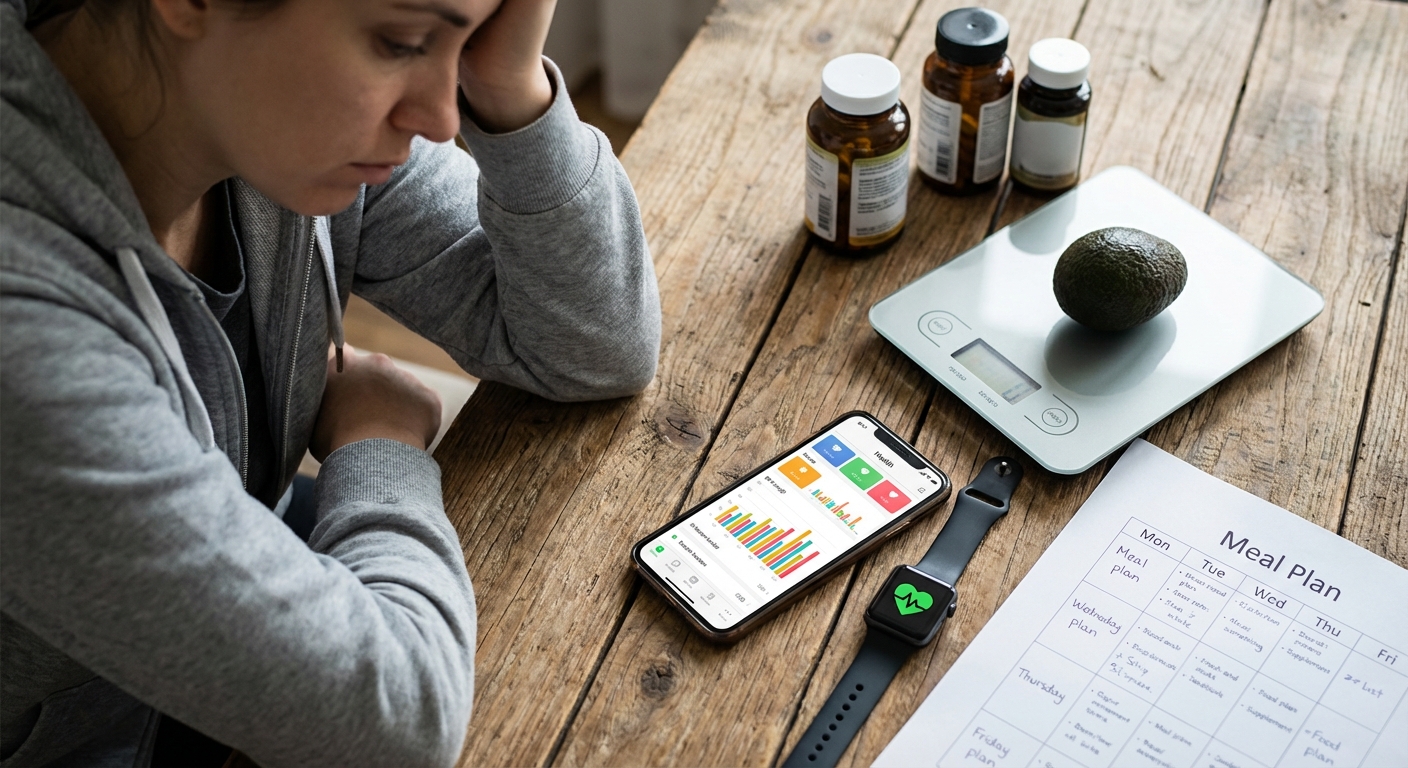
You wore the tracker. You logged the macros. You monitored your sleep stages, your HRV, your step count, your hydration levels. You did the cold plunge, the red light therapy, the gratitude journal, the 5 AM wake-up. You optimized your morning routine until it ran like a small manufacturing operation. And somewhere around month three, lying awake at 11 PM wondering why your deep sleep score dropped two percentage points, you realized something had gone sideways. The thing that was supposed to make you well had become another source of anxiety. Wellness had become another thing to be bad at.
You’re not imagining this. There’s a name for that specific anxiety you feel about your sleep data: orthosomnia. Coined by Dr. Kelly Baron and her colleagues at Rush University Medical Center in a 2017 paper published in the Journal of Clinical Sleep Medicine, the term describes patients who develop sleep disturbances precisely because they’re obsessing over their sleep tracker data. People who previously slept fine began lying awake worrying about whether they were getting enough REM. The tool designed to improve sleep was actively making it worse.
Orthosomnia is a small example of a much larger pattern. The wellness industry, worth over $5.6 trillion globally, has spent the last decade convincing us that the path to health runs through more data, more optimization, more precision, more control. And in 2026, a growing number of people are pushing back. Not because the science is wrong, but because the relationship between data and wellbeing has become pathological.
The Quantification Trap
The rise of wearable technology promised to democratize health data. And in many ways, it delivered. People with chronic conditions gained real-time insights into their patterns. Athletes fine-tuned their recovery. The problem emerged when optimization thinking, borrowed from Silicon Valley productivity culture, colonized every aspect of personal health. Suddenly, a walk in the park wasn’t exercise unless it was tracked. A night of sleep wasn’t restful unless the data confirmed it. A meal wasn’t nourishing unless the macronutrients had been calculated.
This is the quantification trap: the moment measurement stops serving experience and starts replacing it. You eat the meal but experience only the numbers. You sleep but trust the data more than how you actually feel. You exercise but the satisfaction comes from the ring closing on your wrist, not from the sensation of moving your body. The metric becomes the experience, and the experience without the metric feels incomplete.
The Global Wellness Summit’s 2026 trend report named this phenomenon directly. Among their ten predictions for the year, “The Over-Optimization Backlash” describes how “data-driven wellness can tip from motivation into fixation.” The report identifies a broader cultural shift away from performance metrics toward what they call “emotional repair, nervous-system safety, and embodied care.” Wellness in 2026, they argue, is moving from measurement to meaning.
This isn’t an anti-science position. Nobody is suggesting we throw away medical data or ignore evidence-based interventions. The shift is more subtle: a recognition that the pursuit of perfect health can become its own form of illness, and that the relentless drive to optimize every biological function is itself a stress response masquerading as self-care.
What the Longest-Lived People Never Tracked
If optimization were the key to longevity, you’d expect the world’s healthiest populations to be the most data-driven. They’re not. The five Blue Zones regions identified by researcher Dan Buettner, pockets in Sardinia, Okinawa, Loma Linda, Nicoya, and Ikaria where people routinely live past 100, share nine common lifestyle factors. Not one of them involves a fitness tracker.
What Buettner found in Blue Zones was natural movement, not gym routines. Meals eaten with family, not calorie-counted in isolation. Social belonging through faith communities or tight-knit social circles. A sense of purpose. Moderate wine with friends. Beans as a dietary staple. None of it optimized. All of it deeply, communally human.
The Blue Zones research revealed a striking statistic: only about 20% of longevity is determined by genetics. The other 80% comes from lifestyle and environment. But when Buettner analyzed what “lifestyle” actually meant in practice, it wasn’t the individual discipline-and-willpower model the wellness industry sells. It was built environments that made healthy choices the default, social structures that kept people connected, and cultural rhythms that naturally incorporated rest, purpose, and movement. The healthiest people on Earth weren’t trying to be healthy. They were living in contexts that made health the path of least resistance.

The Loneliness at the Center of Optimization Culture
Robert Waldinger directs the Harvard Study of Adult Development, the longest-running study of human happiness, which has tracked participants since 1938. The study’s central finding, replicated across generations and demographics, is that the quality of our relationships is the single strongest predictor of both happiness and physical health. “The people who were the most satisfied in their relationships at age 50,” Waldinger reports, “were the healthiest at age 80.”
This finding puts the optimization movement in a different light. If the most powerful health intervention isn’t a supplement or a sleep protocol but the quality of your human connections, then a wellness culture built on individual optimization is solving the wrong problem. You can have a perfect HRV score and still be lonely. You can hit every macro target and still lack the social bonds that Waldinger’s research identifies as the actual foundation of a long, healthy life.
The irony is that optimization culture, by its nature, tends to be isolating. It’s you versus your data. Your biometrics are personal. Your morning routine is solo. Your supplements are yours alone. The communal aspects of health, cooking together, walking with neighbors, sharing meals, showing up for each other, don’t fit neatly into a tracking app. And yet, those are precisely the behaviors that the longest-lived populations share.
If you’ve already begun questioning the productivity treadmill, as we explored in the case for slow living, the wellness version of that reckoning looks similar. It’s less about doing more and more about letting yourself be part of something.
The Shift Toward Imperfect Wellness
What’s emerging in 2026 isn’t a rejection of health. It’s a recalibration. The Global Wellness Summit describes new wellness experiences that “embrace what humans actually are: imperfect, emotional, relational, and sensory.” They document the rise of wellness raves, sober morning dance events, and communal gathering spaces designed not for optimization but for connection and emotional release. These aren’t anti-science. They’re anti-isolation.
The shift is also showing up in how people relate to their own bodies. The philosophy of enough, the permission to stop relentlessly improving, is becoming a wellness practice of its own. Instead of asking “How can I optimize this?” the emerging question is “How does this make me feel?” Instead of tracking whether you hit 10,000 steps, noticing whether the walk made you feel calmer, more present, more connected to your neighborhood. The data doesn’t disappear, but it stops being the point.
This doesn’t mean throwing away everything that works. If tracking your blood sugar helps you manage a chronic condition, track it. If monitoring your sleep reveals useful patterns, use that information. The backlash isn’t against data itself. It’s against the belief that data equals health, that the quantified life is automatically the good life, and that doing nothing sometimes is a failure of discipline rather than an act of wisdom.
Your Invitation
Consider this: what would your wellness practice look like if no one was watching, not even your watch? If you couldn’t share it, post it, or compare it? If the only measure of success was how you felt in your body, in your relationships, in your daily life?
The people in Blue Zones never asked those questions because they never needed to. They walked because walking was how they got places. They ate plants because plants were what grew. They stayed connected because their culture didn’t offer the option of isolation. We don’t live in Blue Zones, and we can’t replicate those conditions perfectly. But we can notice when our pursuit of health has become another form of striving, and we can choose, deliberately and imperfectly, to build the communal, embodied, untracked wellness that the research keeps pointing us toward.
You don’t need another tracker. You might need another person at the table.
Sources
- Baron, K.G., et al. “Orthosomnia: Are Some Patients Taking the Quantified Self Too Far?” Journal of Clinical Sleep Medicine, 2017.
- Buettner, D., and Skemp, S. “Blue Zones: Lessons From the World’s Longest Lived.” American Journal of Lifestyle Medicine, 2016.
- Waldinger, R. “Over Nearly 80 Years, Harvard Study Has Been Showing How to Live a Healthy and Happy Life.” Harvard Gazette, 2017.
- Global Wellness Summit. “The Future of Wellness 2026 Trends.” Global Wellness Summit, 2026.