“I can’t meditate. My mind won’t stop thinking.”
If you’ve ever said this, you’re not alone. It’s the most common reason people give for not meditating, and it’s based on a fundamental misunderstanding of what meditation actually is.
Meditation isn’t about stopping your thoughts or achieving some blissed-out state of empty mind. That myth makes people feel like failures before they even start. Meditation is simply noticing. Noticing your thoughts, your breath, your body. And when your attention wanders, which it will, constantly, gently bringing it back. The wandering isn’t failure. The returning is the practice.
You already have everything you need. No special equipment, quiet room, flexible hips, or calm mind required. Just a few minutes and the willingness to sit with yourself.
What You’re Actually Training
Meditation is attention training, nothing more mystical than that. You’re practicing noticing what’s happening in your mind and body, and when your attention drifts, you practice returning to the present moment. Every time you notice you’ve wandered and bring yourself back, you’re strengthening neural pathways for attention and emotional regulation.
Research using brain imaging shows that consistent meditation practice changes brain structure and function. Studies from Harvard and other institutions document increased gray matter in regions associated with attention and self-awareness, decreased activity in the amygdala (the brain’s stress center), and improved connectivity between areas that control focus and emotion. The effects are measurable, reproducible, and biologically grounded.
Jon Kabat-Zinn, who brought mindfulness into mainstream medicine, emphasizes that meditation isn’t about feeling a certain way. Some sessions you’ll feel calm. Some you’ll feel agitated or bored. All of that is practice. You can’t fail at meditation unless you don’t try.

The Simplest Way to Start
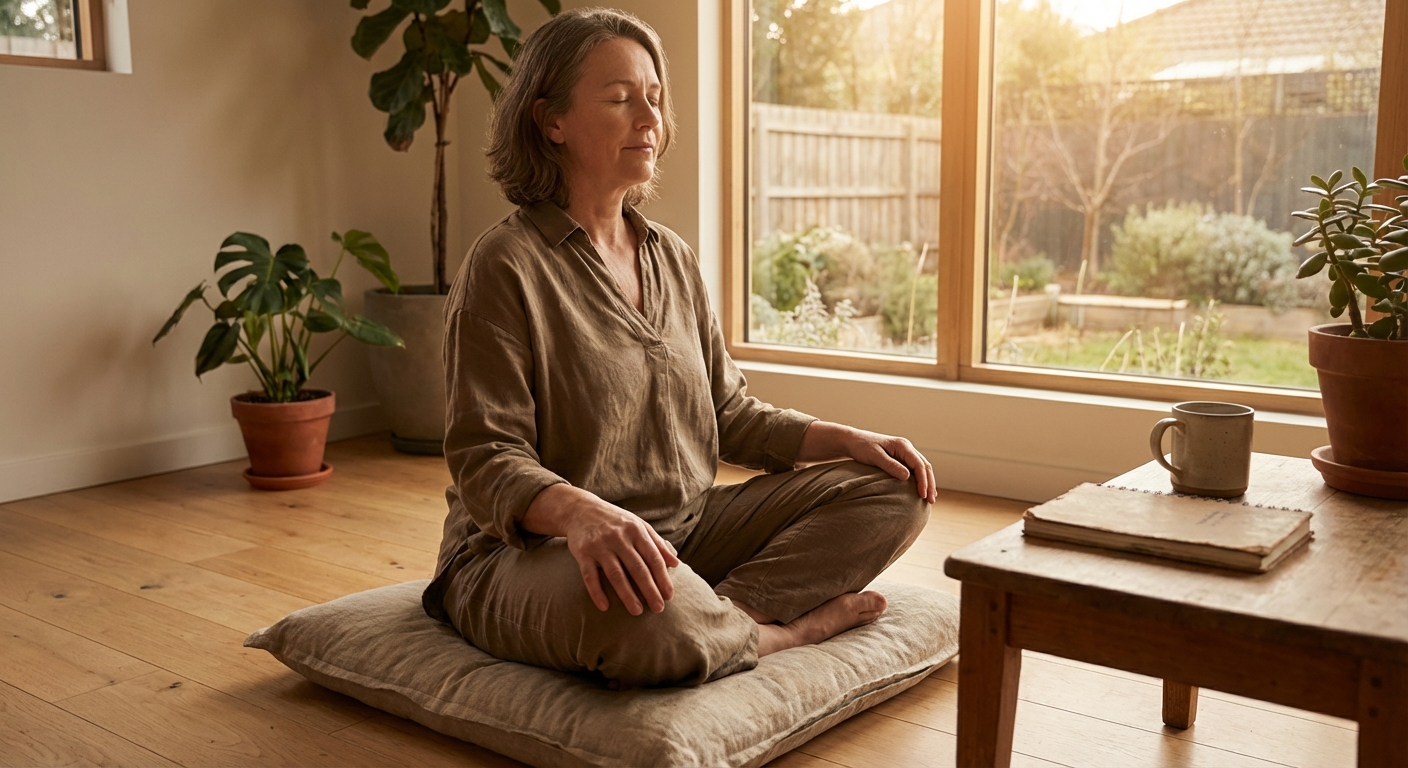
You don’t need to learn a complex technique. Breath awareness is enough. Sit comfortably, anywhere, in any position that doesn’t hurt. Set a timer for two minutes. Close your eyes or keep them softly open. Notice your breathing without trying to change it. Feel air moving in and out, your chest or belly rising and falling.
Your mind will wander immediately. To your to-do list, a conversation from yesterday, what you’re having for dinner. This is normal, not a problem. When you notice you’re thinking, gently return to the breath. No judgment, just “oh, thinking,” and back to breathing. Repeat this cycle until the timer goes off.
That’s meditation. The practice isn’t keeping your mind on the breath forever. It’s noticing when it wanders and bringing it back. Two minutes is enough to begin. Do that daily for a week, then increase to three minutes, then five. By the time you’re at ten minutes, meditation is an established habit. But if you jump straight to thirty minutes, you’ll probably quit within a week.
Finding What Works for You
If breath awareness doesn’t resonate, alternatives exist. Body scan meditation moves attention slowly through physical sensations from feet to head, grounding you in bodily experience. Walking meditation uses slow, deliberate steps as the anchor, perfect for people who can’t sit still. Breathwork practices offer more active approaches that some find easier than passive observation.
Loving-kindness meditation uses silent phrases wishing wellbeing for yourself and others. Sound meditation lets ambient noise or music serve as your attention anchor. Mantra repetition gives your mind something to “do,” which some people find more approachable than watching the breath. All of these are legitimate meditation. Find what works for you.
Guided meditations through apps like Headspace, Calm, or Insight Timer can help if doing it solo feels too hard. Someone talks you through the practice, removing the “am I doing this right?” anxiety that stops many beginners.
The Permission to Be Imperfect
Your meditation practice will be messy. Some days you’ll sit and feel calm. Some days your mind will race nonstop. Some days you’ll fall asleep. Some days you’ll skip it entirely. All of this is normal.
The benefits accumulate gradually. The first few weeks feel awkward and restless. After a month or two, you start noticing thought patterns and catching yourself before reacting. After six months, meditation feels natural, not forced. It’s like exercise: the first weeks are hard, months in you see changes, years in it’s transformed you.
But even imperfect practice matters. Two minutes of distracted meditation beats zero minutes. Learning to pause throughout your day, taking three conscious breaths before responding to stress, extends the practice beyond your formal sitting time. These micro-moments create space between stimulus and response, the space where you actually have choice.
Your Invitation
Not tomorrow. Not when you have more time or feel more ready. Right now. Close your eyes and take three slow, conscious breaths. Notice how each breath feels.
That’s meditation. You just did it.
Now do it again tomorrow. For two minutes. Then the next day. Your mind is waiting. Your breath is always available. You can do this, even if you think you can’t. Especially if you think you can’t.
Sources: Jon Kabat-Zinn’s mindfulness-based stress reduction, Harvard neuroscience research on meditation, contemplative practice traditions.