
Your heart is pounding. Your palms are sweating. In ten minutes, you’ll walk into a meeting that could define the next year of your career. Every fiber of your body is screaming that something is wrong, that you need to escape, that this physical response is proof you’re not ready.
What if that interpretation is the actual problem?
Emerging research in cognitive neuroscience suggests something counterintuitive: the physical sensations of stress and excitement are nearly identical. Racing heart, heightened alertness, increased blood flow. Your body can’t tell the difference between “I’m terrified” and “I’m ready.” But your brain’s interpretation of those sensations determines whether they help or hurt you.
This isn’t positive thinking or toxic optimism. It’s a phenomenon researchers call cognitive reappraisal, and it has measurable effects on your cortisol levels, cardiovascular health, and performance under pressure. The way you frame your stress response literally changes what happens in your body next.
The Two Stress Responses
For decades, we’ve been taught that stress is the enemy. Reduce it, avoid it, eliminate it. But this framing misses something important that researchers have discovered: there’s more than one way your body can respond to challenging situations, and which response you have depends partly on how you perceive the challenge.
Dr. Wendy Berry Mendes at Yale University studies what she calls the “challenge response” versus the “threat response.” Both involve physiological arousal, but they look different under the surface.
In a threat response, your body constricts blood vessels and prepares for damage. Cortisol floods your system. Your body assumes the worst and prepares for injury. This response is appropriate if you’re about to be physically attacked, but it’s counterproductive for a job interview or difficult conversation.
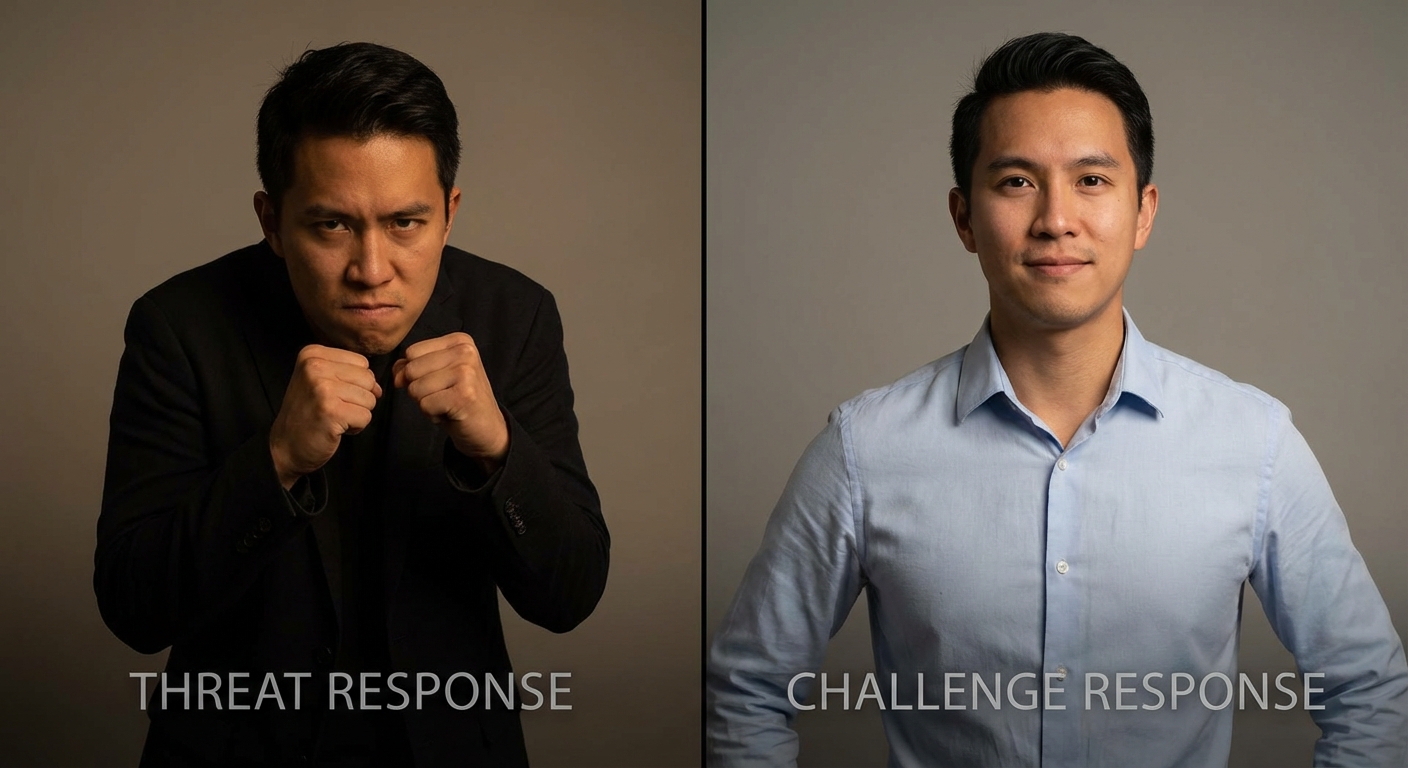
In a challenge response, something different happens. Your heart rate still increases, but your blood vessels dilate. Your body mobilizes energy without the damage-preparation mode. You get the alertness and focus without the physiological costs. Athletes performing at their peak typically show challenge responses, not threat responses.
The remarkable finding is that these responses aren’t fixed. How you interpret a stressful situation influences which physiological pattern your body activates. When participants in studies were taught to view stress arousal as helpful rather than harmful, their bodies actually shifted from threat responses toward challenge responses. Same situation, different interpretation, different biology.
The Science of Reframing
Cognitive reappraisal isn’t about pretending everything is fine. It’s about accurately reassessing what’s happening and choosing an interpretation that serves you.
Dr. Kelly McGonigal, a health psychologist at Stanford, has spent years studying how our beliefs about stress affect its impact on our health. Her review of research found something striking: people who viewed stress as harmful and experienced a lot of it had significantly increased mortality risk. But people who experienced the same amount of stress but didn’t view it as harmful showed no increased risk at all. The belief about stress was as important as the stress itself.
This doesn’t mean you should ignore genuine threats or push through situations that are actually damaging. It means that for many of the stressors we face, situations that are challenging but not actually dangerous, our interpretation matters enormously.

The reframe isn’t “this isn’t stressful” or “I shouldn’t feel this way.” It’s “my body is preparing me for something important.” That racing heart? It’s sending oxygen-rich blood to your brain. Those butterflies? They’re mobilizing energy for the task ahead. The physical sensations aren’t signs of weakness or inadequacy. They’re signs that your body is doing exactly what it evolved to do when something matters.
Research from Harvard Business School found that when participants reframed pre-performance anxiety as excitement, using the simple phrase “I am excited” instead of “I am calm,” they performed better on subsequent tasks. The physiological arousal stayed the same. But the interpretation shifted, and so did the outcome.
The 90-Second Window
Neuroscientist Dr. Jill Bolte Taylor describes what she calls the “90-second rule.” When you experience a strong emotion, the initial chemical surge in your brain lasts approximately 90 seconds. After that, any remaining emotional response is being maintained by your thoughts about the situation, not the original stimulus.
This creates a window of opportunity. When stress hits, you have about 90 seconds of pure physiological response. What happens after that depends largely on the story you tell yourself.
If you tell yourself “I can’t handle this, this is too much, I’m going to fail,” you extend and intensify the threat response. You add cognitive fuel to the physiological fire. The stress compounds.
If you tell yourself “my body is getting ready, this matters to me, I can work with this energy,” you’re more likely to shift toward a challenge response. You’re not suppressing the stress. You’re working with it differently.
This isn’t about immediate mastery. The first time you try to reframe stress in the moment, it might not work perfectly. The neural pathways that interpret arousal as threat have probably been reinforced for years. But those pathways can change. Each time you practice a different interpretation, you make it slightly more accessible for next time.
Practical Reframes That Work
The goal isn’t to memorize affirmations that feel hollow. It’s to find interpretations that feel true and serve you better.
When your heart races before a presentation, instead of “I’m so nervous, everyone will see I’m anxious,” try “My body is giving me energy for this. This matters to me, and my system knows it.”
When you can’t sleep because of tomorrow’s difficult conversation, instead of “I’m so stressed I can’t function,” try “My mind is processing something important. I can trust myself to handle this tomorrow.”
When you feel overwhelmed by your to-do list, instead of “There’s too much, I’m failing, I’ll never catch up,” try “My brain is flagging that priorities need attention. That’s useful information, not proof of inadequacy.”

Notice that these reframes don’t deny difficulty. They don’t claim everything is wonderful. They simply offer a more accurate and less catastrophic interpretation of what the body sensations mean.
This connects to what researchers call “emotional granularity,” the ability to make fine-grained distinctions between emotional states. When you can distinguish between “I’m stressed because this matters” and “I’m stressed because I’m in danger,” you gain options you didn’t have before. If you’re interested in developing this skill, our article on naming your feelings with precision explores this in depth.
When Reframing Isn’t Enough
Cognitive reappraisal is a powerful tool, but it’s not a cure-all. Some stress is a signal that something genuinely needs to change. If you’re in a toxic work environment, no amount of reframing will make it healthy. If you’re dealing with trauma responses, you may need professional support to process what’s happening, not just different interpretations.
The goal of reframing isn’t to make yourself okay with situations that aren’t okay. It’s to ensure that your interpretation of stress matches the actual level of threat. For chronic stress rooted in circumstances that need to change, the answer is changing circumstances, not just changing thoughts.
If you’re experiencing persistent anxiety that interferes with daily functioning, that’s worth discussing with a mental health professional. The techniques here are supportive practices, not replacements for clinical care when it’s needed.
For those dealing with future-focused stress specifically, our article on anticipatory anxiety offers additional strategies for when worry about what’s coming overshadows the present.
Building the Reframe Habit
Like any skill, cognitive reappraisal gets easier with practice. You’re not trying to eliminate stress. You’re trying to change your relationship with it.
Start by noticing your physical stress responses without immediately reacting to them. Can you observe your racing heart for a moment before the cascade of worried thoughts begins? That pause creates space for choice.
Then experiment with different interpretations. Not forced positivity, but genuine alternatives. “My body is preparing me” feels different than “I shouldn’t be feeling this.” Find language that resonates with your own experience.
Finally, reflect after stressful events. What story did you tell yourself? How did that story affect your experience? What might you try differently next time? This isn’t about self-criticism. It’s about learning.
Your Invitation
The next time stress hits, before you try to make it stop, consider that maybe it doesn’t need to stop. Maybe it needs to be understood differently.
Your pounding heart isn’t proof that you’re failing. It’s proof that something matters to you and your body is rising to meet it. Your sweaty palms aren’t signs of weakness. They’re signs of engagement with something challenging.
You might not be able to choose whether you feel stressed. But you have more influence than you think over what that stress becomes. The same physiological arousal that can fuel panic can also fuel performance. The difference often comes down to a story told in about 90 seconds.
That story is yours to tell.
Sources
- Wendy Berry Mendes, Yale University research on challenge vs. threat responses
- Kelly McGonigal, “The Upside of Stress” and Stanford stress research
- Jill Bolte Taylor, “My Stroke of Insight” and the 90-second emotional wave
- Harvard Business School research on anxiety reappraisal and performance