
You’re reading this on a screen right now, which means you’ve already made at least three decisions to ignore other things. The notification that just buzzed. The tab you were about to open. The vague urge to check something else, anything else. You chose this instead. That choice is becoming increasingly rare, and increasingly valuable.
The average person touches their phone 96 times per day. That’s not counting passive screen time, just active pickups. Each touch is a small decision, except most of them don’t feel like decisions anymore. They feel like reflexes. Something buzzes, we reach. We have a moment of stillness, we fill it. We’re waiting for anything, coffee, a meeting to start, a page to load, and our hands move toward our pockets before our conscious mind even registers boredom.
This isn’t a lecture about phones being bad. Technology isn’t the enemy. But the relationship most of us have with our devices has drifted somewhere uncomfortable, where the tool uses us as much as we use it. According to wellness forecasters, mindful technology use is emerging as one of the defining movements of 2026. Not because people want to go offline, but because they want to reclaim something that’s been slowly eroding: the ability to choose where their attention goes.
The Attention Economy Finally Gets Personal
For years, we’ve talked about the “attention economy” as an abstract concept, something that affected advertisers and media companies. But the personal cost has become impossible to ignore. The economy that trades in your attention has gotten extraordinarily good at capturing it, and we’re all feeling the side effects.
The American Psychological Association’s research highlights a “crisis of connection,” with 62% of adults reporting societal division as a significant source of stress. Half of Americans report feelings of emotional disconnection, including social isolation and a lack of companionship. These findings emerge against the backdrop of the most connected generation in history, people who can reach anyone, anywhere, instantly. The paradox is striking: infinite connectivity, widespread loneliness.
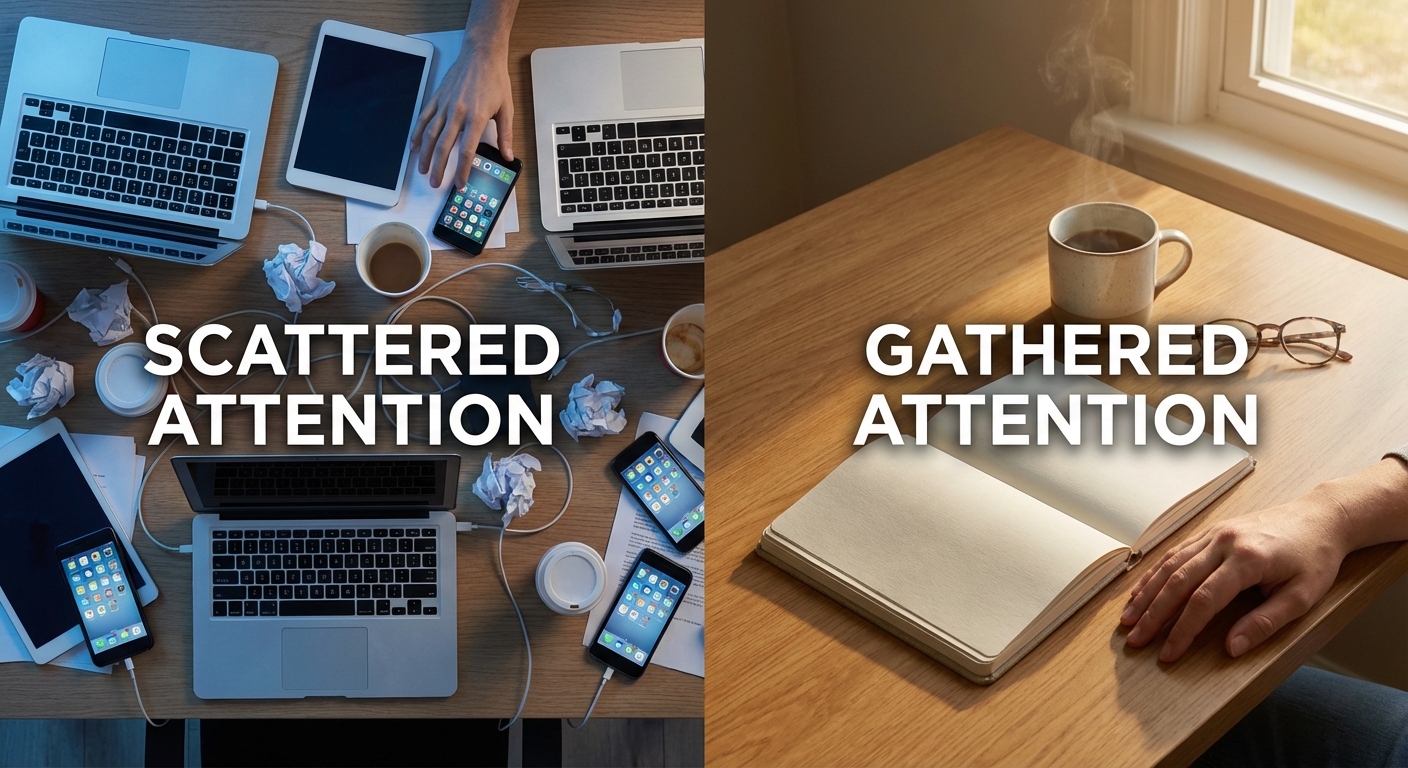
Part of this disconnect stems from where our attention actually goes. We spend hours in digital spaces designed to hold us as long as possible, then wonder why we feel drained and scattered. We scroll through highlight reels of other people’s lives, then feel strangely empty. We respond to notifications all day, then struggle to be present for the people in front of us. The attention we’re giving away isn’t neutral. It’s coming from somewhere.
What Mindful Technology Use Actually Looks Like
Mindful technology use isn’t about demonizing your phone or pretending you can live without email. It’s not about digital detoxes that last three days before crumbling. It’s something more sustainable and more honest: a set of practices that help you use technology intentionally rather than reactively.
The shift starts with noticing. Before you can change your relationship with technology, you have to see it clearly. Notice when you reach for your phone without conscious intention. Notice the moments when you’re most susceptible to the pull, usually transitions, waiting, or emotional discomfort. Notice how you feel after 30 minutes of scrolling versus 30 minutes of something else. This isn’t about judgment. It’s about data gathering. You can’t change patterns you can’t see.
From noticing, you can start making small structural changes. People practicing mindful technology use are simplifying their home screens, removing apps that don’t serve them, and using focus-driven tools instead of distraction-heavy platforms. They’re limiting notifications to what actually matters. They’re creating phone-free zones, not out of rigid discipline, but because they’ve noticed they feel better when certain moments remain uninterrupted.
The goal isn’t to use technology less, necessarily. It’s to use it more deliberately. There’s a difference between spending an hour researching something you care about and spending an hour in an algorithmic feed that leaves you feeling emptier than when you started. Both involve a screen. Only one involves your choice.
The Neuroscience of Scattered Attention
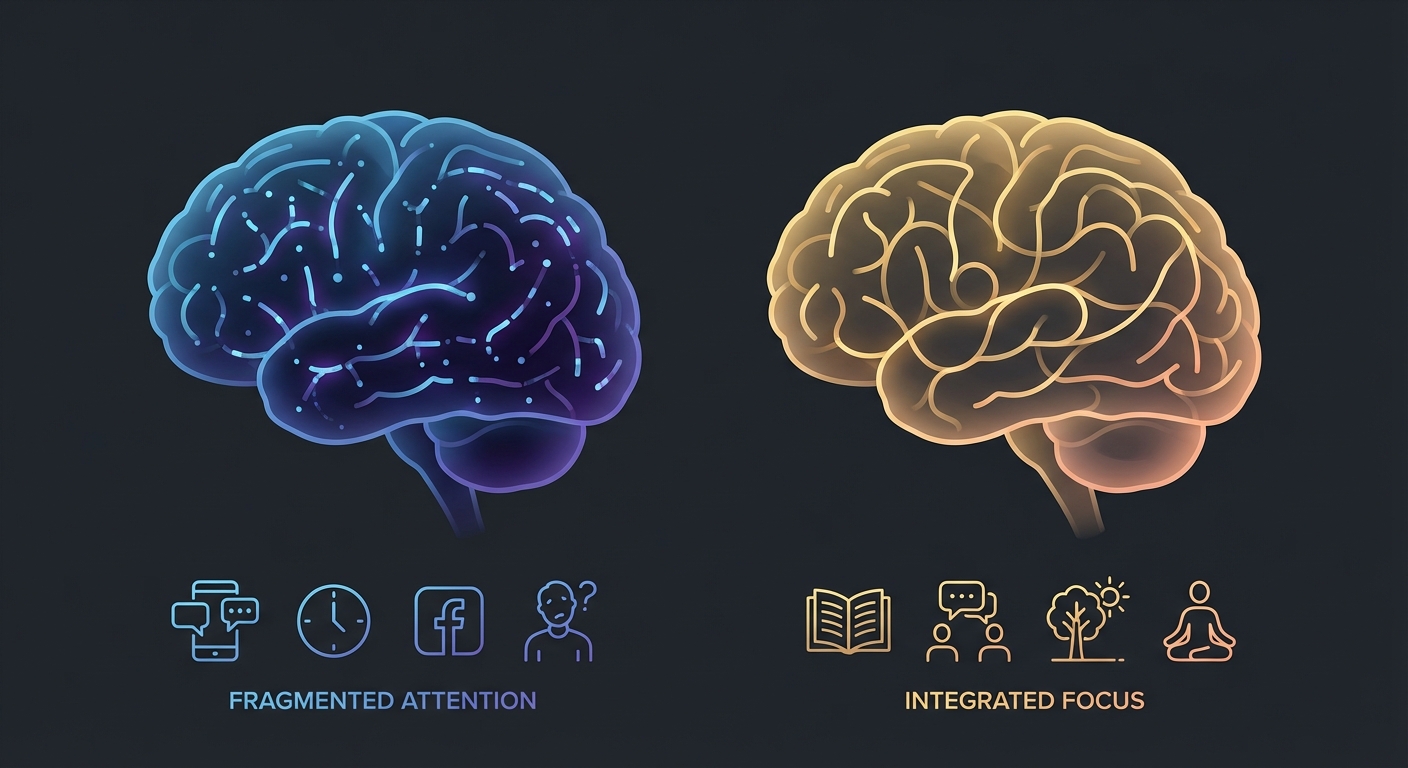
Understanding why attention matters requires looking at what happens in your brain when it’s constantly fragmented. Every time you switch tasks, check a notification, or toggle between windows, your brain pays a cognitive toll. Researchers call it “attention residue,” the mental cost of incomplete attention that lingers even after you’ve moved on.
Studies on focus and attention show that meditation and mindfulness practices enhance mental well-being by cultivating awareness and emotional control. These practices have been shown to induce neuroplasticity, increase cortical thickness, reduce amygdala reactivity, and improve brain connectivity and neurotransmitter levels. In other words, training your attention literally changes your brain structure in ways that support emotional regulation, cognitive function, and stress resilience.
The inverse is also true. Chronic attention fragmentation keeps your brain in a low-level stress state. When you’re constantly switching and scanning, your nervous system never fully settles. You’re always slightly activated, slightly vigilant. This isn’t the acute stress of facing a threat. It’s the chronic stress of never quite being present anywhere. Over time, this takes a toll on everything from sleep quality to relationship satisfaction to creative capacity.
Practical Steps for Attention Reclamation
Reclaiming your attention isn’t a dramatic overhaul. It’s a series of small choices that compound over time. Here’s what actually works, based on both research and real-world practice.
Create friction for distraction. The apps that capture your attention are designed to be frictionless. You can rebalance this by adding small obstacles. Move social media apps off your home screen. Use app timers that require a conscious override. Turn off all notifications except those from actual humans who need to reach you. These barriers don’t need to be insurmountable. They just need to create a pause between impulse and action.
Protect your transitions. The moments between activities are when we’re most vulnerable to distraction. Finished a task? Waiting for something? Just sat down? These are the moments when our hands move toward our phones on autopilot. Try naming the transition when you notice it: “I’m in a transition moment.” That simple awareness can interrupt the reflex and give you a choice.
Build attention anchors. These are regular practices that train your brain to focus. Recent research from Vanderbilt found that focused-attention meditation may stimulate the brain’s waste-clearance processes in ways similar to sleep. You don’t need to meditate for an hour. Even brief periods of focused attention, whether meditation, reading, or deep conversation, strengthen the neural pathways associated with sustained focus.
Designate device-free moments. Not whole days or weekends, just specific moments. The first 30 minutes after waking. Meals. The hour before bed. Conversations with people you care about. These protected spaces give your nervous system regular opportunities to settle, and they protect the moments that matter most from fragmentation.
The Deeper Invitation
At its core, reclaiming your attention is about reclaiming your life. Where your attention goes, your experience follows. If your attention is scattered across feeds and notifications, your experience will feel scattered. If your attention is gathered and present, your experience will feel richer, more coherent, more yours.
This isn’t about productivity, though focus does improve when attention is trained. It’s about presence. It’s about actually being here for your own life instead of perpetually half-present while your mind cycles through digital noise. It’s about having the experience you’re having instead of documenting it, commenting on it, or escaping from it.
The mental health research is clear: mindfulness practices reduce stress, improve emotional regulation, and support wellbeing. But beyond the data, there’s something more personal at stake. Your attention is the only currency you can’t make more of. It’s the substrate of every experience you’ll ever have. How you spend it, whether by choice or by reflex, shapes what your life actually feels like from the inside.

Your Invitation
You don’t need to transform your relationship with technology overnight. Dramatic overhauls rarely stick, and they often create shame when they fail. Instead, try one small experiment this week:
Choose a single transition moment, maybe the first five minutes after waking, or the walk from your car to your front door, and protect it. Don’t fill it with input. Just be in it. Notice what that feels like. Notice what arises when you don’t immediately reach for stimulation. Notice whether that moment feels like something, instead of just a gap between other things.
If it feels uncomfortable, that’s useful information. If it feels like relief, that’s information too. Either way, you’ve done something increasingly rare: you’ve chosen where your attention goes. That choice, repeated over time, is how you reclaim your attention. Not through willpower or dramatic declarations, but through small, consistent acts of presence.
The screens will still be there. The notifications will still beckon. But you’ll be responding from choice rather than reflex. And that changes everything.
Sources: YourStory wellness trends, American Psychological Association, Vanderbilt Health meditation research, Nature Reviews Neuroscience, Greater Good Science Center.