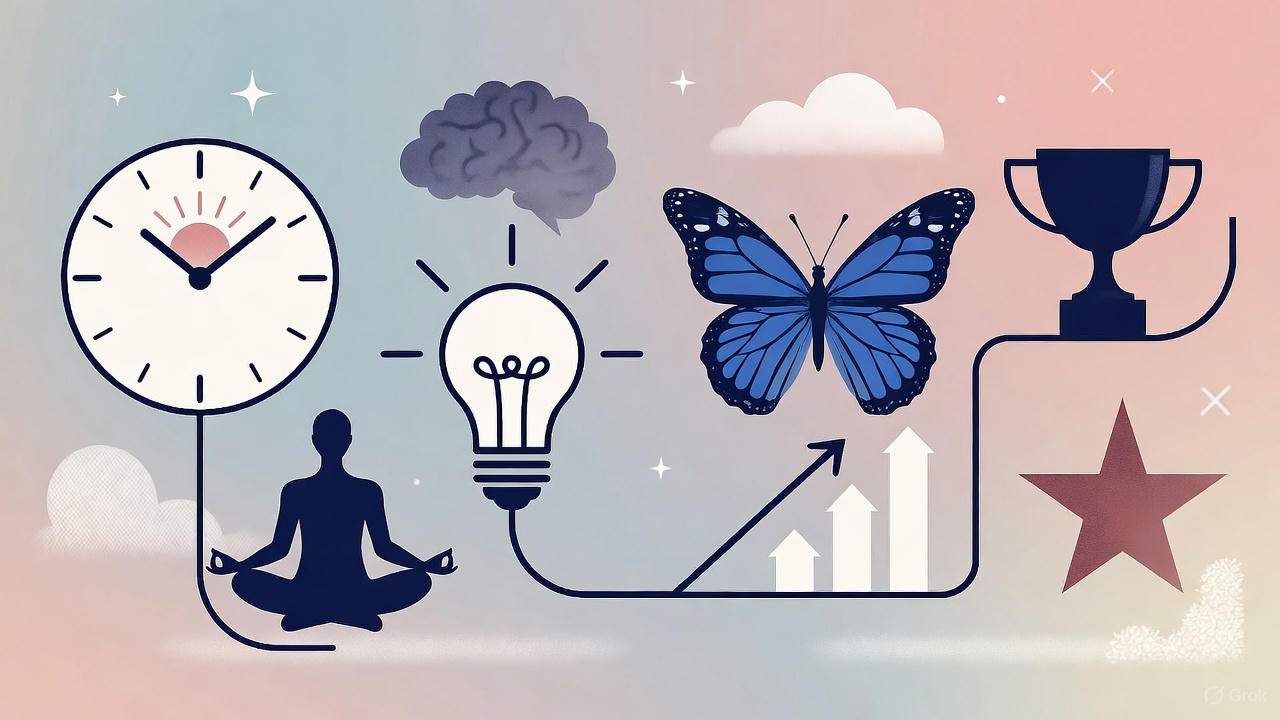
It’s January 15th, and the gym parking lot that was packed two weeks ago now has plenty of spaces. The meal prep containers you bought with such enthusiasm sit unused in the back of the cabinet. Your new journal has exactly three entries, all from January 1st. This pattern repeats every year for millions of people, and we’ve been told the problem is willpower, discipline, wanting it badly enough. But the real problem isn’t you. It’s the entire concept of New Year’s resolutions, which asks you to commit to forever, starting from a place of guilt about the past, with vague intentions about the future.
No wonder research consistently shows that approximately 80% of resolutions fail by February. The structure is designed to fail. But there’s another way, a way that feels less like punishment and more like possibility. Behavioral scientist B.J. Fogg, whose research at Stanford has shaped how we understand habit formation, argues that the key to lasting change isn’t motivation or willpower but design. You have to design for success, and that means working with human psychology rather than against it. The 30-day challenge does exactly that, creating a container short enough to commit to without your brain screaming “forever is too long” but long enough to see real change and build genuine momentum.
Why Thirty Days Works
The magic of thirty days lies in what it asks of you and what it doesn’t. Thirty days is finite and achievable. Your brain can handle “30 days of this.” It cannot handle “this for the rest of my life.” The end is visible from the start, which makes the middle tolerable. You’re not changing your identity forever; you’re running an experiment for a month. Experiments are interesting, not intimidating.

Research on habit formation, synthesized by Phillippa Lally and colleagues at University College London, shows that building an automatic behavior takes anywhere from 18 to 254 days, with an average of 66 days. But here’s what the research also reveals: after approximately 30 days of consistency, something significant shifts. The behavior starts to feel less like a forced action and more like something you just do. Most people who complete 30 days keep going, not because they’re forcing themselves but because stopping feels weirder than continuing. The habit has developed enough momentum that it becomes easier to maintain than to abandon.
James Clear, whose book “Atomic Habits” has helped millions understand behavior change, frames this in terms of identity. After 30 days of showing up, you’re not just someone trying to exercise; you’re becoming someone who exercises. You’re not someone trying to write; you’re becoming a writer. The 30-day container provides enough accumulated evidence that your self-concept begins to shift, and identity change is far more durable than behavior change alone. This is why building systems rather than setting goals creates more lasting change.
Choosing the Right Challenge
Not all challenges are created equal. Choose wrong and you’ll quit by day five. Choose right and you’ll transform. The Goldilocks principle applies: too hard, and you’ll get injured, overwhelmed, or burned out. Too easy, and nothing changes, no momentum builds. The sweet spot is your current reality plus a meaningful stretch, challenging enough to require growth but achievable enough that you won’t fail.
Think of it like lifting weights. If the weight is too light, no adaptation happens. If it’s too heavy, you get hurt. The right weight challenges your system without breaking it. The same principle applies to behavioral challenges. Running five miles daily when you currently run zero miles ever is a recipe for injury and failure. Drinking one glass of water daily when you already drink plenty creates no meaningful change. The goal is to find the challenge that stretches you into new territory while remaining genuinely achievable for 30 consecutive days.

A movement challenge, thirty days of moving your body with intention, works for many people because movement is what habit researchers call a keystone habit. When you move regularly, other behaviors shift without direct effort. Your energy increases. Your sleep improves. Your mood stabilizes. Your food choices often improve naturally. The specifics matter less than the consistency: 20-minute walks, yoga before bed, dancing while cooking, stretching during breaks. What matters is that for 30 days, you’re no longer sedentary by default.
A creation challenge, making something every day, counteracts our consumption-dominated culture. Write 200 words. Take a photograph. Sketch for ten minutes. Cook a real meal. Record a voice memo. The medium doesn’t matter; the making does. Creation reminds you that you’re capable of contributing, not just consuming. A connection challenge, reaching out to someone you care about every day with real engagement rather than passive likes, addresses the loneliness epidemic while strengthening your social fabric. A presence challenge, being fully present for one activity daily without phones or multitasking, rebuilds the capacity for attention that constant distraction has eroded.
The Tracking Method That Works
Here’s where most challenges collapse: either you don’t track at all and forget you’re doing it, or you make tracking so complicated it becomes a second job. The solution is elegant simplicity. Get a paper calendar. Every day you complete your challenge, put a big X through that day. That’s it. The comedian Jerry Seinfeld famously used this method for writing jokes, calling it “don’t break the chain.”
Visual progress is motivating in a primal way. Seeing a chain of X’s creates its own momentum. After a few days, you’ll fight to keep the chain going. There’s no app to update, no complex system to maintain. X or no X. Done or not done. The simplicity removes friction from tracking while maintaining accountability to yourself. An accountability partner adds gentle external pressure: every evening, you each text proof you completed your challenge. Knowing someone is waiting for your message creates just enough social accountability to overcome internal resistance. For more on building sustainable daily practices, see our piece on morning ritual transformation.
Navigating the Predictable Obstacles
The obstacles on a 30-day challenge are remarkably predictable, which means you can prepare for them. Days three through five bring what might be called the novelty crash. The initial excitement has worn off, but results haven’t appeared yet. The behavior feels boring, hard, and pointless. What’s happening is simple: novelty wore off before results could appear. You’re in the valley. The only response is to keep going, acknowledging that day four always feels hard and that feeling isn’t evidence you should quit, just evidence you’re in the hard part.
Days twelve through seventeen bring the questioning week. You’ve been at this for almost two weeks without feeling transformed. Maybe this isn’t working. Maybe you should try something different. This is the messy middle where change is happening invisibly. Your brain is rewiring, but you can’t feel it yet. This is the week that determines everything. Don’t make decisions about quitting during the hardest week. Just get to day twenty and reassess from there.
Days twenty-one through twenty-four bring either the shift or continued struggle. For many people, something clicks around this time and the behavior starts feeling easier, more automatic. For others, it’s still a daily battle. Both are normal. If it’s flowing, enjoy it and notice what’s changed. If you’re still struggling, get curious rather than critical. Is the challenge wrong? Too ambitious? Is something else happening in your life that’s depleting your capacity? Adjust if needed, but make quitting a conscious choice rather than a drift into default.
What Happens on Day Thirty-One
This is where most people fumble. They finish the 30 days, feel accomplished, and then drift back to old patterns without deciding. Don’t let that be you. Before you reach day thirty, decide what happens next. If the habit is adding value and you want to continue, let it become identity. The movement challenge becomes “I’m someone who walks.” The writing challenge becomes “I’m a writer.” Identity shift is more durable than behavior change. Research shows that two-thirds of our lives run on autopilot, which is exactly why building the right automatic behaviors matters so much. If daily was too much or you learned what works and what doesn’t, modify and continue. “I’m not going to create every single day forever, but I am going to create three times a week” is sustainable and builds on what you’ve accomplished.
If you’ve proven you can do hard things for thirty days, you might want to stack a new challenge. But don’t do this too early. Let the first habit solidify before adding another. One thing done well beats five things done badly. And if you learned this particular challenge isn’t for you, release it intentionally. Acknowledge what you learned. Celebrate that you finished. Then choose what’s next. What you can’t do is finish day thirty and just stop without deciding. That’s how you lose momentum and end up back where you started.
Your Invitation
Not January first. Not Monday. Not when things slow down. Now. Choose one thing, not five. Make it specific: not “be healthier” but “walk twenty minutes every morning before work.” Decide how you’ll track it. Tell someone today. Then start. Thirty days from now, you’ll either have built something real or you’ll have the same patterns you have today. The version of you who completes this challenge is different from the version of you right now. Stronger. More confident. More capable. A person who does what they say they’ll do. That person is thirty days away. All you have to do is start.
Sources: B.J. Fogg’s behavior design research (Stanford), Phillippa Lally’s habit formation studies (UCL), James Clear’s “Atomic Habits.”.