
You probably don’t remember brushing your teeth this morning. Not the act itself, anyway. You know you did it because you do it every day, but the actual experience, the sensation of bristles against your gums, the taste of toothpaste, the sound of water running, those details likely slipped past your conscious awareness entirely. Your body handled it while your mind was somewhere else, maybe rehearsing a conversation or worrying about your inbox.
This isn’t a failure of attention. It’s exactly how your brain is designed to work. And according to new research, it happens far more than most of us realize.
A groundbreaking study published in Psychology & Health in 2025 found that 66.34% of our daily behaviors are habitual. Not occasionally automatic, but predominantly so. Two-thirds of what you do in a given day happens on autopilot, running on neural pathways that require almost no conscious input. The researchers at the University of South Carolina also discovered that when behaviors are habits, they’re executed habitually 87.6% of the time. Once a pattern is established, your brain defaults to it with remarkable consistency.
This finding has profound implications for anyone interested in living intentionally. If most of your life is essentially pre-programmed, what does that mean for choice, for growth, for the possibility of change?
What Autopilot Actually Is
To understand why we live so much of our lives automatically, we need to look at how the brain evolved. Nobel laureate Daniel Kahneman famously described two modes of thinking: System 1, which is fast, automatic, and unconscious, and System 2, which is slow, deliberate, and effortful. System 1 is your autopilot. It handles everything from walking to recognizing faces to navigating your morning routine without requiring you to think about any of it.
This isn’t a design flaw. It’s a survival mechanism. As Timothy Wilson of the University of Virginia has argued, if we were forced to consciously consider every aspect of our environment and weigh all our options about what to do, humankind would have died out long ago. Autopilot allows your conscious mind to focus on novel problems while your brain’s background processes handle the familiar ones.
The trouble is that what was adaptive for survival isn’t always optimal for fulfillment. Research from Harvard psychologists Matthew Killingsworth and Daniel Gilbert found that people spend approximately 47% of their waking hours in a state of mind-wandering, with their thoughts drifting away from the present moment. More striking still: when participants reported that their minds were wandering, they also reported being significantly less happy.
Being on autopilot, it turns out, has an emotional cost.
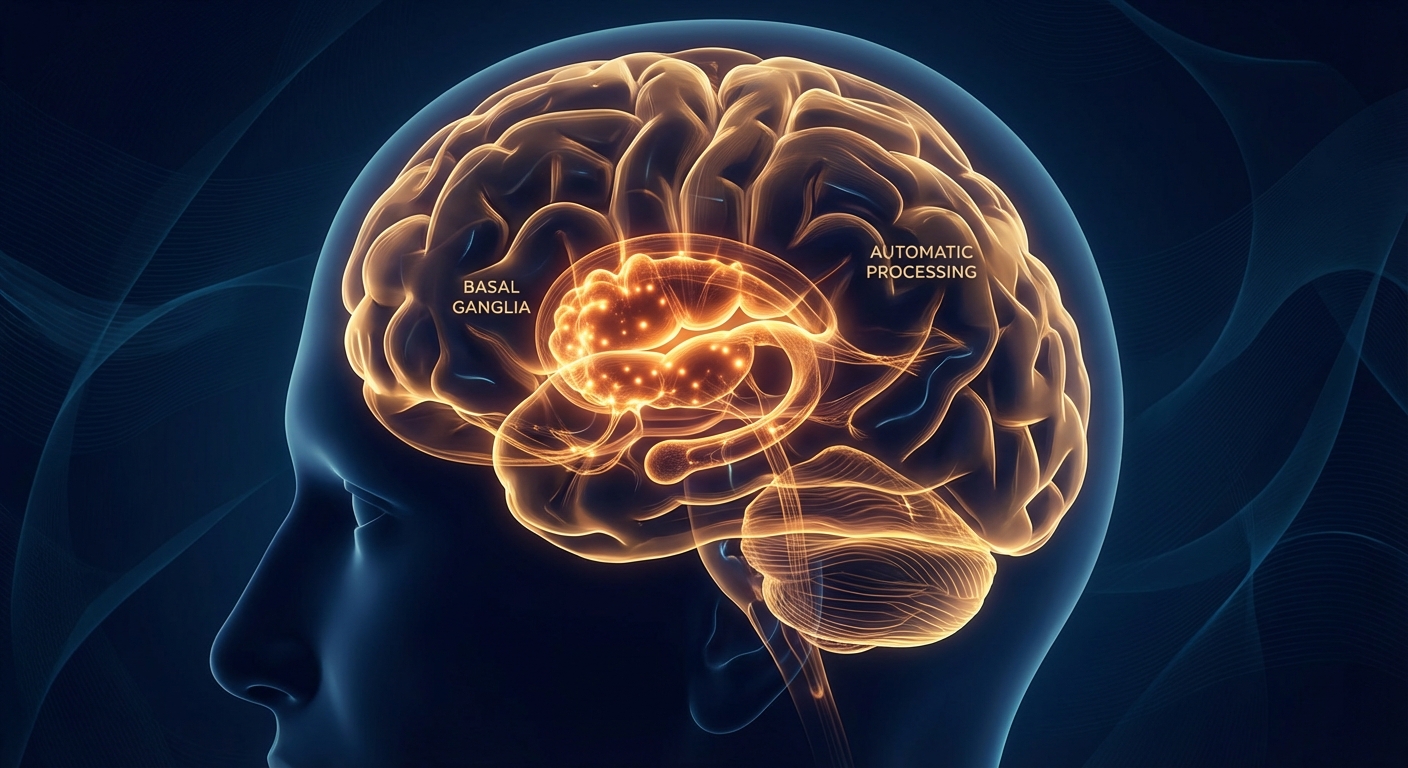
The Neuroscience of Habit
Your brain has a specific region dedicated to habits: the basal ganglia, a cluster of structures located deep within the cerebral hemispheres. When you perform a behavior repeatedly in the same context, and that behavior leads to some kind of reward, the basal ganglia essentially takes over. The behavior becomes what neuroscientists call a “stimulus-response” pattern, triggered automatically by environmental cues without requiring conscious decision-making.
This process is incredibly efficient. When researchers at Georgetown University examined the neurological basis of habit formation, they discovered that a brain protein called KCC2 plays a crucial role in reshaping how cues become linked with rewards. Shifts in KCC2 levels can make habits form more quickly or more powerfully than expected, helping explain why some behaviors become automatic so rapidly.
The implications are significant for both building and breaking habits. When neurons fire in coordinated patterns, they amplify dopamine activity. These short bursts of dopamine serve as potent learning signals, helping the brain assign meaning and value to experiences. This is why habits connected to immediate rewards, like checking your phone or eating sugary foods, form so readily. The dopamine hit reinforces the behavior before your conscious mind has a chance to intervene.
But habits aren’t truly involuntary. Unlike reflexes that bypass the brain entirely, habitual behaviors can be interrupted. Research published in PMC shows that the ventrolateral prefrontal cortex is uniquely positioned to coordinate the overriding of habitual behaviors in real time. You’ve probably experienced this: suddenly catching yourself mid-action and realizing you were about to do something you didn’t intend. That moment of awareness is your prefrontal cortex reasserting conscious control.
The 66% Question
If two-thirds of your behaviors are habitual, here’s the question worth sitting with: which two-thirds?
Not all habits are created equal. Some, like brushing your teeth or locking your door when you leave, serve you well. They free up cognitive resources for more important matters. Others, like doom-scrolling before bed or reaching for snacks when you’re stressed, work against your intentions. And many habits fall somewhere in between, neither clearly helpful nor harmful, just the way you’ve always done things.
The research suggests that most people haven’t consciously chosen the majority of their daily behaviors. These patterns accumulated over time, shaped by environment, by convenience, by what was rewarded and what wasn’t. Your morning routine, your commute habits, your default responses to stress, all of these were likely established without deliberate decision-making.
This isn’t a moral failure. It’s simply how human cognition works. But it does raise an interesting possibility: if you could become more aware of your automatic patterns, you might be able to redesign some of them. Not all of them, that would be exhausting and counterproductive. But the ones that matter most for the life you’re trying to build.

Waking Up Within Your Life
The opposite of autopilot isn’t constant vigilance. That would be unsustainable and unnecessary. The opposite is what mindfulness practitioners call presence: the capacity to be aware of what you’re doing while you’re doing it, at least some of the time.
Research on mindfulness-based interventions, reviewed in a 2025 paper in the Journal of Psychology & Behavioral Science, shows that meditation practices can enhance self-regulation, improve attentional control, reduce stress, and foster emotional balance. These capacities are closely linked to the ability to recognize and interrupt automatic behaviors. In other words, mindfulness doesn’t eliminate habits, but it creates more opportunities to catch yourself before autopilot takes over.
You don’t need to meditate for hours to access this. The practice can be as simple as building “awareness triggers” into your day. Every time you walk through a doorway, take one conscious breath. Every time you pick up your phone, pause and notice the impulse before acting on it. These micro-moments of presence gradually build the neural capacity to step out of autopilot when it matters.
The goal isn’t to become hyper-aware of every tooth-brushing session. It’s to develop enough meta-awareness that you can recognize when autopilot is serving you and when it isn’t. Some habits deserve to run unchallenged. Others deserve your attention.
Redesigning Your Defaults
If you want to change a habitual behavior, the research is clear: willpower alone rarely works. Habits are triggered by environmental cues, so the most effective interventions involve changing those cues rather than trying to resist them through sheer determination.
A 2025 study found that people who identified and modified the environmental triggers for their habits were significantly more successful at changing those behaviors than people who relied on motivation. If you’re trying to stop checking your phone first thing in the morning, charging it in another room will likely be more effective than telling yourself to be more disciplined. If you want to exercise more consistently, laying out your workout clothes the night before creates a cue that reduces the activation energy required.
The research on habit formation timelines has also evolved. The popular notion that habits take 21 days to form has been definitively debunked. A systematic review from the University of South Australia found that new habits begin forming in about two months on average, with a median of 59 to 66 days, but can take up to 335 days to become truly automatic. This matters because it sets realistic expectations. If your new behavior doesn’t feel effortless after three weeks, that doesn’t mean you’ve failed. It means you’re human.

The Overlap of Habit and Intention
Here’s something surprising from the latest research: habits and intentions aren’t opposites. The 2025 study found that 76.2% of daily behaviors were intentional, and there was significant overlap, about 46%, between habits and intentions. This means that many of our automatic behaviors are also things we consciously want to do. We’ve simply done them enough times that they no longer require deliberate thought.
This is actually good news. It means that when you successfully build a habit aligned with your values, you get the best of both worlds: the behavior serves your intentions while requiring minimal cognitive effort. Your autopilot becomes an ally rather than an obstacle.
The challenge is that our environments are often designed to exploit habit formation for someone else’s benefit. Social media platforms, food companies, and attention merchants have all gotten very good at creating cues that trigger habitual behaviors. Your phone buzzes, and your hand reaches for it before you’ve made any conscious choice. The cue-response pattern is so strong that resisting it feels like swimming upstream.
Understanding this dynamic doesn’t mean you have to live off the grid. It means you can become a more conscious architect of your own habit environment. You can choose which cues to strengthen and which to weaken. You can design your spaces to support the life you want rather than the life that happens by default.
Your Invitation
Two-thirds of your life is on autopilot. This isn’t a problem to solve so much as a reality to work with. Your brain will always seek efficiency, always try to automate repeated behaviors, always run on well-worn neural pathways when possible. This is what brains do.
The opportunity isn’t to fight this tendency but to direct it more intentionally. To notice which patterns are serving you and which aren’t. To build environmental cues that make good behaviors easier and problematic behaviors harder. To practice enough presence that you can catch yourself before autopilot carries you somewhere you didn’t want to go.
You won’t become fully conscious of every moment. That’s not the goal, and it wouldn’t be desirable even if it were possible. But you can become conscious enough, aware enough, present enough to make choices about the things that matter most.
Start small. Pick one habitual behavior you’d like to change, and focus on identifying its triggers rather than relying on willpower. Notice when your mind has wandered, and gently bring it back without judgment. Treat these moments not as failures but as opportunities, each one a chance to practice the skill of waking up within your own life.
The two-thirds that run on autopilot may never become fully conscious. But the other third? That’s where you live. That’s where choice happens, where growth happens, where the life you actually want to build gets built. Pay attention to it. It’s more powerful than you might think.
Sources: University of South Carolina, Scientific American, Georgetown University, PMC, Journal of Psychology & Behavioral Science, University of South Australia, Daniel Kahneman on System 1 and System 2 thinking, Matthew Killingsworth and Daniel Gilbert (Harvard) on mind-wandering.