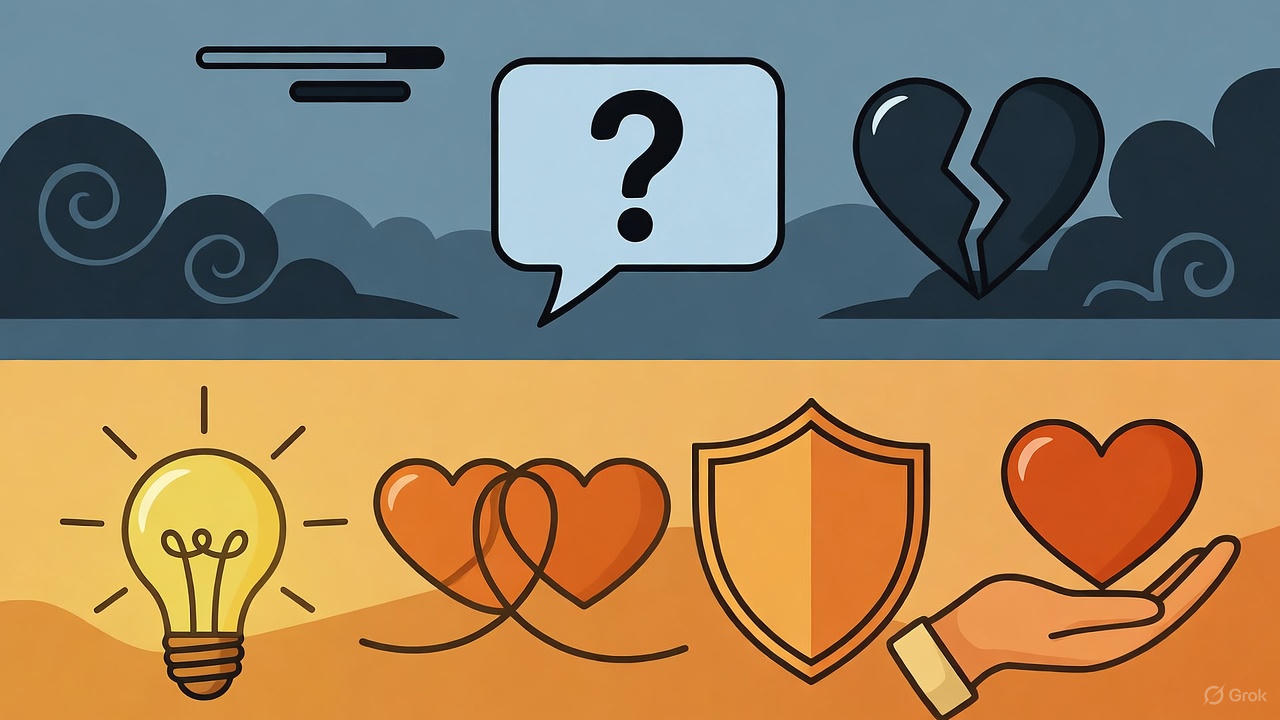
You know the conversation you need to have. You’ve been rehearsing it in your head for weeks, maybe months. The one that makes your stomach tighten just thinking about it. Maybe it’s telling your partner you’re unhappy about something that’s been festering. Maybe it’s setting a boundary with a family member who keeps crossing the line. Maybe it’s addressing a problem with a friend or colleague that’s been silently eroding your trust. Whatever it is, you know it needs to happen. And every day you don’t have it, the distance between you and the other person grows.
Here’s what most people don’t realize: that hard conversation you’re avoiding is also the conversation that could save your relationship. Research from the Gottman Institute, which has studied relationships for over four decades, consistently shows that it’s not the presence of conflict that predicts relationship failure. It’s the avoidance of conflict, the stonewalling, the silent resentment that builds when difficult things go unsaid. The conversation that feels too risky to have is often the conversation that could restore connection and rebuild trust. But first, you have to find the courage to start.
Understand Why You’re Avoiding It
Before you can have the conversation, it helps to understand what’s keeping you from it. The fears that make us avoid difficult conversations are almost universal, which means you’re not weak or avoidant for feeling them. You’re human.
Fear of conflict sits at the top of the list for many people. What if they get angry? What if the conversation spirals into a fight? What if things get ugly in ways you can’t take back? This fear makes sense. Most of us weren’t taught how to navigate conflict well. We either grew up in homes where conflict was explosive and dangerous, so we learned to avoid it at all costs, or in homes where conflict was suppressed and hidden, so we never learned the skills to engage with it constructively.
Fear of rejection runs even deeper for some. What if they don’t care about how you feel? What if they leave? What if bringing this up makes you lose them entirely? This fear is particularly powerful in relationships where we feel insecure about our standing or where the relationship already feels fragile. Fear of vulnerability asks what happens if you share how you really feel and they invalidate it, dismiss it, or use it against you later. Opening up requires trust, and trust requires taking a risk that might not pay off. And then there’s the fear of being the bad guy. What if your truth devastates them? What if you’re wrong? What if you’re making a big deal out of nothing?
All of these fears are valid. Sometimes they’re even warranted, not every conversation goes well, and not every relationship can handle honesty. But here’s what’s equally true: avoiding the conversation guarantees the relationship stays stuck. Silence doesn’t preserve connection. It erodes it. Resentment grows in the space between what needs to be said and what remains unsaid.

Recognize the Cost of Staying Silent
When you chronically avoid hard conversations, the relationship pays a price even if the surface looks calm. Understanding this cost can provide the motivation needed to finally speak up.
Resentment builds silently. Every time the issue comes up and you don’t address it, you bank a little more frustration. Over time, that resentment calcifies. What started as a small irritation becomes a massive, unspoken wall between you. You might not even remember the original issue anymore, just the accumulated weight of everything that went unsaid. You start withdrawing to protect yourself. You pull back emotionally, physically, sometimes intimately. You stop being fully present in the relationship because full presence feels too painful or too risky. The other person may notice this withdrawal but have no idea what’s causing it.
The relationship becomes surface-level. You talk about logistics, schedules, and safe topics. But you never discuss what’s really going on beneath the surface. The depth disappears. You become two people sharing space rather than sharing lives. You might even lose yourself in the process. When you chronically silence your own needs, you start to lose touch with what those needs even are. Your own voice gets quieter. You forget what you actually think and feel because you’ve trained yourself not to express it.
And eventually, the explosion becomes inevitable. All that unspoken tension erupts, often at the worst possible moment, in the least productive way. A minor disagreement becomes a massive fight because it’s carrying the weight of months or years of accumulated silence. The cost of avoiding hard conversations is intimacy itself. You trade honesty for temporary peace and lose connection in the process.
Prepare Before You Speak
Hard conversations are more likely to go well when you approach them thoughtfully rather than impulsively. Preparation isn’t about scripting every word. It’s about getting clear on your own intentions and creating conditions for success.
Start by getting clear on your why. Before you talk to them, talk to yourself. What do you actually need from this conversation? What outcome are you hoping for? Why does this matter enough to risk discomfort? What happens if you never say anything? Write down your answers. Getting clear helps you stay focused when emotions run high. It also helps you distinguish between wanting to be heard and wanting to control the outcome. You can control the first; you can’t control the second.
Timing matters more than most people realize. Don’t have this conversation when either of you is hungry, exhausted, or already stressed about something else. Don’t do it in public or around others who might overhear. Don’t start it right before bed or before a major event. And don’t try to have it when emotions are at their peak. Wait until you’re calm enough to think clearly. Choose a time when you’re both relatively settled, have privacy, and have space for the conversation to unfold without time pressure.
Manage your expectations before you begin. This conversation probably won’t fix everything instantly. It might not even go well. But it’s a beginning. Lower the stakes in your mind. You’re not trying to achieve perfect resolution in one conversation. You’re trying to open a door that’s been closed. Finally, ground yourself. Before the conversation, do something to calm your nervous system. Take deep breaths, go for a walk, journal your thoughts, or remind yourself of your intention: connection, not conflict. You’ll communicate better when you’re regulated rather than activated.

Navigate the Conversation With Care
Having the conversation itself requires balancing honesty with compassion. You want to be clear about your experience without triggering unnecessary defensiveness.
Lead with care by starting with affirmation of the relationship. Let them know you’re bringing this up because the relationship matters to you, not because you’re attacking them. You might say something like “I care about our relationship, and that’s why I need to talk about something that’s been on my mind” or “I value you, and I’ve been struggling with something I want to share with you” or “This is hard for me to bring up, but it’s important, and I believe we can work through it together.” This lowers defenses and signals safety before you get into the difficult content.
Use “I” statements to talk about your experience rather than their faults. Instead of “You never listen to me,” try “I feel unheard when I’m talking and you’re looking at your phone.” Instead of “You’re so critical,” try “I feel hurt when I share something and it’s met with criticism.” “I” statements own your feelings without assigning blame. They’re less likely to trigger defensiveness because you’re describing your internal experience rather than making claims about their character.
Be specific rather than vague. Vague complaints don’t give the other person anything to work with. Specific examples do. Instead of “You don’t appreciate me,” try “Last week when I stayed up late to help you with your project, I didn’t hear a thank you, and that hurt.” After sharing your experience, clearly state what you need. “What I need is…” or “What would help me is…” or “What I’m hoping for is…” Don’t make them guess. Speak your need plainly.
Then invite their perspective. After you’ve shared, give them space to respond. “How do you experience this?” or “What’s your take on this?” or “I’d love to hear your perspective.” Listen, really listen, to their response. They may have a completely different experience of the same situation. That doesn’t mean you’re wrong. It means you’re both human, experiencing the same events through different lenses.
Handle Difficult Reactions
Not every response will be receptive. Knowing how to navigate difficult reactions keeps the conversation productive even when it gets uncomfortable.
If they get defensive, stay calm. Don’t escalate by matching their energy. Reflect back what you’re hearing: “I hear that you’re feeling attacked. That’s not my intention. I’m trying to share how I’m feeling so we can understand each other better.” Give them space to process. Defensiveness often softens if you don’t respond with more intensity. Sometimes people need a moment to move past their initial reaction before they can truly hear you.
If they dismiss or minimize your concern, hold your ground without becoming aggressive. You might say “This might not seem like a big deal to you, but it’s important to me, and I need you to take it seriously.” Don’t let them talk you out of your feelings. Your experience is valid even if they don’t share it or understand it. If they turn it around and respond by bringing up your flaws or past mistakes, don’t get derailed. Acknowledge their concerns without abandoning your own: “I hear you have concerns too, and I want to hear them. But first, I need us to finish this conversation. Can we address your concerns after we work through this?”
If they shut down and go silent or withdraw, acknowledge it with compassion: “I notice you’ve gone quiet. Are you okay? Do you need a moment?” Some people need time to process before they can engage. That’s okay. Suggest continuing later: “Let’s take a break and come back to this in an hour.” The goal isn’t to force resolution in one conversation. The goal is to keep the door open for continued dialogue.

What Comes After the Conversation
The conversation itself is just the beginning. What happens afterward determines whether it leads to lasting change or fades without impact.
Repair and reconnect after the conversation ends. Hard conversations are vulnerable and often uncomfortable for everyone involved. Afterward, find a way to reconnect. Thank them for listening. Acknowledge their courage in staying present. Do something together that feels good, whether that’s a walk, a meal, or simply a hug. John Gottman’s research emphasizes that repair attempts, the efforts couples make to reconnect after conflict, are the single most important predictor of relationship success. The repair matters as much as the conversation itself.
Follow through on any agreements you made. If you both agreed on changes, follow through. If you said you’d work on something, work on it. If they said they’d shift something, give them grace as they try. Change takes time. Keep communicating. One conversation rarely fixes everything. Think of it as opening a door, not walking all the way through it. More conversations will likely be needed, and that’s okay. You’ve started a process that was previously stuck.
Sometimes, even when you do everything right, the conversation doesn’t go well. They react badly, refuse to engage, or the relationship doesn’t improve. If that happens, you have choices. You can accept them as they are, deciding that the relationship is worth keeping despite this issue. You can set boundaries to protect yourself while remaining in the relationship. Or you can leave, recognizing that some relationships are fundamentally incompatible with your wellbeing. But here’s what you won’t have: the regret of never trying. You’ll know you spoke your truth. That matters, regardless of the outcome.
Your Invitation
Having hard conversations is an act of courage and love. It says: I care about this relationship enough to risk discomfort. It says: I trust you enough to show you the real me. It says: I believe we’re strong enough to handle the truth.
Not every hard conversation will bring you closer. But the ones that do transform relationships from surface-level to soul-deep. You deserve relationships where you can be honest. Where your needs matter. Where hard things can be said and worked through together. And that starts with finding the courage to say the thing you’ve been avoiding.
What’s the conversation you need to have? Start practicing what you’ll say. Choose the moment. Ground yourself. And then, take a breath and begin. Your relationship is waiting on the other side.
For more on navigating repair after things go wrong, explore repair after conflict. If setting boundaries feels impossible without overwhelming guilt, boundaries without guilt offers practical language and frameworks. And for deeper exploration of what transforms surface-level relationships into something more meaningful, transformative conversations can help you understand what makes dialogue truly healing.
Sources: Gottman Institute relationship research, communication psychology, conflict resolution studies.