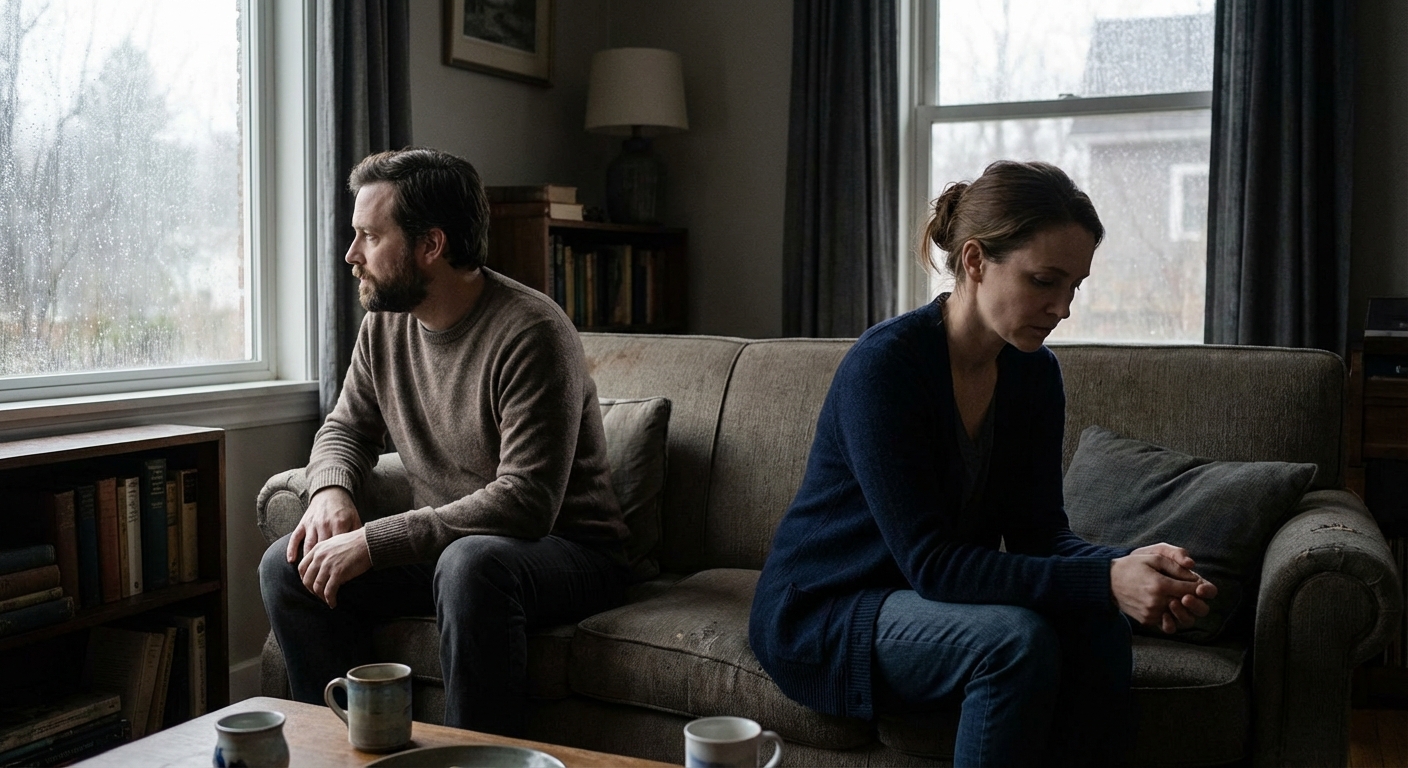
There’s a moment in healthy relationships that looks like loneliness to people who’ve never experienced it. You’re both home. You’re in different rooms. You’re doing your own thing, reading, working, existing separately. There’s no conversation happening. No shared activity. To an outsider, it might look like distance. Like something’s wrong.
But you know better. This is intimacy. The rarest kind. The kind where you can be fully yourself, fully separate, and still feel completely connected. Where togetherness doesn’t require constant interaction. Where love means “I choose you” not “I need you.” This is the art of being alone together. And it might be the most important skill a relationship can develop.
The Difference Between Interdependence and Enmeshment
We talk a lot about finding “the one,” our other half, our better half, the person who completes us. But that framing contains a poison pill. You’re not half a person looking for your other half. You’re a whole person who might choose to build something with another whole person. That distinction changes everything about how relationships function and how they fail.
Dr. Sue Johnson, founder of Emotionally Focused Therapy and one of the leading researchers on adult attachment, distinguishes between healthy interdependence and what therapists call enmeshment or codependence. In codependence, two people have fused to the point where neither can function as a distinct individual. You can’t make decisions without them. Your moods are completely dependent on theirs; if they’re having a bad day, yours is automatically ruined. You’ve lost track of your own interests, your hobbies have become their hobbies, your friends are their friends. Space feels threatening rather than restful. You’ve merged into “we” and lost “I.”

In interdependence, by contrast, two complete people choose to build together. You can function independently but prefer not to; you’re capable on your own and better together. You have your own emotional regulation; their bad day doesn’t automatically ruin yours, though you can be supportive without absorbing their emotions. You maintain separate interests and friendships. Space feels healthy, even necessary. You’re still “I” inside the “we.” You know what you want, what you feel, what matters to you. The relationship enhances this selfhood rather than erasing it. Learning to set boundaries without guilt is often the first step toward this kind of healthy interdependence.
Parallel Play for Adults
Remember parallel play from childhood? Two kids in the same space, playing separately, occasionally interacting but mostly doing their own thing? That developmental stage didn’t end when you grew up. It just looks different. Adult parallel play is reading in the same room while your partner works at their desk. Cooking different dishes but in the same kitchen. Watching different shows but in the same space. Existing separately while still being together.
This is some of the sweetest time in a relationship, and it’s the kind that often goes unrecognized or undervalued. No performance required. No entertainment needed. No conversation necessary. Just comfortable coexistence. The couples who’ve mastered this will tell you that those quiet evenings where you’re just there together, asking nothing of each other, are the good stuff. That’s the intimacy that lasts, the kind that doesn’t depend on novelty or stimulation or constant engagement.
Elena, who’s been with her partner for eight years, described it this way: “Friday nights, we’re both on the couch. I’m reading, he’s gaming. We barely talk. But I love it. It’s my favorite time of the week. We’re together without needing to be on for each other. I can just exist. So can he. That’s love.” This capacity for comfortable silence, for presence without performance, for connection without conversation, is what attachment researchers call “secure base” functioning. You’re together enough to feel safe, and separate enough to feel free.
When Space Needs Differ
Here’s what breaks a lot of relationships: one person needs more alone time than the other, and instead of navigating that difference, they turn it into evidence that something’s wrong. The person who needs more space feels suffocated and guilty. Why don’t I want to be with them all the time? What’s wrong with me? The person who wants more togetherness feels rejected and anxious. Why don’t they want to be with me? What’s wrong with us?
Usually, nothing’s wrong. You just have different nervous systems and different ways of recharging. Dr. Amir Levine, co-author of “Attached” and a psychiatrist at Columbia University, notes that attachment styles interact with introversion and extroversion to create different needs for proximity and space. Introverts genuinely recharge alone; social interaction, even with people they love, depletes energy, and solitude restores it. Extroverts recharge through connection; too much alone time feels draining rather than restful.
When partners with different needs pair up, this difference can become the source of constant conflict or it can become a complementary strength. The conflict version sounds like “You never want to do anything!” versus “You never give me space!” The complementary version sounds like “I know you need tonight alone. I’m going out with friends. Win-win.” Navigating this requires naming the difference without judgment: “I need more alone time than you do. That’s not about you. It’s how I’m wired.” It requires creating structures that honor both needs, regular alone time for the introvert and regular quality time for the extrovert, both protected and respected. It requires trusting that space creates closeness rather than threatening it. For more on how to navigate these differences constructively, see our piece on loving someone who’s different from you.
Maintaining Self in Partnership
The slow erosion happens so gradually you don’t notice until you wake up one day and don’t recognize yourself. You stopped going to yoga because it was easier to just do what they wanted. You don’t see your friends as much because couple time took priority. You used to paint; when did you stop? Your opinions have become their opinions. Your preferences have been subsumed. This isn’t anyone’s fault. It’s the default drift of relationships if you’re not paying attention. Maintaining yourself in partnership requires intentionality and ongoing attention.
Protected solo time matters, non-negotiable time that’s just yours, weekly at minimum, for your interests, your friends, your own thoughts. Separate friendships matter; shared friends are wonderful, but you also need your own people, relationships that are yours rather than “ours.” Building and maintaining adult friendships requires deliberate effort, but that effort protects both your individuality and your partnership. Your own interests matter, things you do just for you, hobbies and classes and pursuits where they don’t have to join you. Your own space matters, even if it’s just a corner of a room, a place to be yourself without audience.
Regular check-ins with yourself matter: Am I still here? What do I want? What do I feel? Don’t lose the thread of your own experience. Permission to say no matters, to plans you don’t want, to activities that don’t fit, to things they love that you don’t. You don’t have to do everything together to love each other deeply. Sarah, who almost lost herself in her first marriage, learned this the hard way: “I wanted to be the perfect partner, so I made myself smaller. More agreeable. Less complicated. The marriage still ended, and I didn’t even recognize myself. With my current partner, I’m fiercely protective of my selfhood. I have my writing mornings. My solo hikes. My friend dinners. He has his things too. We’re both whole people who choose each other. It’s so much stronger.”
Building Security Through Separation
Here’s the paradox that attachment research reveals: the more secure your attachment, the more you can be separate without threat. When you’re anxiously attached, separation triggers panic. You cling tighter. You need constant reassurance. Space feels like abandonment. When you’re securely attached, separation is just separation. They’re doing their thing. You’re doing yours. You’ll reconnect later. No threat, no panic. Just trust.
Building this security happens through consistent reconnection, the pattern of separating and coming back, over and over, that proves space doesn’t mean goodbye. It happens through reliable presence; when you’re together, you’re actually present, not half-present while scrolling, but fully there. It happens through honest communication, “I need tonight alone” or “I’m going out with friends Saturday” said clearly and received without defensiveness. It happens through follow-through, doing what you say you’ll do, coming home when you say you will, because reliability builds security.
Time proves what words can’t. The first few times one person takes space, it might feel scary for the other. But after the pattern repeats, space, return, reconnection, space, return, reconnection, security builds. Elena described her journey: “It took me a year to trust that when my partner said ‘I need a solo weekend,’ it meant he’d be back Sunday, more present and more loving. Not that he was leaving me. My anxiety wanted to make it about abandonment. Reality proved otherwise. Now when he takes space, I barely blink. I know he’s coming back.”
The Sweetness of Returning
Here’s what people who’ve mastered being alone together know: the reuniting is sweeter when you’ve actually been separate. When you spend all your time together, there’s no room to miss each other. No space for anticipation. No stories to share because you were there for all of it. But when you have your own lives that you bring back to the shared life? That’s when relationship stays interesting.
“How was your day?” becomes a real question, not a formality. Coming home to each other feels like something, not nothing. You have experiences to share, not just routines to maintain. You don’t just coexist; you actively choose each other, again and again. Marcus put it this way: “The night my partner comes back from her book club is my favorite night of the week. She’s energized. She has things to tell me. She chose to be somewhere else, and now she’s choosing to be here. That choice, that active returning, that’s everything.”
Your Invitation
If you’re in a relationship where you’ve lost yourself, you can find yourself again. It starts with small claims of space and self. A solo walk. An evening with your own friends. An hour in a room by yourself. These aren’t acts of distance; they’re acts of self-preservation that ultimately strengthen what you share.
If your partner needs more space than you’re comfortable with, you can learn to trust it. Security builds over time, through the repeated experience of separation followed by reunion. Their need for solitude isn’t rejection of you; it’s how they stay whole so they can bring their whole self back to you.
If you’re afraid to ask for what you need, you can practice. Start small: “I need an hour alone tonight.” Notice that asking doesn’t destroy the relationship. Build from there. The strongest relationships aren’t the ones where two people can’t function apart. They’re the ones where two people function beautifully apart and still choose to come together.
Alone together. Two whole people, building something that honors both. That’s not distance. That’s intimacy that lasts.
Sources: Dr. Sue Johnson’s Emotionally Focused Therapy, Dr. Amir Levine’s “Attached,” attachment research on secure base functioning.