
You finished the big project. You pushed through the deadline. You handled the crisis. Now you’re sitting on the couch, and something feels wrong. Not wrong with you, exactly. Wrong with the sitting. Like you should be doing something. Like rest has to be earned through complete depletion, and since you can still technically function, you haven’t earned it yet.
This is the exhaustion prerequisite: the belief that rest is only legitimate after you’ve proven you truly need it. Until you’re falling apart, you should be productive. Until the tank hits empty, you should keep driving. The couch is for people who’ve completely run out of gas, not for people who are merely tired.
The problem with this framework is that it only permits rest as recovery from crisis, never as prevention of one. And by the time you’ve earned rest by these standards, you’re not resting. You’re recovering. That’s a different thing entirely.
The Productivity Trap of Earned Rest
We live in a culture that treats rest as a reward rather than a requirement. The hustle narrative runs deep: work hard, then you can relax. Push through, then you deserve a break. Grind now, rest later. But “later” keeps receding. There’s always another deadline, another responsibility, another thing that needs handling before you’re officially allowed to stop.
Psychologist Saundra Dalton-Smith, author of Sacred Rest, identifies this pattern as one of the core drivers of modern burnout. “We’ve been conditioned to believe that our worth is tied to our output,” she explains. “Rest becomes something we steal rather than something we choose. And stolen rest never truly restores us because we’re too busy feeling guilty about taking it.”
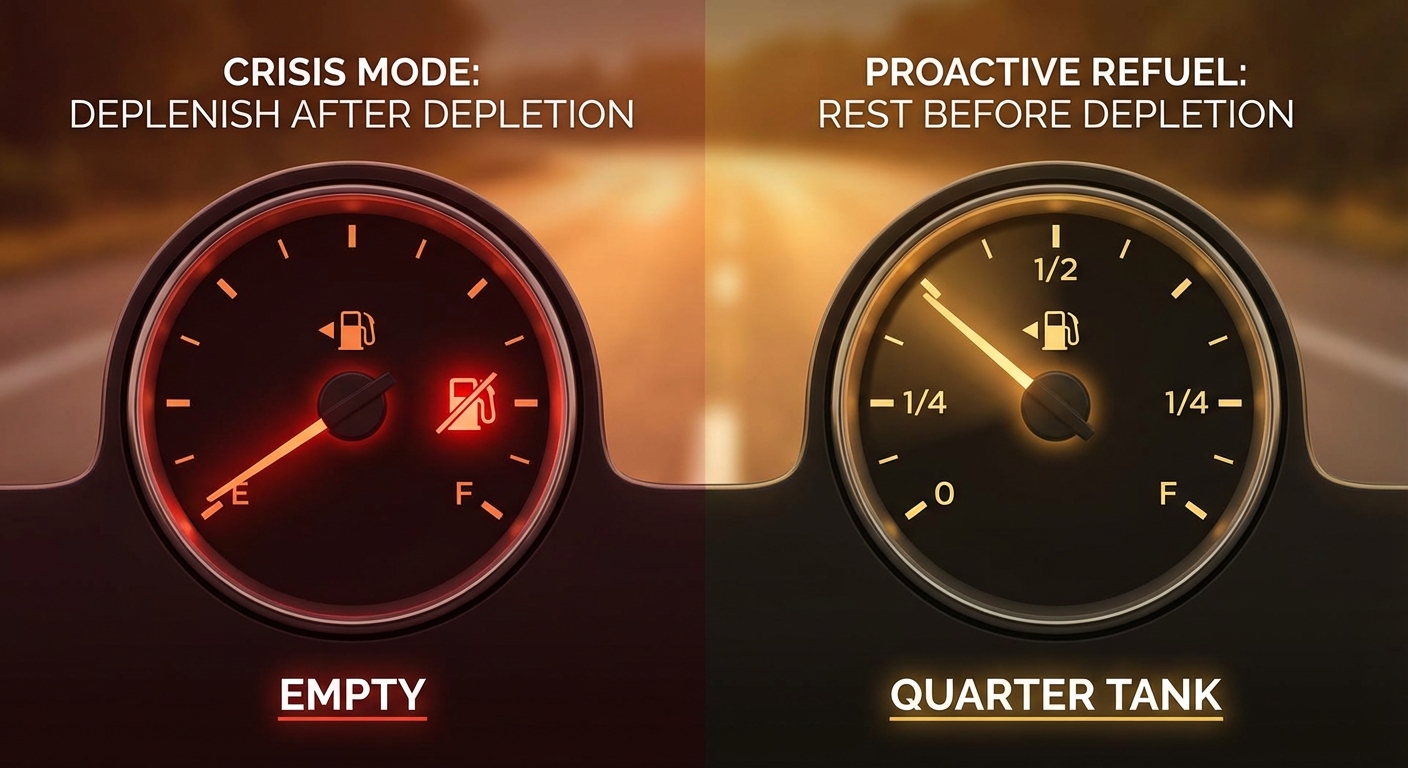
The rest revolution is changing how we think about recovery. The research on recovery supports a different approach. Studies on athletic performance, cognitive function, and workplace productivity consistently show that strategic rest, taken before exhaustion sets in, produces better outcomes than pushing to depletion and then recovering. Elite athletes don’t train until they collapse. They build rest into their programs because recovery is when adaptation happens. The same principle applies to your brain, your emotions, and your capacity to show up for the people and work that matter.
But knowing this and feeling it are different things. The guilt persists even when the logic is clear. So let’s address the guilt directly.
Rewriting the Permission Structure
The voice that says you haven’t earned rest yet is usually borrowing authority from somewhere. Maybe it sounds like a parent who valued productivity above all. Maybe it sounds like a boss who rewarded people who never took breaks. Maybe it sounds like the culture at large, which measures human worth in output and treats exhaustion as a badge of honor.
Notice whose voice it actually is. Then ask: is that the authority you want to live under?
Rest doesn’t require justification. You don’t need to be sick, overwhelmed, or falling apart to deserve a pause. You don’t need to have crossed everything off your list, met every obligation, or satisfied every expectation. Rest is a need, like eating or sleeping. You don’t have to earn your dinner by being sufficiently hungry. You don’t have to earn rest by being sufficiently depleted.
This reframe isn’t about being lazy or abandoning responsibility. It’s about recognizing that sustainable contribution requires sustainable energy. You can’t pour from an empty cup, as the saying goes, but the deeper truth is that you shouldn’t wait until the cup is empty to refill it.

Practice Rest as Prevention
If you’ve spent years operating under the exhaustion prerequisite, choosing rest before crisis will feel uncomfortable at first. That discomfort doesn’t mean you’re doing it wrong. It means you’re doing something new.
Start small. Rest doesn’t have to mean a vacation or a whole day off. It can be fifteen minutes with nothing to do. It can be leaving work at 5 instead of 6. It can be sitting with your coffee instead of drinking it while you answer emails. The point isn’t the duration. The point is the intention: you’re choosing rest because rest matters, not because you’ve completely run out of gas.
Notice the guilt without obeying it. When the voice says you should be doing something, acknowledge it. “I notice I feel guilty about resting.” Then let the guilt be there without changing your behavior. Guilt is a feeling, not a command. You can feel guilty and rest anyway. Over time, the guilt diminishes as you build evidence that rest doesn’t make you lazy. It makes you more available for what matters.
Build rest into your structure, not just your emergencies. Block time for it. Treat it like an appointment you can’t cancel. The people who seem to balance everything aren’t secretly superhuman. They’ve just learned to protect their recovery as fiercely as they protect their commitments.
The Paradox of Productive Rest
Here’s the irony: rest makes you better at everything else. The research is unambiguous. Sleep improves memory consolidation, emotional regulation, and creative problem-solving. Breaks during work increase focus and reduce errors. Vacations, taken regularly rather than stockpiled for “someday,” correlate with higher job satisfaction and lower burnout.
Rest isn’t the opposite of productivity. It’s the foundation of sustainable productivity. The people who seem to have endless energy haven’t figured out how to need less rest. They’ve figured out how to honor rest before they’re desperate for it.
This doesn’t mean rest has to be “productive” to be worthwhile. You don’t need to meditate efficiently or optimize your nap. Sometimes rest is just rest: staring at the ceiling, watching something mindless, doing nothing in particular. The value isn’t in what you produce during rest. The value is in what becomes possible because you rested.
Your Permission Slip
You’re not too busy to rest. You’re too busy not to rest. The things you’re working so hard on deserve a version of you that isn’t running on fumes. The people you love deserve your presence, not just your productivity. Energy management is about protecting what matters most. And you deserve to feel rested before you’ve hit rock bottom.
So here’s your permission slip, though you never needed one: you can rest before you’re exhausted. You can pause before the crisis. You can sit on the couch, close your eyes, and let the to-do list wait. Not because you’ve earned it, but because rest isn’t a reward. It’s how humans work.
What would change if you stopped waiting to deserve rest and started treating it as essential?
Sources: Saundra Dalton-Smith (“Sacred Rest”), research on athletic performance and recovery, cognitive function and rest studies.