
You’ve optimized your schedule, time-blocked your calendar, and eliminated distractions. But by 2 PM, you’re staring at your most important task with a brain that feels like mud. The time is there. The energy isn’t.
This is the fundamental problem with time management: it treats all hours as equal. But anyone who’s tried to do creative work after a day of meetings knows that 9 AM you and 4 PM you are completely different people with completely different capabilities.
Time is finite and non-renewable. You get 24 hours, and that’s it. But energy fluctuates. It can be managed, protected, and renewed. And when you start managing your energy instead of just your time, everything about productivity shifts.
You stop fighting against your natural rhythms. You stop forcing yourself to do deep work when you’re mentally exhausted. You start aligning tasks with the energy they require, and suddenly you’re accomplishing more while feeling less depleted. The shift from time management to energy management isn’t about working more. It’s about working smarter by honoring how your body and brain actually function.
The Four Types of Energy
Tony Schwartz, through his research at The Energy Project, identifies four distinct types of energy that we need to track and manage. Understanding these categories helps explain why you might feel depleted in some ways while having capacity in others.
Physical energy is the foundation that everything else rests on. It comes from your body’s actual resources: sleep, food, movement, and overall health. When your physical energy is good, you wake refreshed, maintain sustained energy throughout the day, and find physical tasks manageable. When it’s depleted, you experience chronic fatigue even after sleep, need caffeine to function, feel physically sluggish, and get sick frequently. Physical energy renews through quality sleep, regular movement, nutritious food at consistent intervals, adequate hydration, and time in nature.
Emotional energy is your capacity to be present, patient, and emotionally available. Good emotional energy shows up as patience with people, ability to handle frustration, feeling connected to others, and emotional flexibility. Depleted emotional energy manifests as irritability, short temper, feeling numb or disconnected, snapping at people you care about, and excessive reactivity. Emotional energy renews through positive social connection, activities that bring joy, expressing emotions through talking, journaling, or therapy, setting boundaries, and spending time with people who energize rather than drain you.

Mental energy is your cognitive capacity for focus, decision-making, and complex thinking. Clear thinking, ability to focus deeply, good memory and recall, and decisions feeling manageable all indicate healthy mental energy. Brain fog, difficulty concentrating, decision fatigue where everything feels hard, and mental overwhelm signal depletion. Mental energy renews through genuine breaks from cognitive work (not just switching to phone scrolling), nature exposure, social interaction that doesn’t require performance, and activities that engage different brain areas.
Spiritual energy is your sense of purpose, meaning, and connection to something larger than yourself. When spiritual energy is present, you feel that your work and life matter, you have a sense of purpose, you’re connected to your values, and you have motivation beyond external rewards. When it’s depleted, you feel like you’re just going through motions, you lack purpose or meaning, work feels pointless, and you experience existential emptiness. Spiritual energy renews through time on activities aligned with your values, contribution to causes you care about, reflection and self-connection, and encounters with beauty and awe.
All four types interact with each other. Depleted physical energy affects mental energy. Lack of spiritual energy drains emotional energy. You can’t just manage one type and expect the others to take care of themselves.
Mapping Your Personal Energy Patterns
Most people have never actually tracked their energy. They just assume it’s random or entirely dependent on external factors like how much coffee they’ve had or whether they slept well. But energy has patterns, and identifying yours is the first step to managing it strategically.
For one week, track your energy levels every two to three hours using a simple log. Note the time, rate your physical, mental, and emotional energy from one to ten, and record what you were doing. This doesn’t need to be elaborate. A note on your phone or a small notebook works fine.
After a week, patterns emerge. Maybe you’re mentally sharpest from 8 to 11 AM, then crash after lunch. Maybe your emotional energy is best in evenings after work transition time. Maybe physical energy peaks mid-afternoon. These patterns aren’t random. They’re influenced by circadian rhythms (your biological clock), ultradian rhythms (the 90 to 120 minute cycles of alertness that structure your day), meal timing and blood sugar, sleep quality, and the balance of stress and recovery in your life.
Once you see your patterns clearly, you can design around them instead of fighting them. This is profoundly different from trying to force productivity during your worst hours.
Matching Tasks to Energy States
The energy management breakthrough is aligning work with the energy it requires. Different tasks demand different types and levels of energy, and matching them intelligently makes everything more sustainable.
High mental energy work includes creative tasks like writing, designing, and strategizing. It includes complex problem-solving, learning new skills, making important decisions, and any deep focus work that requires sustained concentration. Schedule these during your mental peak hours. If that’s 9 to 11 AM for you, protect that time fiercely. Don’t give it away to meetings or email.
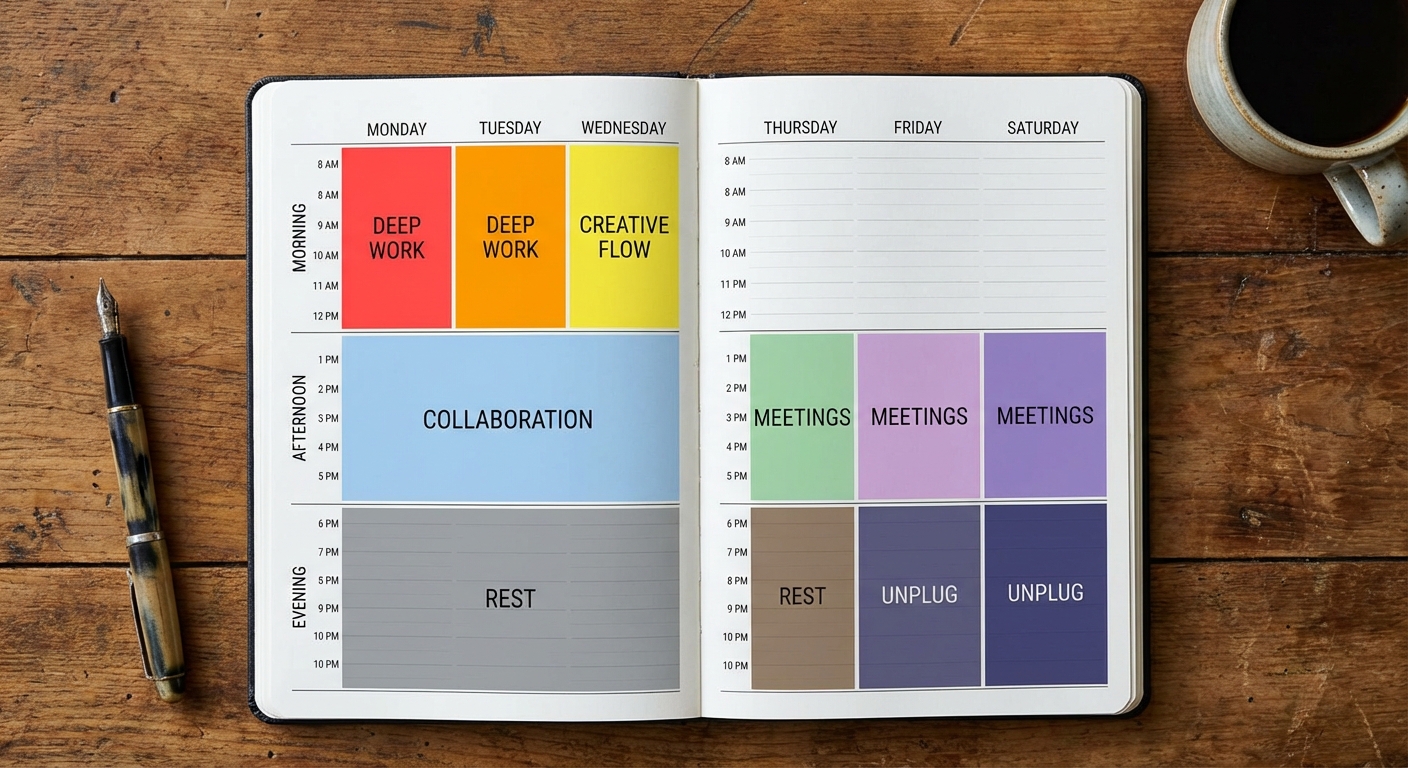
Moderate mental energy work includes routine tasks that require focus but aren’t complex: planning and organizing, editing and refining, and most meetings. Schedule these during your decent-but-not-peak hours. If that’s early afternoon for you, that’s when these tasks belong.
Low mental energy work, though not zero energy, includes administrative tasks, email processing, organizing files, light reading, and routine communication. Schedule these during your slump times. If you crash at 2 to 3 PM, that’s when you do the work that doesn’t require sharp thinking.
High emotional energy work includes difficult conversations, networking and social interaction, collaboration requiring patience, and supporting others who need you. Schedule when you’re emotionally resourced, not depleted. For many people, this is mornings after rest or evenings after transition time from work.
The radical shift is admitting that you can’t do everything equally well at all times. That’s not weakness. It’s reality. You’re not being lazy by acknowledging that your 3 PM brain can’t handle complex strategy. You’re being realistic about how human cognition actually works.
Protecting Your Peak Energy
If you’ve identified that your peak mental energy is 9 to 11 AM, that time is sacred. It’s when you do the work that actually moves the needle. Protect it by blocking it on your calendar and making it unavailable for meetings. Eliminate inputs during that time: no email, no Slack, no news. Just the important work.
Prepare the night before so you know exactly what you’re working on when peak time arrives. Don’t waste your best hours deciding what to do. Create your environment deliberately: phone away, door closed if possible, headphones on, everything you need within reach. Remove friction from the work itself.
Many people make the mistake of giving their peak energy to other people’s priorities, responding to emails, attending meetings, handling requests, and then trying to do their important work during their worst energy times. This is exactly backwards. Your peak energy belongs to your most important work. Everything else gets scheduled around that core.
Renewing Energy Intentionally
Energy isn’t just about when it naturally rises and falls. You can actively renew it through deliberate practices.
Physical energy renews through short walks of 10 to 15 minutes every 90 minutes or so, stretching or movement breaks, power naps of 20 minutes maximum (longer creates grogginess), healthy snacks that stabilize blood sugar rather than spiking it, and adequate hydration (dehydration tanks energy faster than most people realize).
Mental energy renews through complete breaks from cognitive work. This means not checking your phone, but actually resting your mind. Nature exposure helps even if you’re just looking at trees through a window. Social interaction that doesn’t require performance provides relief. Activities that engage different brain areas offer renewal by switching from analytical to creative processing.

Emotional energy renews through connection with people you love, activities that bring joy without pressure, laughter and play, gratitude practice, and time alone if you’re introverted. Spiritual energy renews through aligned action (doing things that matter to you), reflection and meaning-making, connection to purpose, service and contribution, and encounters with beauty and awe.
The key insight is that renewal is active, not passive. Scrolling social media doesn’t renew mental energy despite feeling like a break. A walk without your phone does. Watching TV doesn’t renew emotional energy. Connection with someone you care about does. Know the difference.
Building Recovery Periods Into Your Life
Just like athletes need rest days, knowledge workers need recovery periods built into their schedules.
Micro-recovery happens every 90 to 120 minutes: 5 to 15 minute complete breaks from work. Walk, stretch, stare out the window, close your eyes. Actually disengage from the cognitive demands.
Daily recovery means 1 to 2 hours after work where you genuinely disconnect. Not working while calling it rest, but actual transition time. Your nervous system needs to shift out of work mode.
Weekly recovery means one full day with no work. Sabbath-style rest that allows full replenishment. This doesn’t mean you can’t do anything, but it means you’re not working or thinking about work.
Annual recovery means actual vacation, not “working remotely from a beach.” One to two weeks completely off allows a full nervous system reset that you can’t get any other way.
Most people skip all of these, especially the micro and daily recovery, then wonder why they’re perpetually exhausted. Your body and brain need recovery cycles built in. Rest isn’t just sleep. It’s structured periods of renewal throughout every scale of time.
Working With Your Chronotype
Some people are morning larks, some are night owls, and most fall somewhere in between. Fighting your natural chronotype is exhausting and ultimately futile.
If you’re a night owl forced into early morning meetings, you’re spending your worst energy hours on important tasks. If you’re a morning person trying to do deep work at 8 PM, you’re fighting biology.
When possible, align your schedule with your chronotype. Morning people should protect early hours for important work and schedule social and routine tasks later. Night people, if they can, should start later and work later, doing administrative stuff in mornings and deep work in evenings. Middle chronotypes can use mornings for focused work, afternoons for collaborative work, and evenings for routine tasks.
Most people can’t completely redesign their schedule around chronotype due to job constraints. But even small adjustments help. If you’re a night owl, can you delay your start by an hour? If you’re a morning person, can you block early hours for deep work before meetings begin? Any movement toward alignment with your natural rhythms reduces friction.
Your Invitation to Begin
At the end of all this research and frameworks, the most valuable tool is self-awareness. Know when you have energy and when you don’t. Know what renews you and what depletes you. Know what tasks require what type of energy. Know when to push and when to rest.
This requires experimentation and honest assessment. It requires rejecting the one-size-fits-all productivity advice and finding what actually works for your specific patterns. And it requires permission to structure your life around energy, not just time.
You’re allowed to say “I’m not at my best right now, let’s reschedule.” You’re allowed to protect your peak energy for your most important work. You’re allowed to rest when you’re depleted instead of pushing through.
Time management asks: how can I fit more into my hours? Energy management asks: how can I do what matters while staying resourced and well? Different question. Better outcomes.
If you’re interested in complementary approaches, explore how systems outperform goals for sustainable results. For deeper understanding of rest as renewal, read about the art of doing nothing. And for bringing focus to your peak hours, our piece on single-tasking offers practical strategies.
Sources: Tony Schwartz’s research at The Energy Project, circadian and ultradian rhythm research, chronotype studies, workplace performance and recovery research.