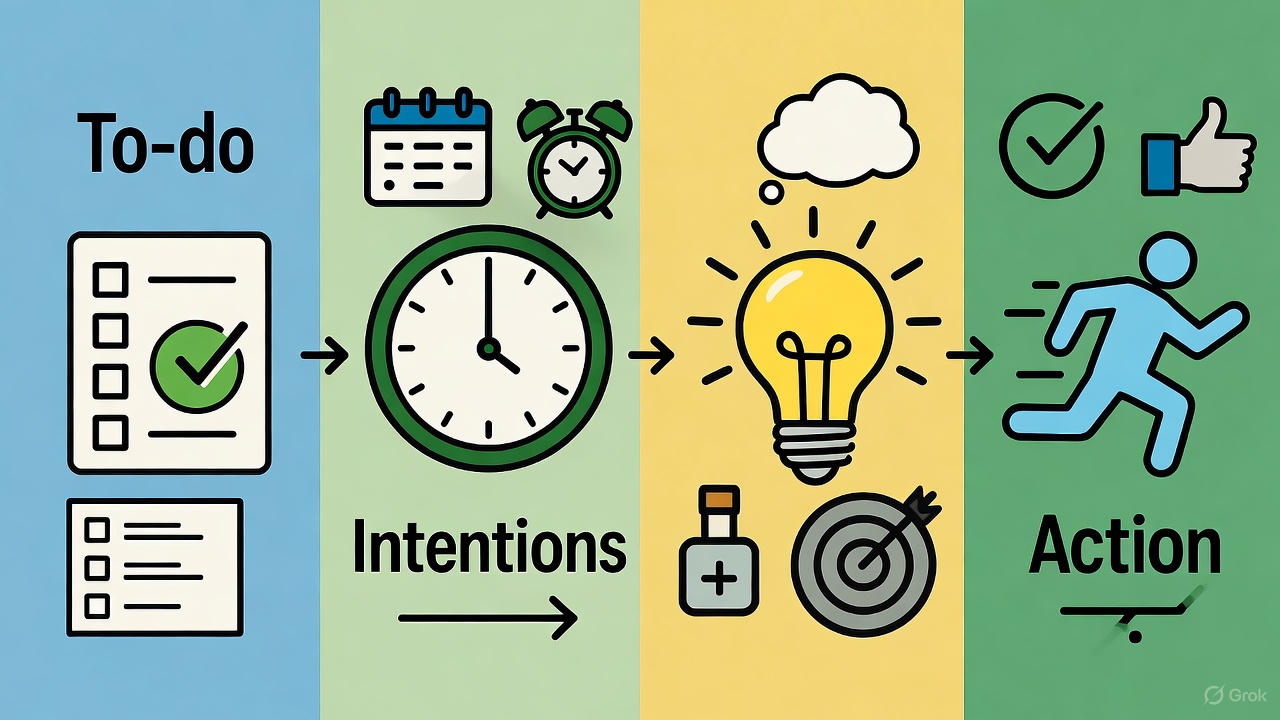
For years, I lived by my to-do list. Every morning, I’d write down everything I needed to accomplish. Every evening, I’d look at that same list, barely touched, and feel like a failure. The problem wasn’t lack of motivation. It wasn’t laziness. It was that my to-do list was a wish list, not a plan. Tasks floated in the abstract: “Finish proposal.” “Call Mom.” “Work out.” But when, exactly, was I supposed to do these things? Between meetings? During lunch? In those mythical “free” moments that never actually appeared?
Then I discovered time blocking, and everything shifted. Cal Newport, who wrote “Deep Work” and popularized time blocking in professional circles, describes it simply: instead of a to-do list full of good intentions, you create a calendar full of committed time. Instead of hoping to find time, you create it. Instead of reactively responding to whatever lands in your inbox, you proactively design your day. The concept is almost embarrassingly simple. But simplicity is exactly what makes it work.
Understand Why To-Do Lists Fail
Before diving into time blocking, it’s worth understanding why the traditional to-do list, despite its ubiquity, often fails to produce results. The list itself isn’t the enemy. The problem is what lists don’t do.
To-do lists don’t account for time. You might have 47 items on your list but only 6 available hours in your day. The list doesn’t care. It just keeps growing, and you keep feeling behind no matter how much you accomplish. Research on task management shows that most people underestimate how long tasks take by 40-50%, which means your list was probably impossible from the start. Lists treat all tasks as equal, which is rarely true. “Email Sarah” sits next to “Write quarterly strategy.” But one takes 2 minutes, the other takes 2 hours. The list doesn’t distinguish. So you gravitate toward the quick wins, the small tasks that feel productive, while the meaningful work gets perpetually pushed to tomorrow.
Lists don’t protect focus time. A to-do list says “do this” but doesn’t say “don’t do that.” So you get interrupted, distracted, and pulled in multiple directions, always with the justification that you’re working on something from the list. The shallow work expands to fill whatever time is available, while deep work gets squeezed out entirely. Lists also rely heavily on willpower. Every task requires a micro-decision: “Should I do this now?” Decision fatigue is real, and by noon, you’re exhausted from choosing. The list becomes a source of anxiety rather than clarity. Perhaps most fundamentally, lists don’t reflect reality. Your list says “Write report” but your calendar is wall-to-wall meetings. When, exactly, are you supposed to write?

Learn the Core Method
Time blocking is exactly what it sounds like: you block out specific chunks of time on your calendar for specific tasks. Instead of writing “Draft article” on your list and hoping you’ll find time, you look at your calendar and decide: tomorrow from 9-11 AM, I’m drafting the article. You literally block that time like you would block a meeting. The task becomes an appointment with yourself. And you keep it.
This isn’t revolutionary. But it’s transformative, because most people treat their calendar like a dumping ground for other people’s priorities while their own priorities live on a perpetually ignored to-do list. Time blocking flips that equation. Your priorities get calendar time first. Everything else fills in around them.
The process starts with a brain dump. Get everything you need to do this week out of your head and onto paper or screen. Work tasks, personal tasks, errands, everything. Don’t edit or prioritize yet. Just capture. Next, estimate time for each task, being honest rather than optimistic. “Draft presentation” might feel like a 1-hour task, but if you’re realistic, it’s probably closer to 3 hours. Better to over-estimate and finish early than under-estimate and feel perpetually behind.
Then prioritize. Not everything is equally important. Mark items as critical (must happen this week), important (should happen if possible), or nice to have (can wait). Now look at your actual calendar. Where is your available time? Factor in existing commitments, transition time between activities (you can’t schedule back-to-back blocks with no breathing room), and your energy patterns (don’t schedule deep work during your afternoon slump). Finally, for each critical task, assign it a time block on your calendar. “Monday 9-11 AM: Draft Q1 report.” “Tuesday 2-3 PM: Prep presentation slides.” Treat these blocks like meetings with your most important client, because they are meetings with yourself and your priorities.
Match Your Blocks to Your Energy
Not all time blocks serve the same purpose. Understanding the different types helps you design days that work with your natural rhythms rather than against them.
Deep work blocks are uninterrupted, focused time for cognitively demanding tasks. These typically run 90-120 minutes, which aligns with research on ultradian rhythms suggesting that’s about how long we can sustain intense concentration before needing a break. Deep work includes writing, strategic planning, complex problem-solving, and learning new skills. During these blocks, close all notifications, put your phone away, use website blockers if needed, and have everything you need beforehand. The goal is to eliminate any excuse to break focus.
Shallow work blocks handle administrative tasks, emails, and routine work. These typically run 30-60 minutes. Shallow work includes responding to emails, data entry, expense reports, and scheduling. The key is batching these together rather than scattering them throughout your day. Set a timer to prevent shallow work from expanding beyond its allotted time. When shallow work is unbounded, it tends to fill whatever space you give it.
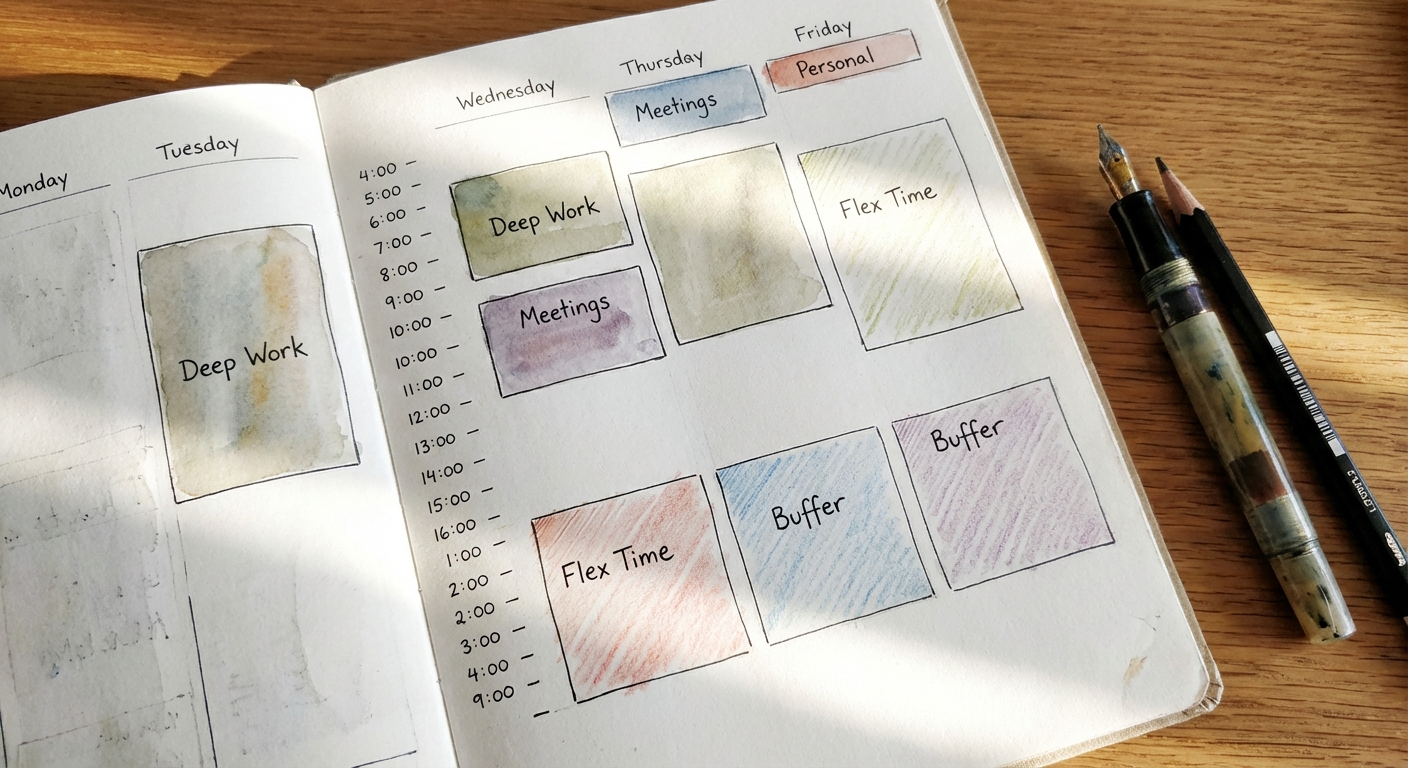
Break blocks matter more than most people acknowledge. Yes, block time for breaks, because otherwise you won’t take them. Include actual lunch away from your desk, short walks, stretching, and mental rest. Research on productivity consistently shows that breaks improve performance, yet we resist them because they feel unproductive. Block them anyway. Personal blocks protect time for non-work priorities: exercise, cooking, family time, hobbies. If it matters to you, it gets blocked. Otherwise, work expands to fill all available space and the things you care about get squeezed to the margins.
Navigate the Common Pitfalls
Time blocking has failure modes that are worth anticipating. Knowing what goes wrong helps you build a sustainable practice rather than an idealistic one that collapses under real-world pressure.
Over-scheduling is the most common mistake. You block every single minute of your day with no breathing room, then feel like a failure when the first unexpected thing throws off your entire schedule. The fix is the 60-40 rule: block a maximum of 60% of your time. Leave 40% for interruptions, breaks, and overflow. This feels inefficient until you realize that flexibility is what makes the system sustainable.
Perfectionism derails people who spend more time organizing their blocks than actually working. Color-coding, optimizing, reorganizing. The fix is accepting that rough blocks are fine. You don’t need Pinterest-worthy planning. Just block and go. The precision matters less than the commitment. Ignoring energy patterns leads to scheduling deep work at 3 PM when you’re cognitively depleted. The fix is matching tasks to your natural rhythms. Identify your peak energy hours and protect them for your most demanding work. Handle administrative tasks during natural lulls.
Treating blocks as sacred even when reality changes leads to frustration. Life happens. Emergencies arise. Meetings run long. The fix is flexibility without abandonment. Adjust blocks as needed, moving rather than deleting them. The point is intention, not rigidity. And skipping breaks, while tempting in the name of productivity, backfires. You’re not a machine. Block breaks and take them. You’ll actually work better when you return.
Handle the Inevitable Interruptions
“But what about interruptions? My day never goes as planned!” This is the most common objection to time blocking, and it’s valid. Interruptions happen. The question is how you respond to them.
Minor interruptions lasting less than 5 minutes can be handled quickly, then you return to your block. Don’t treat every small disruption as a reason to abandon your plan. Major interruptions, like unexpected meetings or genuine emergencies, require noting where you left off, handling what needs handling, then rescheduling the disrupted block for later that day or week. The work still needs to happen; it just happens at a different time.
Chronic interruptions are a systems problem, not a time-blocking problem. If you’re constantly interrupted, address the root cause. Set “Do Not Disturb” hours and communicate them to colleagues. Close your door or wear headphones as a signal. Batch interruptions into designated office hours. Gloria Mark’s research on workplace interruptions shows that it takes an average of 23 minutes to return to a task after being interrupted. Protecting focus time isn’t selfishness. It’s responsible work design.

Extend Time Blocking Beyond Work
Time blocking isn’t just for professional tasks. Use it for your whole life, because the things that matter don’t happen accidentally. They happen when you make space for them.
Block exercise time. If fitness matters to you but keeps getting pushed aside, it needs a calendar slot. Research on habit formation shows that scheduled behaviors are far more likely to occur than intended behaviors. Block creative time for whatever feeds your soul, whether that’s writing, music, painting, or building. These activities get crowded out by “urgent” demands unless they have protected space. Block relationship time: date nights, quality time with children, friend visits. These aren’t indulgences to fit in if there’s room. They’re the relationships that make life meaningful.
Block rest. This feels almost paradoxical, but scheduling downtime ensures it actually happens. Many people treat rest as the absence of plans, which means it gets filled with whatever demands their attention. Blocked rest is intentional rest. It’s deciding in advance that Saturday afternoon is for reading in the hammock, and protecting that decision from the inbox, the errands, and the creeping sense that you should be doing something productive.
Your Invitation
This week, try time blocking for just three days. Pick three priority tasks, the most important things that need to happen. Find time on your calendar and block 90 minutes for each. Honor those blocks when the time comes, doing the actual thing you planned rather than checking email first or scrolling “just for a minute.” Observe what happens. Notice how it feels to work with intention instead of reaction.
If it works, and for most people it does, expand the practice. Block more tasks. Build it into your morning routine. Make it a system rather than an experiment. Your to-do list isn’t the problem. The problem is that tasks without time are just wishes. Turn wishes into commitments. Block your time. Take control of your days.
For more on protecting your focus time from digital demands, explore single-tasking. If energy management feels more relevant than time management, energy management addresses working with your natural rhythms. And for thinking about what actually deserves your time in the first place, systems over goals offers a different framework for productive living.
Sources: Cal Newport’s “Deep Work,” research on task estimation and planning fallacy, ultradian rhythm studies, Gloria Mark’s research on workplace interruptions and attention fragmentation.