You’ve tried to build better habits. You’ve set alarms, downloaded apps, written intentions in journals with inspirational quotes on the cover. You’ve started strong on Monday mornings, full of resolve and optimism. And somewhere around Wednesday, or maybe the following Monday, or perhaps that same Monday evening, you’ve watched your motivation evaporate like morning fog.
Here’s what almost nobody tells you: your failure wasn’t about willpower. It wasn’t about wanting it badly enough, or being disciplined enough, or having the right mindset. The problem was much simpler and much more fixable. Your environment was working against you, and no amount of motivation can consistently overcome a space that’s designed for different behaviors.
New research from neuroscience labs is revealing just how powerfully environmental cues shape our habits. Scientists have discovered that shifting levels of a brain protein called KCC2 can reshape the way cues become linked with rewards, sometimes making habits form more quickly or more powerfully than expected. The implications are significant: the objects around you, the layout of your spaces, even the placement of your phone are not neutral. They’re constantly nudging you toward certain behaviors, whether you want those behaviors or not.
The Willpower Myth Exposed
For decades, self-improvement culture has sold us a story about willpower. The successful people, we’re told, simply have more of it. They resist temptation through sheer force of character. They wake up at 5 AM because they’re disciplined. They skip the cookie because they’re committed. And if you can’t do these things, well, you just need to try harder, want it more, believe in yourself.
This story is comforting because it feels fair. It suggests that success is available to anyone willing to dig deep enough. But it’s also largely wrong. Behavioral scientist B.J. Fogg has spent years studying what actually drives behavior change, and his research points to a humbling truth: motivation is unreliable. It fluctuates based on sleep, stress, blood sugar, social context, and a hundred other factors outside your conscious control. Designing for “motivation waves” by reducing barriers during low-motivation periods is far more effective than relying on consistently high willpower.
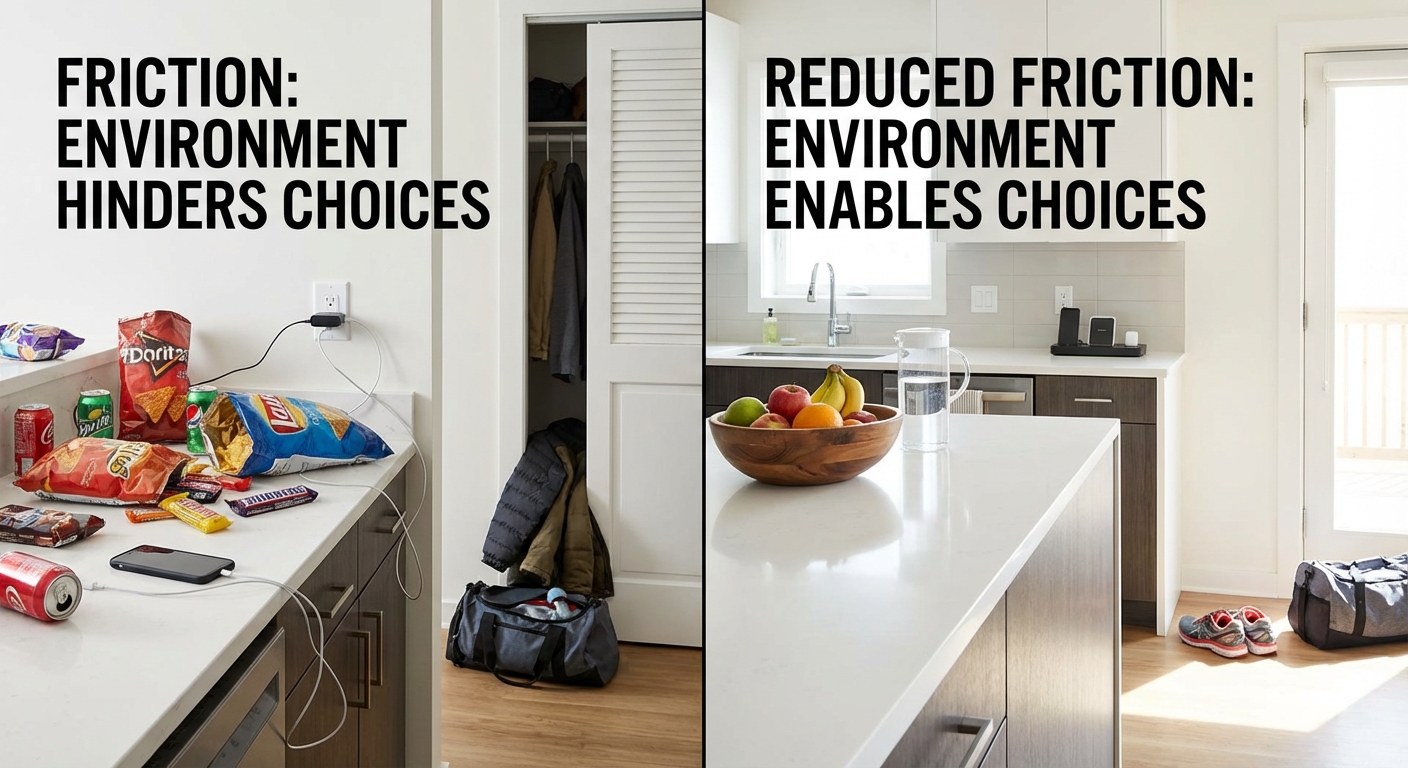
The people who successfully maintain habits aren’t necessarily more disciplined than you. They’ve often just arranged their lives so that the desired behavior is easier than the alternative. They’ve made the good choice the default choice. They’ve designed environments where willpower becomes almost unnecessary because the friction has been removed.
How Your Environment Shapes Behavior
Every space you inhabit is constantly communicating with your brain. The objects in your line of sight, the sounds you hear, the ease or difficulty of accessing certain things: these aren’t just background details. They’re behavioral prompts that your brain processes whether you’re aware of it or not.
Consider what happens when you walk into your kitchen late at night. If the cookies are on the counter and the vegetables are buried in the crisper drawer, you’re not making a free choice between cookies and vegetables. You’re making a choice where one option requires zero effort and the other requires opening the refrigerator, digging through produce, and probably washing something. The cookies will win most of the time, not because you lack willpower, but because humans consistently choose the path of least resistance.
This principle extends far beyond food. Research on habit formation shows that executives who used habit stacking, attaching new habits to existing routines in their physical environment, reported 64% higher success rates than those who tried to establish standalone habits. The environment provided the cue. The existing routine provided the trigger. The new habit rode along on infrastructure that was already working.
Your phone offers perhaps the starkest example of environmental design shaping behavior. Every app on your home screen is there because someone decided it should be easy to access. Every notification is calibrated to pull your attention at specific moments. You’re not weak for checking your phone constantly. You’re responding predictably to an environment that was engineered by thousands of people specifically to capture your attention.
Redesigning Your Spaces for Success
The good news is that you can become the engineer of your own environment. You can arrange your spaces to make desired behaviors easier and undesired behaviors harder. This isn’t about perfection or elaborate systems. It’s about small, strategic changes that shift the balance of friction.
Start by auditing your current environment with fresh eyes. Walk through your home and workspace as if you were a behavior designer trying to understand what actions this space encourages. Where does your attention naturally go? What’s easy to reach? What requires effort? Notice the habits your environment is already promoting, whether you chose them or not.
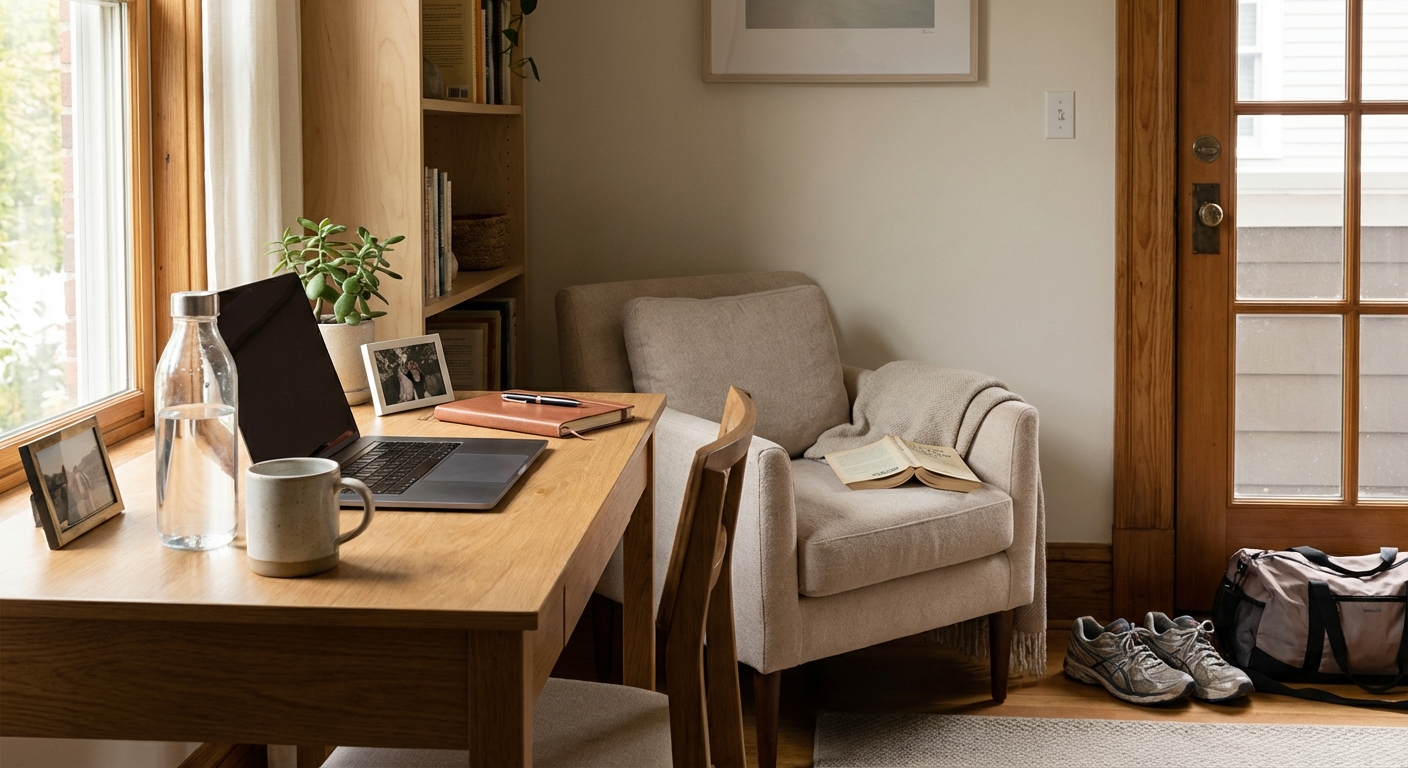
Then make changes that reduce friction for what you want to do. If you want to read more, put a book on your pillow so you encounter it at bedtime. If you want to drink more water, keep a filled water bottle on your desk where you’ll see it constantly. If you want to exercise in the morning, lay out your workout clothes the night before so getting dressed requires no decisions. Each of these changes takes minutes to implement but can shift patterns that willpower alone couldn’t budge.

The 10-Second Rule
One practical framework that captures this principle is what some researchers call the 10-second rule. The idea is simple: if you want to do something more often, make it accessible in 10 seconds or less. If you want to do something less often, make it take more than 10 seconds to access.
Want to practice guitar? Keep the guitar on a stand in your living room, not in a case in the closet. Want to scroll social media less? Move the apps off your home screen so you have to search for them. Want to eat healthier snacks? Pre-cut vegetables and put them at eye level in your refrigerator. Want to watch less TV? Unplug the television and put the remote in a drawer. Each of these changes adds or removes just enough friction to tip the balance.
This approach works because it doesn’t require you to be a different person. It doesn’t demand superhuman discipline or unwavering motivation. It simply acknowledges that you’re a human who will usually take the easier path, and then it makes the path you want to take the easier one. You’re not fighting your nature. You’re designing around it.
The cumulative effect of these small changes can be remarkable. When your environment is aligned with your intentions, you stop spending energy on resistance and start spending it on action. The habits that felt impossible when you were relying on willpower begin to feel almost automatic when your surroundings are working with you instead of against you. For more on building systems that outlast motivation, consider how environment design fits into broader behavior architecture.
Your Invitation
This isn’t about creating a perfect space or controlling every variable in your life. It’s about recognizing that you exist in constant dialogue with your environment, and that dialogue shapes your behavior more than you probably realize. Research suggests that roughly two-thirds of our daily actions operate on autopilot, driven by cues we barely notice. By becoming conscious of those cues, you gain leverage that willpower alone could never provide.
Start small. Pick one habit you’ve been struggling with and ask yourself: what would make this easier? What’s currently creating friction? What environmental change could I make today that would shift the default? You don’t need to redesign your entire life. You just need to redesign the parts of your environment that are actively working against you. The willpower you’ve been blaming yourself for lacking was never the real problem. The real problem was solvable all along.