
You’re trying to write that report, but part of your mind is still in the meeting you just left. You keep replaying what your colleague said, wondering if you should have responded differently, thinking about the email you need to send afterward. Fifteen minutes pass. You’ve written two sentences. Your attention is technically on the document in front of you, but significant mental resources are still allocated somewhere else entirely.
This experience has a name: attention residue. Coined by business professor Sophie Leroy at the University of Washington Bothell, the term describes what happens when you switch from one task to another. Your attention doesn’t transfer cleanly. Part of it stays stuck on the previous task, especially if that task was unfinished, emotionally engaging, or time-pressured. You’re physically present in your new task, but cognitively, you’re still partly elsewhere.
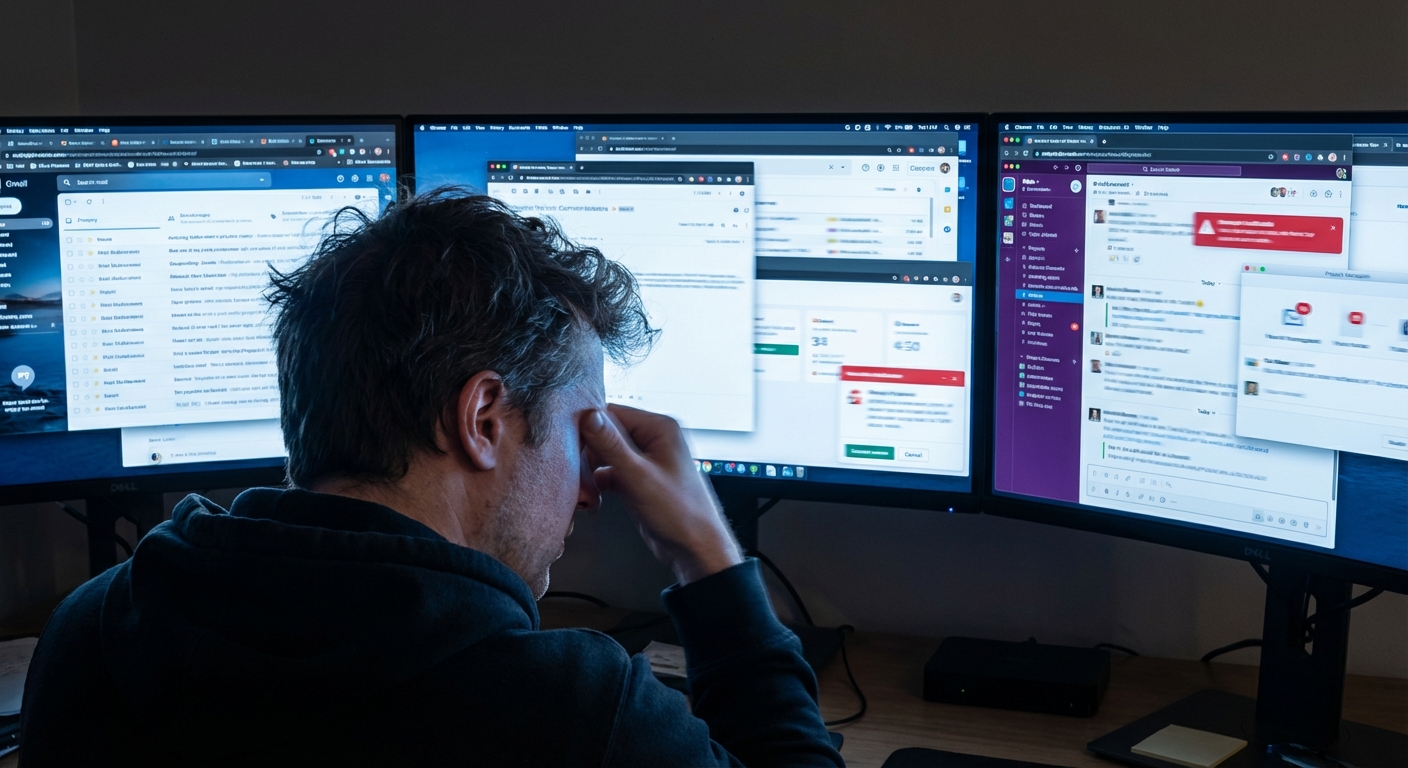
The implications are significant. In a world that treats task-switching as inevitable, even virtuous, attention residue reveals a hidden cost that most productivity advice ignores. Every time you jump from Slack to email to your actual work, you’re not just losing the seconds of transition. You’re carrying forward fragments of each previous task, creating an invisible drag on everything you try to do next.
The Research Behind Fragmented Focus
Professor Leroy’s foundational research demonstrated that people who switch tasks while the previous task is unfinished perform significantly worse on the new task. The effect isn’t subtle. Participants who believed they would face time pressure when returning to an interrupted task showed both high levels of attention residue and measurable performance decrements on their current work. Their bodies were in one task; their minds were still managing another.
The timing of the effect is revealing. Research from the American Psychological Association suggests that the cognitive effects of attention residue can persist for 15 to 23 minutes after switching tasks. This means that if you’re switching between tasks every ten minutes, which is common in many work environments, you may never actually achieve full cognitive engagement with anything. You’re perpetually operating at reduced capacity, thinking about several things poorly rather than one thing well.
Recent data makes the scope of the problem clear. A 2024 study from MIT’s Attention Lab found that continuous partial attention, the state of frequent micro-switching between tasks, raised error rates by 37 percent and reduced working memory accuracy by 20 percent. The effects compound: the more you switch, the worse you get at the thing you’re trying to do, and the more likely you are to make mistakes that create more problems to manage.
The average knowledge worker now loses 2.1 hours per day to distractions and recovery time, according to 2024 workplace studies. That’s not 2.1 hours of scrolling social media. It’s 2.1 hours of trying to get back to where you were before the interruption, of rebuilding cognitive context, of shaking off the residue of the previous task so you can actually engage with the current one.
The True Cost of Context Switching
The business world has long recognized that multitasking is less efficient than focused work, but the full costs of attention residue are worse than most people realize. Beyond lost time, there are significant impacts on cognitive quality, decision-making, and wellbeing.
Research highlighted in 2024 found that heavy multitasking can lead to a drop of up to 10 IQ points, roughly equivalent to missing a night of sleep. Constantly fragmenting your attention doesn’t just slow you down; it actively makes you worse at thinking. The creative insights, the careful analysis, the nuanced judgment that knowledge work requires become harder to access when your brain is managing residue from five different tasks simultaneously.
The impact on workplace wellbeing is equally concerning. The World Health Organization’s 2024 data indicates that the stress associated with constant task switching and attention residue contributes to workplace burnout, costing the global economy approximately $322 billion annually in healthcare expenses and lost productivity. The connection between attention fragmentation and burnout isn’t just correlational; the mechanisms are clear. Constantly managing open cognitive loops is exhausting in ways that focused work, even demanding focused work, is not.
Our digital tools compound the problem. A 2024 analysis found that constant monitoring of chat platforms like Slack and Teams increases perceived stress by 14 percent and decreases self-rated productivity by 11 percent. Workers now average nine active software tools per day, each competing for attention, each creating opportunities for residue accumulation. The tools designed to make us more productive may be creating the conditions that make deep work impossible.
Why Some Tasks Create More Residue
Not all task switches are equally harmful. Leroy’s research identifies several factors that determine how much residue a task leaves behind, which offers clues about how to manage the problem.
Unfinished tasks create significantly more residue than completed ones. Your brain treats open loops as problems requiring ongoing monitoring, which means that task you were pulled away from mid-thought will keep demanding cognitive resources even as you try to focus on something else. This is related to the Zeigarnik Effect, the psychological finding that uncompleted tasks are remembered better than completed ones, but the implications go beyond memory. The unfinished task doesn’t just stay in your mind; it actively interferes with your current focus.
Time pressure amplifies the effect. If you know you’ll need to return to an interrupted task and complete it under deadline pressure, the residue is worse than if you have plenty of time. Your brain anticipates the future stress and keeps more resources allocated to managing it. This creates a cruel irony: the busier you are, the more harmful interruptions become, precisely because you can’t afford the cognitive overhead.
Emotional engagement matters too. Tasks that involve conflict, uncertainty, or high stakes leave more residue than routine activities. The meeting where your idea was criticized will occupy mental bandwidth long after it ends. The difficult conversation you’re anticipating will shadow your focus all day. The brain prioritizes emotionally significant material, which means emotionally charged tasks have special power to fragment your attention.

Practical Strategies for Cleaner Attention
The research doesn’t just identify the problem; it points toward solutions. While we can’t eliminate task-switching entirely, we can reduce the residue that switching creates.
Complete more tasks before switching. This sounds obvious, but it runs counter to how most people work. Instead of starting a task, getting interrupted, starting another task, and cycling through partially completed work all day, try batching your work into complete units. Write the entire email before checking Slack. Finish the section of the report before responding to the notification. The brief delay in responding to interruptions is typically far less costly than the attention residue created by constant switching.
Create cognitive closure rituals. When you must switch tasks before completion, take a few seconds to create a clear stopping point. Write down exactly where you are and what the next step is. This simple act tells your brain that the task is “handled” for now, reducing the cognitive monitoring that creates residue. Professor Leroy’s research found that participants who created this kind of explicit closure showed significantly less attention residue than those who simply dropped one task and picked up another.
Protect transition time. The 15-23 minutes of residue aren’t optional; they’re how your brain works. Build this reality into your schedule rather than fighting it. If you have a meeting at 2:00, don’t expect to do deep work at 1:55. Use transition periods for low-stakes activities that don’t require full cognitive engagement: organizing your desk, reviewing your task list, taking a short walk. Give the residue time to clear before demanding your full focus.
Reduce switching frequency. This may require renegotiating expectations with colleagues and managers, but the research supports it. The World Economic Forum’s Future of Jobs 2025 report lists “Attention Control and Focus Management” among the top ten skills for the next decade, and California’s proposed Right-to-Disconnect legislation recognizes that recovery time is essential for cognitive restoration. The cultural conversation is shifting toward acknowledging that constant availability has cognitive costs that undermine the work we’re supposedly available to do.
The Deeper Invitation
Attention residue isn’t just a productivity problem; it’s a quality of life problem. The experience of being fully present, of engaging completely with what’s in front of you, of giving your whole mind to a single thing, is increasingly rare. We’ve normalized partial attention as the cost of doing business in a connected world, but the cost is higher than we typically acknowledge.
The fragmented state isn’t just less productive; it’s less satisfying. There’s a particular quality of engagement that emerges when attention is whole, when you’re not managing residue from the last thing while anticipating the next thing, when you’re simply here, doing this. That state, which psychologists call “flow,” requires the kind of clean cognitive transitions that attention residue makes impossible.

Your Invitation
Tomorrow, try an experiment. Choose one hour when you’ll work on a single task without switching. Turn off notifications. Close unnecessary tabs. Let the incoming messages wait. Complete something before you start something else.
Notice what happens to your experience. The residue-free state feels different, not just more productive but more alive. Your mind isn’t managing multiple open loops; it’s engaged with one thing. The quality of your work will likely improve, but more importantly, the quality of your experience will improve. You’ll remember what it feels like to think one thought at a time.
Attention residue is a useful concept because it names something we all experience but rarely acknowledge. Your attention isn’t a light switch that flips instantly from one task to another. It’s more like a heavy curtain that takes time to fully close on one scene before opening on the next. When we ignore this reality, we create conditions for fragmentation and frustration. When we work with it, we create conditions for focus and presence.
The modern world will keep generating interruptions. The tools will keep competing for attention. But your relationship to those demands is something you can shape. Understanding attention residue is the first step toward protecting something increasingly precious: the experience of being fully here.
Sources:
- Sophie Leroy, Attention Residue Research, University of Washington Bothell
- Attention is Today’s Productivity Gap, Institute of Organizational Mindfulness
- What Is Attention Residue?, Monitask
- Context Switching is Killing Your Productivity, Conclude.io
- Attention Residue Research: How Task Switching Destroys Competitive Advantage
- How Much Time Do We Lose Task-Switching?, Productivity Report 2025