
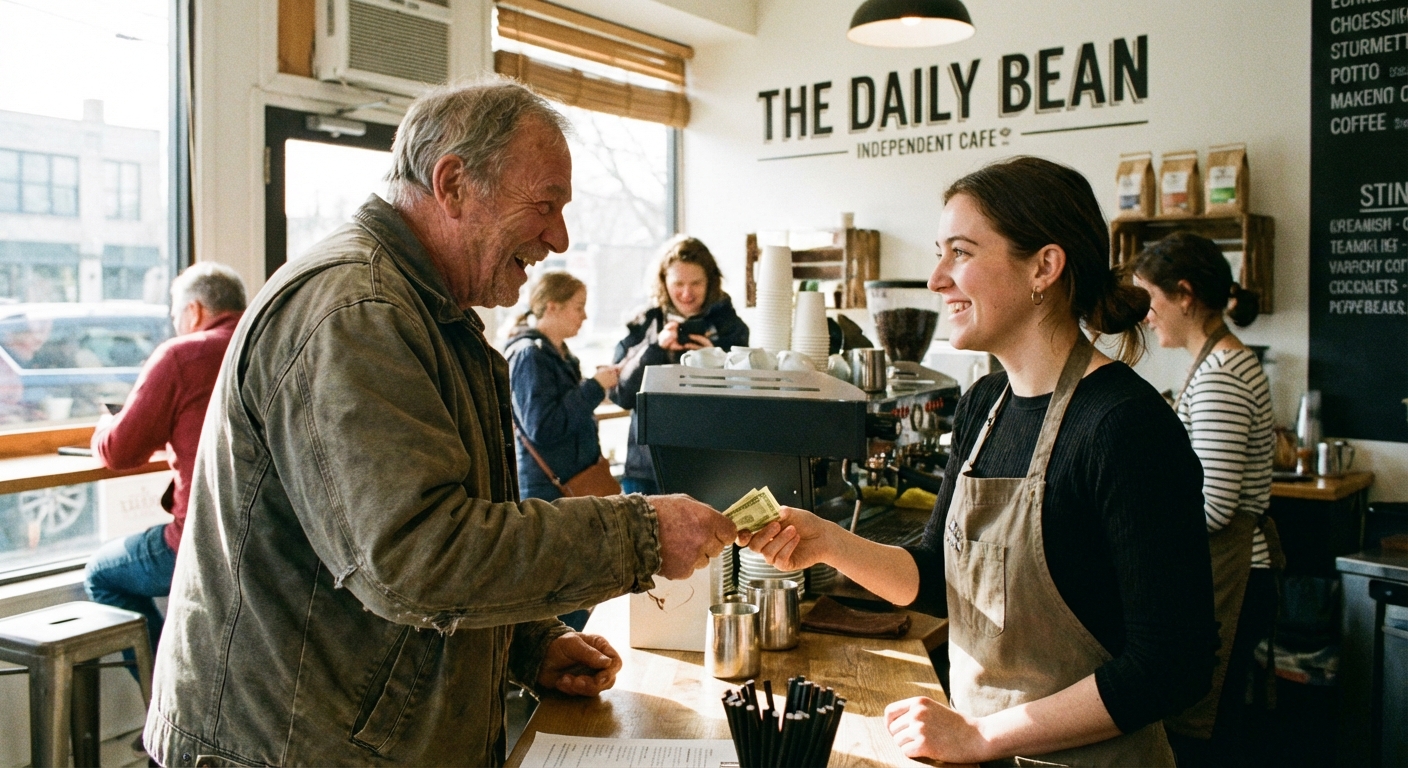
The barista at your coffee shop knows your order. The neighbor down the hall always says hello when you cross paths. The regular at the dog park whose name you don’t know but whose dog’s name you do. These aren’t deep relationships. You might not even think of them as relationships at all. But research shows these micro-connections, brief, repeated, positive interactions with people in your orbit, matter more than we realize. They’re the invisible infrastructure of wellbeing.
The loneliness epidemic is real and documented. The U.S. Surgeon General has declared loneliness a public health crisis, with roughly 60% of Americans reporting regular feelings of isolation. We have more ways to “connect” than ever, social media, video calls, instant messaging, yet we’re more isolated than we’ve been in generations. Something essential is missing, and it’s not deep friendship. It’s the web of casual belonging that used to come automatically with daily life and now requires deliberate creation. For those struggling to build deeper relationships, our guide on making friends as an adult addresses that complementary challenge.
Why Weak Ties Actually Matter
Sociologist Mark Granovetter’s foundational research on “the strength of weak ties” revealed something counterintuitive: our casual acquaintances often provide different but equally important benefits than our close relationships. While strong ties offer emotional support and deep understanding, weak ties offer access to new information, diverse perspectives, and the sense of being part of a larger social fabric.

A landmark University of Chicago study by behavioral scientists Nicholas Epley and Juliana Schroeder tested what happens when commuters connect with strangers versus keeping to themselves. Participants predicted that connecting would be awkward and make their commute worse. The reality was the opposite: people who connected reported more positive experiences, better mood, and a greater sense of connection. And importantly, the people they connected with felt the same way. Our predictions about whether others want connection are often wrong. We assume people want to be left alone. Usually, they welcome brief, positive interaction.
Research on neighborhood social capital tells a similar story. People who regularly greet neighbors and local shopkeepers report higher life satisfaction and lower loneliness than those who don’t, even when controlling for number of close relationships. The micro-connections weren’t replacing deep friendship. They were adding a layer of belonging that deep friendship alone can’t provide. They were answering a different question: not “Who loves me?” but “Where do I belong? Who sees me moving through the world?”
The Three Types of Micro-Connection
The first type involves what researchers call “familiar strangers”: people you see repeatedly in your routine. Coffee shop staff, grocery store workers, dog park regulars, gym morning crew, neighbors. What they provide is recognition. “I know you. You know me. We’re part of each other’s daily landscape.” This simple recognition, being a familiar face somewhere, creates belonging even without deep knowledge of each other’s lives.
Maya described her experience: “I started actually talking to people at my yoga studio instead of just nodding and leaving. Learned their names. Asked how they were doing. Three months later, I had friends. Real friends. From just being willing to engage with people I was already seeing regularly.” The relationship potential was already there; it just needed someone to activate it.
The second type involves friendly strangers: people you encounter briefly and may never see again. The person in the elevator, the customer in line behind you, the parent at the park, the fellow commuter. What they provide is a reminder that humans are generally kind, that brief connection is possible, that you’re part of a shared humanity. Elena described starting to say good morning to people she passed on her walks: “Most ignored me. Some looked startled. But some smiled and said it back. A few became regular walking-time hellos. It made my neighborhood feel less anonymous. I felt like I belonged somewhere.”
The third type involves service workers: baristas, store clerks, mail carriers, delivery drivers, restaurant servers. These interactions offer the opportunity to practice kindness and recognition, and for them, your acknowledgment that they’re human, not just function, can genuinely improve their day. Research shows that service workers who receive regular kindness and recognition report better job satisfaction and mental health. Learning names, making eye contact, saying thank you like you mean it, asking how their day is going, these aren’t just nice gestures. They’re contributions to someone else’s wellbeing.
Why This Matters More Now
We’re structurally isolated in ways previous generations weren’t. Working from home eliminates water cooler conversations, casual lunches with colleagues, and daily familiar faces in an office. Car-dependent suburbs mean driving from garage to parking lot with no walking past neighbors, no chance encounters. Online shopping means never seeing the same shop workers, never browsing and chatting with other customers. Headphones everywhere signal “don’t talk to me” whether we mean it or not.
We’ve eliminated most opportunities for micro-connection from default modern life. The interactions that used to happen automatically, seeing the same faces at the corner store, chatting with neighbors while walking to work, knowing the shopkeepers in your area, now require deliberate effort to create. If you want them, you have to seek them out, and that feels awkward in a culture that’s trained us to prize efficiency and privacy over casual connection. For those living alone, our piece on solo living and finding joy in solitude explores how to balance independence with intentional connection.
The Resistance and the Reality
The resistance sounds like this: “I don’t want to bother people. They don’t want to talk to me. It’ll be awkward. I’ll seem weird.” The research tells a different story. Most people appreciate connection. Brief, positive interaction brightens days, both yours and theirs. The awkwardness you’re anticipating exists mostly in imagination; in practice, a smile or a hello is welcomed far more often than it’s rejected.
The practices themselves are simple. Make eye contact and smile at people. Simple, powerful, and acknowledgment of another person’s humanity. Say hello to people you see regularly: neighbors, dog walkers, regular commuters. You don’t need long conversations. Just “hello” or “good morning” creates connection. Recognize that small talk isn’t shallow; weather, weekend plans, and surface observations are entry points that matter. They’re how humans test the waters before going deeper.
Ask people about themselves. The barista, the postal worker, the person next to you waiting somewhere. “How’s your day going?” “Do you live around here?” These questions communicate interest. Compliment genuinely when you notice something: “Great jacket,” “Your dog is adorable,” “That’s a beautiful plant.” Notice something, say something. Help when you can: hold the door, let someone go ahead of you in line, help carry something. Small acts of assistance create connection because they acknowledge mutual humanity.
Building Community Through Small Acts
Sarah described becoming a regular somewhere: “I started going to the same coffee shop every morning instead of rotating between chains. Within a month, they knew my order. Within three months, we were having real conversations. I looked forward to it. It made me feel like I belonged somewhere.” The belonging she describes wasn’t about deep friendship. It was about being a known presence in a specific place, having a node in the web of daily life where she was recognized and expected.
Community isn’t something that exists out there that you join. It’s something you create through repeated small acts of connection. The neighborhood Facebook group you actually participate in. The local businesses you support with regularity. The people you see on walks you start greeting. The building you live in where you know people’s names. These micro-connections accumulate into something that feels like belonging.
Marcus lived in a big apartment building where everyone used to rush past each other. He started saying hello to people in the elevator. At first, people looked startled. But slowly, others started doing it too. “Now there’s a culture of friendliness in the building. People hold the door. Help with packages. Chat in the lobby. One person started it, me, but now it’s the whole community.” Social contagion is real. Your choice to connect creates permission for others to connect.
Your Invitation
You can’t solve loneliness entirely with micro-connections. You still need close relationships for emotional intimacy and deep support. But micro-connections address a different dimension of loneliness: the feeling of being invisible, of moving through the world unseen, of not belonging anywhere. When the barista knows your name, you belong somewhere. When your neighbor says hello, you’re part of a community. When the dog park regulars ask where you’ve been, you’re noticed and missed.
This week, try one small experiment. Make eye contact and smile at five people today. See how it feels. Or learn the name of one person you see regularly but never talk to. Use it next time you see them. Or have one brief conversation with a stranger. In line, at coffee, at the park. Just see what happens. Or say hello to your neighbors every time you see them. Even just a wave or nod. Or become a regular somewhere: same coffee shop, same workout class, same farmers market. Show up enough that you become familiar.
Pick one. Notice how it feels to reach across the default isolation. You can’t control whether you have deep friendships. But you can control whether you smile at the mail carrier. Whether you chat with the person next to you. Whether you’re someone who connects or someone who isolates. Small choice, repeated daily, creates a life that feels less lonely.
Start with hello. See where it goes.
Sources: U.S. Surgeon General’s advisory on loneliness, Mark Granovetter’s “The Strength of Weak Ties,” Nicholas Epley and Juliana Schroeder’s University of Chicago commuter study, research on neighborhood social capital.