
The tension in your shoulders isn’t random. Neither is the tightness in your jaw you notice at the end of certain meetings, or the way your stomach knots when your phone buzzes with certain names, or the heaviness in your chest that arrives uninvited on Sunday evenings. Your body is speaking to you in a language you’ve probably been taught to ignore, and what it’s saying matters.
We live in a culture that treats the body as a vehicle for the mind, something to be fueled, maintained, and occasionally repaired, but not listened to. Physical sensations get acknowledged only when they become impossible to ignore: the headache that demands medication, the exhaustion that finally forces rest, the illness that stops everything. The quieter signals, the ones that whisper before they scream, get dismissed as background noise.
But those signals contain information your conscious mind might not have access to. Your body processes experience constantly, registering threats and opportunities, comfort and danger, alignment and resistance. When something feels wrong, your body often knows before your thoughts catch up. Learning to listen doesn’t require mystical intuition. It requires attention, practice, and the willingness to take physical experience seriously.
The Science of Embodied Knowing
The idea that emotions live in the body, not just the brain, has moved from alternative wellness into mainstream neuroscience. Research on interoception, the ability to sense internal bodily states, shows that this awareness correlates with better emotional regulation, decision-making, and overall wellbeing. People who are more attuned to their physical sensations tend to be better at identifying and managing their emotions.
Your gut literally has its own nervous system, containing over 100 million neurons that communicate bidirectionally with your brain. The phrase “gut feeling” isn’t metaphor; it’s physiology. When you sense that something is off without being able to articulate why, your enteric nervous system may be picking up on cues your conscious mind hasn’t processed. Dismissing these sensations as irrational means ignoring a sophisticated information system.
The vagus nerve, which connects your brain to your heart, lungs, and digestive system, plays a central role in stress response and emotional regulation. When you feel your heart racing in anxiety or your breathing shallow in fear, that’s vagal activity you’re noticing. Practices that tone the vagus nerve, including slow breathing, cold exposure, and social connection, can shift your physiological state in ways that affect your mental experience.
Dr. Bessel van der Kolk’s research on trauma has popularized the phrase “the body keeps the score,” referring to how past experiences get stored in physical patterns that persist long after the events themselves. But you don’t need to have trauma for this principle to apply. Every significant experience, from chronic stress to repeated joy to suppressed emotions, leaves traces in your body that influence how you move through the world.
Mapping Your Body’s Signals
The first step in listening to your body is simply noticing what’s there. This is harder than it sounds because most of us have trained ourselves into chronic disconnection. We override hunger signals, push through fatigue, and ignore tension until it becomes pain. The body sends messages; we’ve just stopped checking the inbox.
A body scan practice, systematically moving your attention through different body parts, can begin to rebuild awareness. Start with your feet and slowly move upward, noticing whatever sensations are present without trying to change them. Tension, warmth, numbness, pulsing, tingling, heaviness, lightness: whatever you find, simply notice it. This isn’t about achieving a particular state; it’s about information gathering.
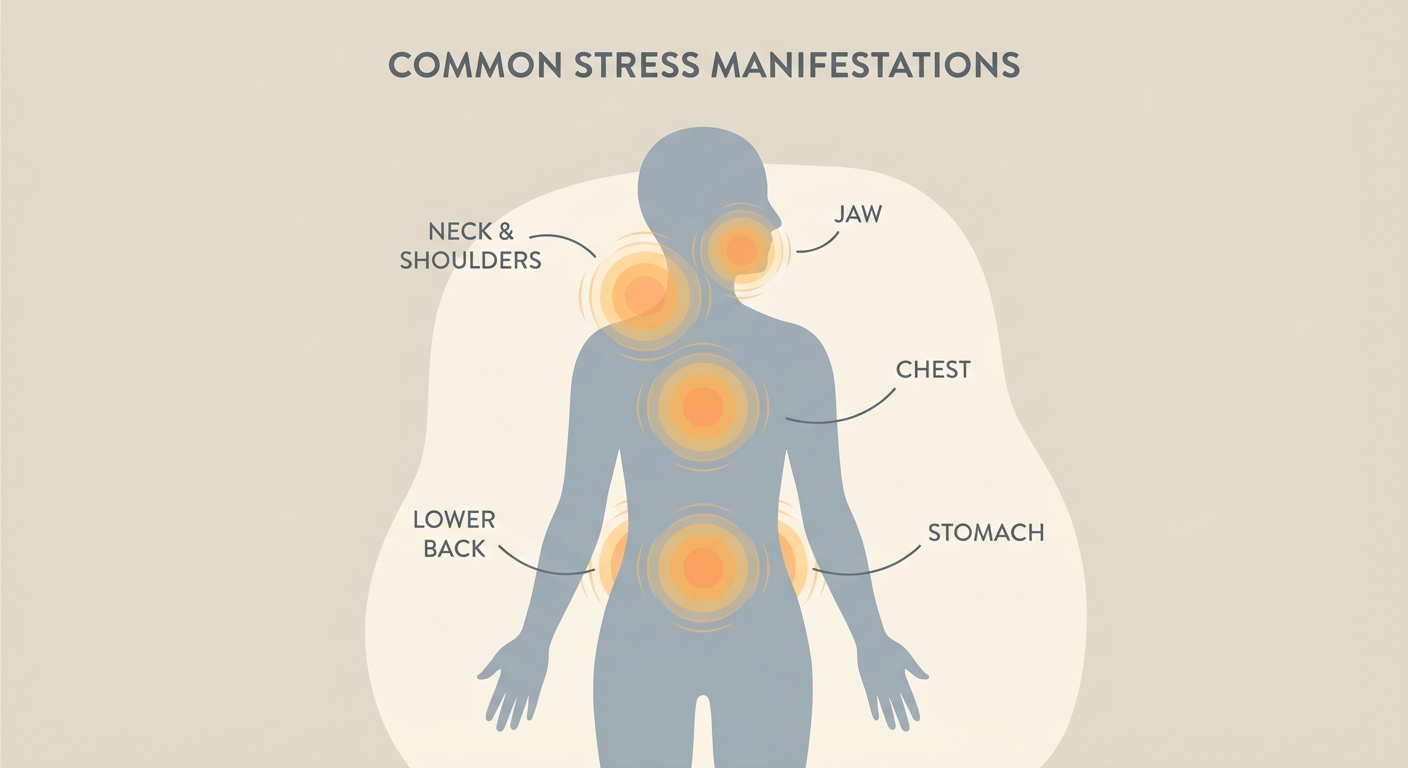
Over time, patterns emerge. You might discover that your shoulders creep toward your ears when you’re anxious, or that your jaw clenches when you’re suppressing frustration, or that your chest tightens when you’re around certain people. These patterns become meaningful when you track them against emotional and situational contexts. The sensation alone is data; the sensation plus context becomes insight.
Keep a simple log if it helps. When you notice a strong physical sensation, jot down what it is, where you feel it, and what was happening when you noticed it. After a few weeks, you’ll likely see correlations that weren’t obvious before. Your body has been speaking all along; you’re just learning to read the transcript.
Pay particular attention to transitions. How do you feel physically when you wake up? When you arrive at work? When you come home? When you prepare for bed? Transitions often reveal what your baseline has become, and that baseline might be carrying more tension or fatigue than you realize.
Common Signals and What They Might Mean
While body signals are highly individual, some patterns are common enough to be worth flagging. These aren’t diagnoses, they’re invitations to curiosity about what might be happening beneath the surface.
Chronic shoulder and neck tension often relates to holding responsibility or feeling burdened. The phrase “carrying the weight of the world” reflects a physical reality: when we feel responsible for too much, we tend to tense the muscles we’d use to actually carry heavy loads. If your shoulders never relax, it might be worth examining what you feel you can’t put down.
Jaw clenching and teeth grinding frequently accompany suppressed expression. When we don’t say what we need to say, the muscles of speech tense as if ready to act but prevented from doing so. If you wake with jaw pain or catch yourself clenching during the day, consider what words you’re holding back.
Stomach issues, including butterflies, knots, nausea, and digestive disturbance, often signal anxiety or dread. The gut is particularly sensitive to emotional states, and the direction of causation runs both ways: stress affects digestion, and digestive issues affect mood. Chronic stomach trouble that defies medical explanation might have an emotional component worth exploring.
Chest tightness and heart palpitations can relate to fear, grief, or heartache in the literal sense. The “broken heart” isn’t purely poetic; emotional pain and physical heart sensations share neural pathways. When your chest feels heavy without physical exertion, something emotional may need attention.
Fatigue that doesn’t resolve with rest sometimes indicates depression, burnout, or misalignment between your life and your values. The body conserves energy when the mind has lost motivation. If you’re tired despite adequate sleep, the exhaustion might be existential rather than physical. For those sensing a deeper misalignment, our piece on managing your energy rather than your time offers a framework for understanding what might be draining you.

Responding to What You Hear
Listening to your body isn’t useful unless you respond to what you hear. The signal exists to prompt action, and ignoring it after acknowledging it is only marginally better than not noticing at all.
Some responses are immediate and physical. Tension calls for movement, stretching, shaking, or changing position. Shallow breathing calls for intentional deep breaths. Fatigue calls for rest when possible or gentleness when rest isn’t available. These physical responses honor the body’s message in its own language.
Other responses require addressing the underlying cause. If your stomach knots every Sunday evening thinking about work, the solution isn’t just deep breathing; it’s examining what about your work situation is creating dread. If your shoulders never relax, reducing your actual burden, not just your physical tension, may be necessary. The body’s signals often point to life changes that your mind has been avoiding.
Sometimes the response is simply acknowledgment. “I notice I’m anxious right now” can shift your relationship to the sensation without requiring you to fix it immediately. Naming what’s present reduces its power and creates space between you and the sensation. You’re not your anxiety; you’re the one who notices the anxiety.
Be careful about using awareness as another opportunity for self-criticism. If you discover that your body holds chronic tension, that’s information, not failure. If your stress manifests physically in ways you’ve been ignoring, that’s feedback, not evidence of weakness. The goal is curiosity and compassion, not another stick to beat yourself with.
Building Sustainable Body Literacy
Like any skill, body awareness develops with practice. You can’t expect years of disconnection to reverse overnight, and the cultivation of interoception is a gradual process with increasing returns.
Regular practices that bring attention inward support this development. Meditation is the obvious one, but yoga, tai chi, and even mindful walking serve similar functions. The common element is deliberate attention to physical experience without the goal of changing it. You’re not trying to relax; you’re trying to notice. And when you do want to actively shift your nervous system state, understanding how breathwork calms everything gives you a powerful tool.
Somatic therapies can accelerate the process, particularly if you’re working through stored experiences that manifest physically. Approaches like Somatic Experiencing, developed by Peter Levine, or Hakomi, which integrates mindfulness with body-centered psychotherapy, specifically address the connection between physical sensation and emotional experience.
Movement practices that emphasize internal sensation rather than external performance also help. Feldenkrais, Alexander Technique, and certain approaches to dance and martial arts prioritize awareness over achievement. They teach you to feel what you’re doing rather than just do what you’re told.
Even small daily habits matter. Pausing before meals to check in with actual hunger. Noticing how your body feels before automatically reaching for coffee. Taking a breath before responding to a stressful message. These micro-practices accumulate into a general orientation of embodied awareness.
Your Invitation
Right now, before reading further, pause. Close your eyes if you can. Take three slow breaths. And simply notice what you notice. What sensations are present in your body at this moment? Where do you feel tension? Ease? Aliveness? Numbness? You don’t need to interpret it or fix it. Just notice.
This is the practice. This is the whole thing. Repeated thousands of times, in thousands of moments, it becomes a way of being rather than an exercise. You become someone who lives in your body rather than someone who occasionally visits it.
Your body has been with you every moment of your life. It has kept you alive through everything you’ve experienced. It has held what you couldn’t consciously process and carried what you couldn’t speak. The least you can do is listen to what it’s been trying to tell you.
The conversation is already happening. You just need to join it.
Sources: Dr. Bessel van der Kolk’s research on trauma and the body, interoception research in neuroscience, vagus nerve studies, Somatic Experiencing (Peter Levine), Hakomi body-centered psychotherapy.