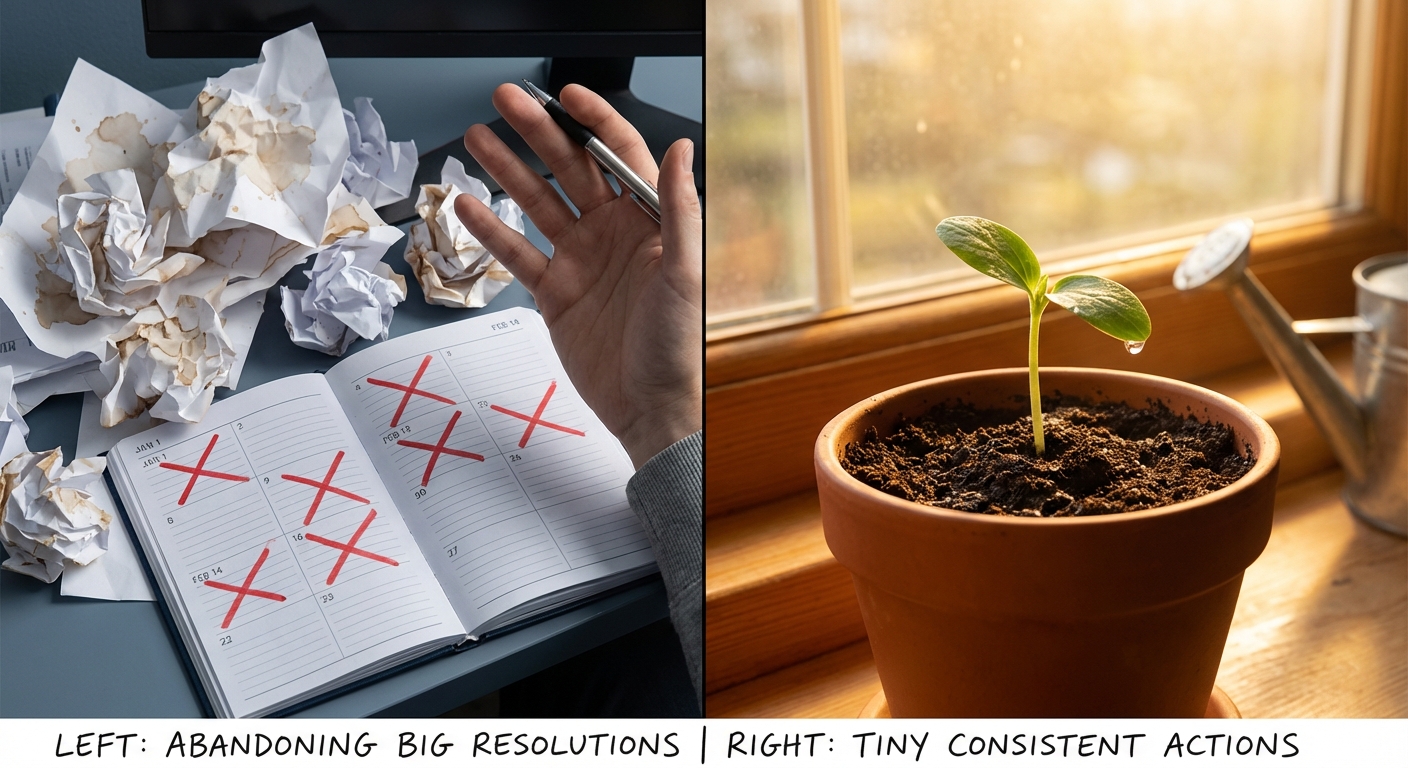
It’s January 6th, and you’ve already skipped two workouts. The meditation app you downloaded sits unopened, its cheerful notification mocking you each morning. That ambitious reading goal? You haven’t cracked a book since New Year’s Day.
Here’s what you need to hear: you’re not weak, undisciplined, or fundamentally incapable of change. The problem isn’t you. The problem is the entire framework you’ve been handed for how to change your life.
Research from behavioral scientists consistently shows the same thing: approximately 88% of people fail to achieve their New Year’s resolutions, according to studies from Baylor College of Medicine. Only 25% remain committed after just one month. These numbers aren’t a testament to human weakness. They’re an indictment of a broken approach to change.
The Willpower Myth That Sets You Up to Fail
We’ve been sold a lie about how change works. The story goes like this: decide what you want, summon enough willpower, push through the discomfort, and eventually you’ll transform. It sounds reasonable, which is why it’s so dangerous.
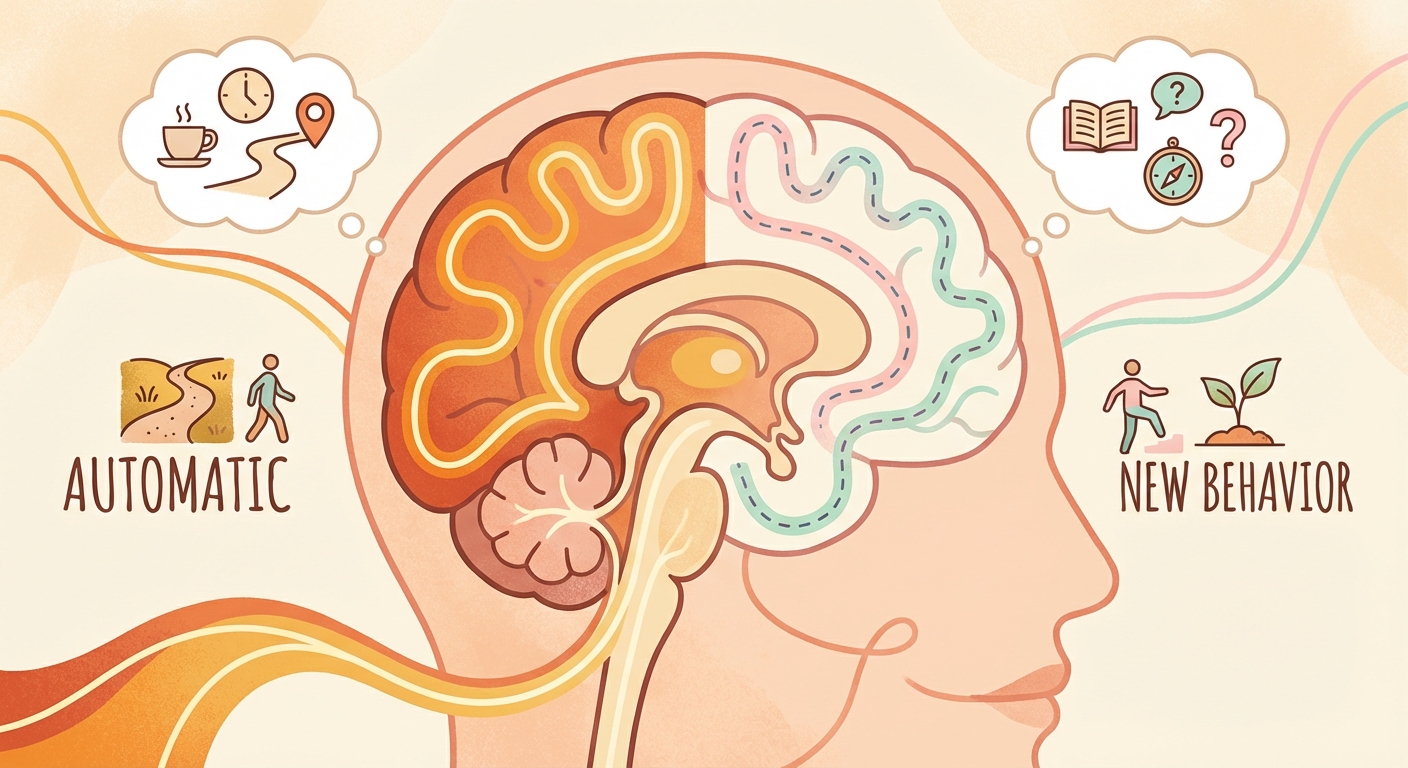
“Repetition, not intention, rewires behavior,” explains Cherian Koshy, author of Neurogiving and expert in behavioral neuroscience. “Resolutions fail because they rely on willpower, and willpower is unreliable.” This isn’t a character flaw. It’s neurobiology. Your brain is designed to conserve energy, which means it follows what’s easy, not what’s aspirational.
Think about your own experience. You started January with genuine motivation, probably even excitement about your goals. That motivation felt like fuel. But motivation fluctuates based on sleep, stress, weather, and a hundred other factors outside your control. When motivation dipped, even slightly, the resolution became harder to maintain. When it dipped significantly, often around week two, the behavior collapsed entirely.
The neuroscience here is clear. Your prefrontal cortex, the part responsible for willpower and executive function, is essentially a muscle that fatigues. Every decision you make throughout the day depletes it. By evening, when you planned to exercise or meditate or cook that healthy meal, you’re operating with a depleted resource. The resolution never stood a chance, not because you didn’t want it enough, but because you asked the wrong part of your brain to carry the load.
What Actually Works: The Micro-Habit Revolution
If willpower is unreliable, what can we depend on? The answer, backed by decades of research from Stanford’s Behavior Design Lab and others, is systems over goals and tiny over ambitious.
Dr. B.J. Fogg, founder of the Behavior Design Lab at Stanford, has spent years studying why some behaviors stick while others fade. His central finding challenges everything we’ve been taught about New Year’s resolutions: start so small it feels almost ridiculous. Want to floss? Start with one tooth. Want to exercise? Start with putting on your workout shoes. Want to meditate? Start with three breaths.
This sounds too simple to work, which is exactly why it does. When a behavior requires minimal effort, it bypasses the willpower problem entirely. Your brain doesn’t resist it because there’s nothing to resist. And once the tiny behavior becomes automatic, usually within two to three weeks, you can gradually expand it. The one tooth becomes two, then five, then a full mouth. The workout shoes lead to a short walk, then a longer one, then a jog.
Research from Dominican University found that people who write down goals with personal meaning are 42% more likely to achieve them. But here’s the part that study often leaves out: the goals that succeeded weren’t just meaningful, they were broken into daily actions small enough to actually complete. A goal without a system is just a wish. A system without tiny steps is just another thing to fail at.
The Habit Stacking Secret
Another evidence-based approach that research supports is habit stacking, attaching a new behavior to an existing one. This technique leverages what behavioral scientists call “implementation intentions,” the specific when and where of a behavior.
Instead of “I will meditate more,” try “After I pour my morning coffee, I will sit and take five deep breaths.” Instead of “I will read more,” try “After I get into bed at night, I will read one page.” The existing habit serves as a trigger, eliminating the need to remember or decide. The new behavior rides on the neural pathway you’ve already built.
James Clear, whose work on habit formation has reached millions, calls this “making it obvious.” When a behavior is connected to a specific time, place, and existing routine, it requires almost no mental effort to initiate. The decision is already made. You’re not choosing to meditate; you’re simply doing what you always do after pouring coffee.

Why Your Environment Matters More Than Your Motivation
Here’s an uncomfortable truth that resolution culture ignores: your environment shapes your behavior far more than your intentions. If you want to eat healthier but your kitchen is stocked with junk food, you’re not testing your willpower, you’re guaranteeing its failure. If you want to scroll your phone less but it sits on your nightstand, you’ve already lost.
Behavioral economists call this “choice architecture,” the way your surroundings make certain behaviors easier or harder. The most successful behavior changers don’t rely on being stronger than their environment. They redesign their environment so the desired behavior becomes the path of least resistance.
Want to exercise in the morning? Sleep in your workout clothes. Want to drink more water? Put a full glass on your nightstand before bed. Want to read instead of scrolling? Put your phone in another room and a book in your hands. These aren’t willpower hacks; they’re environmental redesigns that make the right choice automatic.
Research consistently shows that lasting change depends more on how goals are set up, supported, and built into everyday life than on motivation or discipline. Time pressure, financial stress, caregiving responsibilities, and countless other constraints limit what people can realistically change regardless of their intentions. Working with your environment, rather than against it, acknowledges these realities.
The Permission to Pivot
What if your resolution needs to change entirely? This is the part that rigid goal-setting culture gets catastrophically wrong. A resolution isn’t a blood oath. It’s a hypothesis about what might improve your life.
Sometimes you discover, a week or a month in, that the goal you set isn’t actually what you need. Maybe you thought you wanted to wake up at 5 AM, but you’re learning you’re genuinely not a morning person. Maybe you thought you wanted to run, but your body is telling you it craves swimming or walking instead. This isn’t failure. This is information.
The psychological concept of “course correction” suggests that the most successful long-term changers aren’t the ones who stick rigidly to their original plan, they’re the ones who adapt when they learn something new. Your January 1st self made a guess. Your January 6th self knows more. Listen to what you’ve learned.

Starting Over, Starting Small, Starting Today
If your resolutions are already struggling, here’s your reset. Not a new set of ambitious goals to fail at, but a different approach entirely.
First, pick one thing. Not five things, not the complete life overhaul. One behavior you want to change. Research is clear that attempting multiple changes simultaneously dramatically reduces success rates for all of them.
Second, make it tiny. Whatever you think is small enough, make it smaller. The goal isn’t to transform your life this week. The goal is to build the neural pathway that will eventually support the transformation. One pushup. One page. One minute of silence.
Third, attach it to something you already do. Choose a reliable existing habit and link the new behavior to it. After I brush my teeth, I will do one pushup. After I sit down at my desk, I will write one sentence. The existing habit becomes the trigger.
Fourth, track consistency, not intensity. A checkmark for showing up matters more than how much you did once you showed up. The streak itself becomes motivating, and the habit becomes identity. You’re not trying to exercise; you’re becoming someone who exercises.
Your Invitation
The cultural message around resolutions is relentlessly judgmental. Stick to your goals or you’re weak. Push through or you’re lazy. Transform completely or you’ve failed.
The research tells a different story. Change is hard not because you’re inadequate, but because your brain is designed to resist it. The people who successfully change their lives aren’t more disciplined. They’re more strategic. They work with their neurobiology instead of against it.
You haven’t failed your resolutions. You’ve just been using the wrong strategy. Start smaller than feels meaningful. Build the system before chasing the goal. Redesign your environment to make the right choice easy. And give yourself permission to adapt when you learn something new.
The best time to plant a tree was twenty years ago. The second best time is today. The best approach? Plant a seed so small you can’t possibly fail to water it.