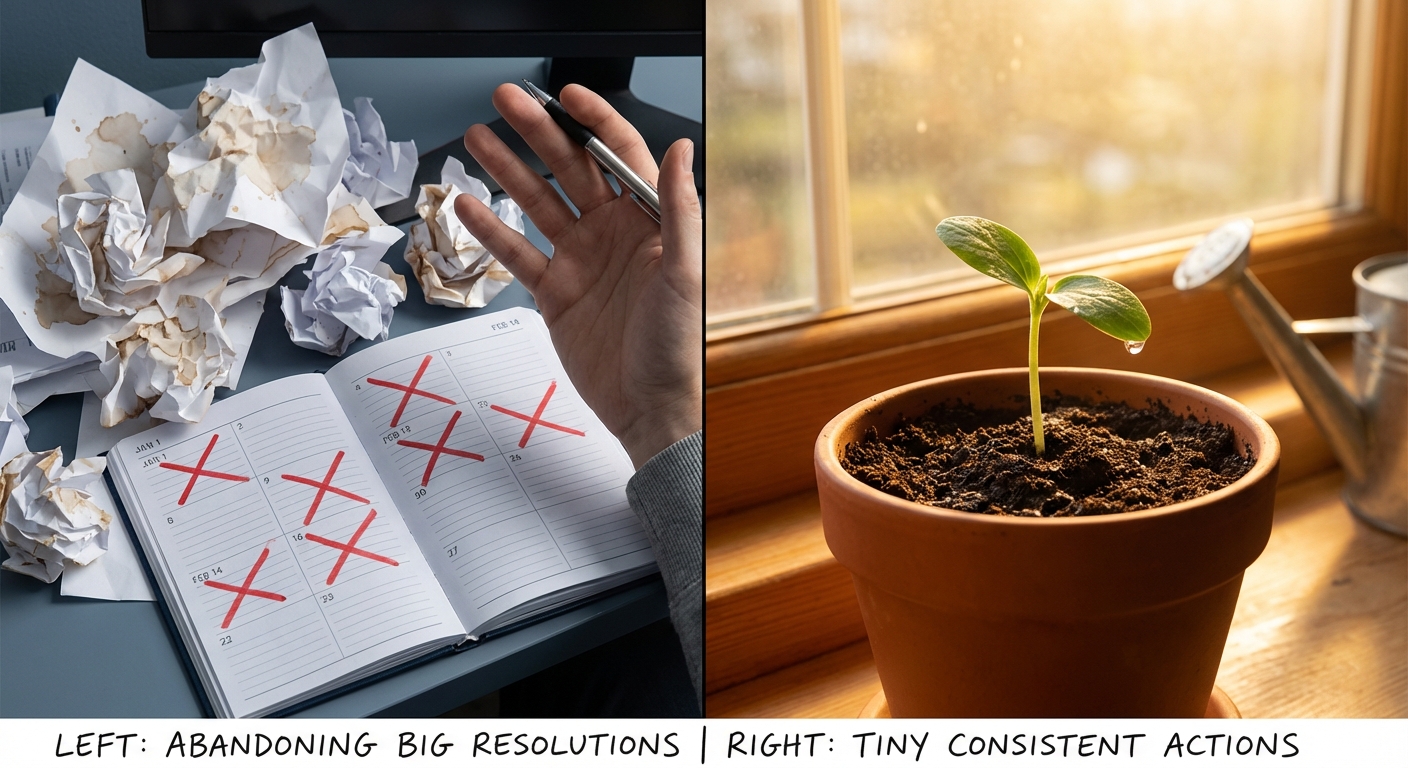
You want to write a book. So you commit to writing 2,000 words every day. You want to get fit. So you promise yourself you’ll work out for an hour five times a week. You want to meditate. So you download an app and pledge to sit for 30 minutes each morning. These commitments feel right. They feel proportional to your goals, serious enough to matter, ambitious enough to create real change.
They’re also almost guaranteed to fail.
Not because you don’t want the outcomes. Not because you lack discipline or follow-through. But because you’ve misunderstood the relationship between the size of a commitment and its likelihood of sticking. The research on behavior change tells a counterintuitive story: when it comes to building lasting habits, asking less of yourself often gets you more.
The emerging trend of micro-habits represents one of the most significant shifts in self-improvement thinking for 2026. Instead of elaborate routines that require motivation you don’t consistently have, people are discovering the surprising power of commitments so small they feel almost embarrassingly easy. Read one page. Do one pushup. Write one sentence. Meditate for one minute. The goals sound trivial. The results are anything but.
Why Big Goals Backfire
Ambitious goals have a seductive logic. If you want big results, you should make big commitments. If you’re serious about change, your efforts should feel serious. Anything less seems like you’re not really trying, not really committed, not really in it for real.
But this logic ignores a fundamental truth about human psychology: we’re not motivation machines. We’re complex beings whose willpower fluctuates wildly based on sleep, stress, emotional state, and countless other variables. On a good day, that 2,000-word commitment feels achievable. On a bad day, on a tired day, on a day when life has thrown unexpected obstacles in your path, it feels impossible. And once you skip a day, the whole structure begins to crumble.
Big commitments also activate what psychologists call the “what-the-hell effect.” Once you’ve broken your streak, once you’ve failed to meet the ambitious target, the psychological cost of getting back on track feels enormous. You’ve already failed, so what’s the point? The very ambition that was supposed to drive you forward becomes the reason you stop entirely. Your commitment was too rigid to bend with life’s inevitable variability, so it broke instead.

The Science of Starting Small
The research supporting micro-commitments is surprisingly robust. A 2025 study on habit formation found that leaders who began with minimal viable habits and gradually scaled up were 2.7 times more likely to maintain long-term habits compared to those who started with ambitious targets. The magic wasn’t in the smallness itself, but in what the smallness made possible: consistency.
Research on habit tracking adds another piece to the puzzle. A study found that individuals using binary tracking, simply recording whether they did the behavior or not with a yes or no, maintained habits 27% longer than those using detailed metrics during the formation phase. The simplicity reduced cognitive load and made the behavior feel more achievable. When your only question is “did I do it?” rather than “did I do it well enough?” you’re far more likely to answer yes.
What makes tiny commitments work isn’t that they produce tiny results. It’s that they create a behavioral foundation that can expand over time. When you commit to one pushup, you’ll often do more once you’re on the floor. When you commit to one page, you’ll frequently read several once the book is in your hands. The micro-commitment gets you started, and starting is the hardest part. As BJ Fogg notes, “Habits eventually require less motivation because they become automatic.” But they can only become automatic if they happen consistently, and they can only happen consistently if they’re small enough to survive your worst days.
How Micro-Commitments Build Identity
There’s a deeper mechanism at work here, one that goes beyond simple behavior repetition. Every time you keep a commitment to yourself, no matter how small, you’re casting a vote for the kind of person you want to be. You’re building evidence that you’re someone who follows through, someone who shows up, someone whose word to themselves means something.
This identity shift matters more than the immediate action. When you write one sentence daily for a month, you haven’t just written 30 sentences. You’ve accumulated 30 pieces of evidence that you’re a writer, someone who writes, someone for whom writing is part of who they are. That identity, once established, begins to pull you toward larger actions naturally. You don’t have to force yourself to write more because writers write. The identity does the heavy lifting that willpower couldn’t.
The opposite is also true. Every time you break a big commitment, you’re casting a vote for a different identity. You’re accumulating evidence that you’re someone who doesn’t follow through, someone who sets ambitious goals and fails, someone whose intentions can’t be trusted. The ambitious goals you thought would motivate you are actually eroding the very foundation that lasting change requires: your belief that you can change at all.

Practical Applications
Starting with micro-commitments doesn’t mean staying small forever. It means building a foundation of consistency that can support growth over time. Here’s how to apply this principle across different areas of life.
For creative work, commit to the minimum viable creative act. One sentence if you want to write. One sketch if you want to draw. One chord progression if you want to compose. The commitment should feel almost too easy, something you could do even on your worst day, even when sick, even when overwhelmed. Once that baseline is established and consistent for at least two weeks, you can consider expanding. But not before.
For physical health, start with movement so brief it seems pointless. One minute of stretching. A single lap around the block. Five squats before your morning shower. The point isn’t the physical impact of these tiny actions. The point is showing up, building the habit loop, and proving to yourself that you’re someone who moves their body. The intensity can come later, after the habit is no longer something you have to remember to do.
For learning and growth, micro-commitments might mean reading one page, watching five minutes of an educational video, or reviewing one concept you want to understand better. If your resolution strategy has been failing, consider whether you’ve been asking too much of yourself too quickly. The learning compounds over time, but only if the behavior persists long enough to compound.
The Bottom Line
The most effective change strategy isn’t the one that looks most impressive on paper. It’s the one you’ll actually stick with when life gets hard, when motivation disappears, when everything conspires to pull you away from your intentions. Micro-commitments work because they’re designed for your worst days, not your best ones. They survive the inevitable fluctuations of energy and willpower that derail bigger ambitions.
This doesn’t mean you shouldn’t have big goals. It means you should separate your goals from your daily commitments. Dream big, but act small. Let the vision pull you forward while the micro-commitment keeps you moving. Over time, those tiny actions accumulate into something that ambitious sprints followed by burnout could never produce: lasting change that becomes part of who you are.
If you’re working on goal-setting for this year, consider what the smallest possible version of your goal would look like. What could you commit to that would feel almost embarrassingly easy? Start there. The size of your commitment isn’t a measure of how serious you are. It’s a measure of how well you understand what actually works.