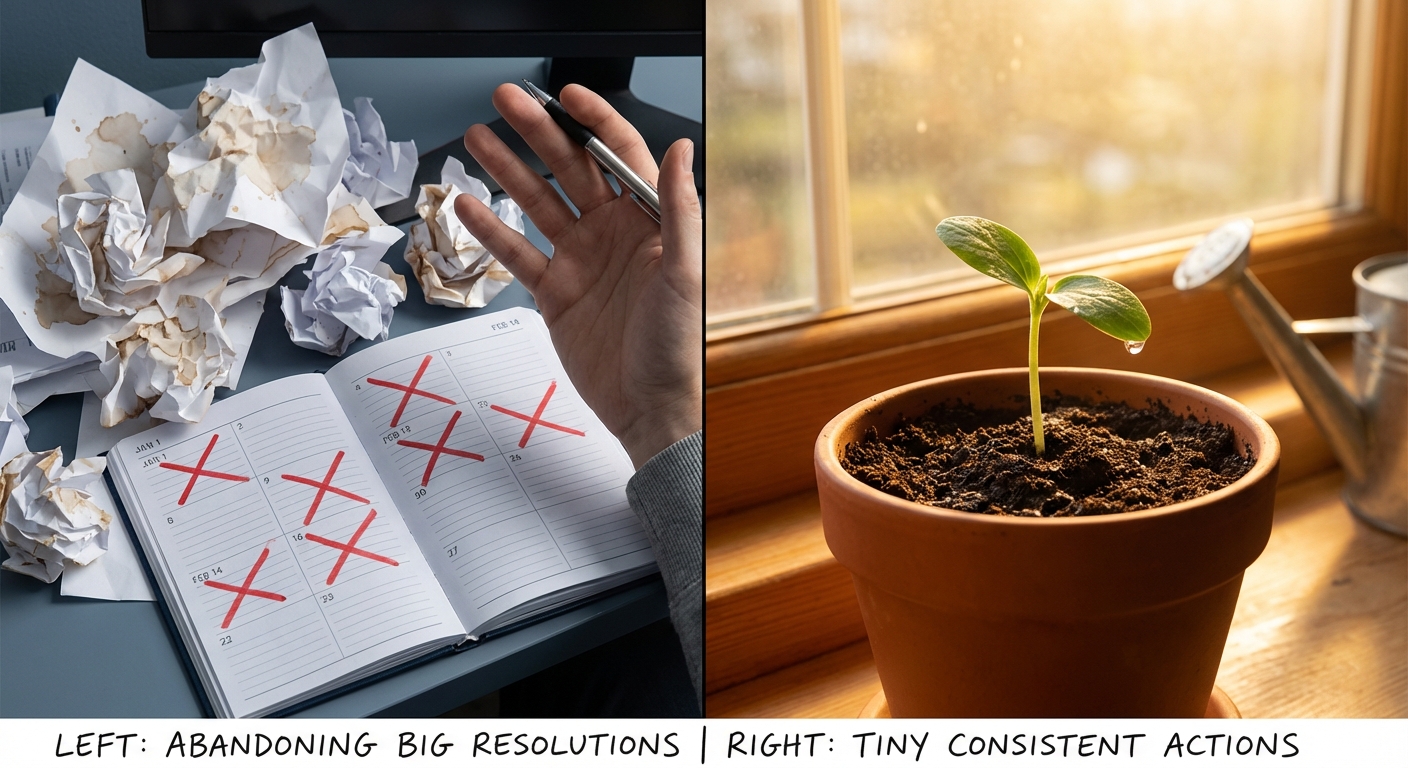
You’ve heard the promise a thousand times. Push through the discomfort. Delay gratification. Build the discipline first, and happiness will follow. Every productivity guru, every hustle-culture influencer, every well-meaning mentor has sold you some version of the same equation: suffering now equals satisfaction later.
What if they have it backwards?
New research published in Social Psychological and Personality Science suggests something that might unsettle the entire self-improvement industry: psychological well-being appears to be a precursor to self-control, not a result of it. In other words, you don’t earn happiness through discipline. You may need happiness to access discipline in the first place.
This isn’t permission to abandon your goals or give up on meaningful effort. It’s something more nuanced and, frankly, more useful. It’s an invitation to reconsider whether the path you’re taking to become more disciplined is actually making discipline harder to achieve.
The Discipline Myth We’ve All Believed
For decades, the dominant narrative in personal development has followed a clear script. Self-control is the foundational virtue. Those who have it succeed; those who lack it struggle. And the way to get it is through force of will, delayed gratification, and tolerating discomfort in service of future rewards.
This narrative draws heavily on the famous Stanford marshmallow experiments from the 1960s, where children who could resist eating a marshmallow for a larger later reward seemed to have better life outcomes. The conclusion seemed obvious: willpower is everything, and training yourself to resist immediate pleasure is the key to long-term success.

But the marshmallow studies have been substantially reinterpreted in recent years. Researchers found that children’s ability to delay gratification was heavily influenced by their trust in the environment and their socioeconomic circumstances. Kids who had reliable adults in their lives waited; kids who had learned that promised rewards often didn’t materialize grabbed what they could. It wasn’t character. It was context.
This matters because the discipline-first model assumes we all start from the same baseline and just need to try harder. It ignores the reality that self-control is a resource that depends on other resources being in place first. You can’t pour from an empty cup, and you can’t exercise discipline when your psychological foundations are depleted.
What the New Research Actually Shows
The recent study challenging the discipline-to-happiness pipeline examined the relationship between well-being and self-control across multiple datasets and methodologies. What researchers found surprised even them: the data consistently showed that well-being preceded self-control rather than following from it.
People who reported higher levels of psychological well-being, including positive emotions, life satisfaction, and a sense of meaning, subsequently demonstrated better self-control. But people who started with high self-control didn’t reliably develop greater well-being over time. The arrow pointed in one direction, and it wasn’t the direction we’ve been told.
This finding aligns with what’s called the “broaden-and-build” theory of positive emotions, developed by psychologist Barbara Fredrickson at the University of North Carolina. When we experience positive emotions, our cognitive and behavioral repertoire expands. We become more creative, more flexible, more able to see the big picture. These expanded capacities make it easier to pursue long-term goals, delay gratification, and resist temptation.

Conversely, when we’re depleted, stressed, or unhappy, our cognitive resources narrow. We become focused on immediate threats and rewards. We lose access to the mental flexibility that long-term thinking requires. From this perspective, pushing through unhappiness in hopes of earning future discipline isn’t just painful. It’s counterproductive.
The researchers are careful to note that this doesn’t mean discipline is worthless or that we should abandon challenging pursuits. It means that investing in well-being isn’t a distraction from becoming more disciplined. It may be the most direct path to getting there.
Why the Grind-First Model Fails
If you’ve ever tried to build a new habit while stressed, exhausted, or depressed, you know how much harder everything becomes. The standard advice tells you to push through anyway, to use the habit as a way to feel better. But this approach often backfires precisely because it misunderstands the order of operations.
Self-control is what researchers call a “limited resource” or, more controversially, something that operates like a muscle that can be fatigued. While the exact mechanisms are debated, there’s broad agreement that self-control is not infinite and that it’s affected by our overall psychological state.
When you’re running on fumes emotionally, you have less capacity for the effortful mental work that self-control requires. Each act of willpower costs more. And because the grind-first approach specifically deprioritizes well-being, it systematically depletes the resource it’s trying to build.
This creates a vicious cycle familiar to many high-achievers: you push yourself harder, burn through more willpower, feel worse as a result, and then conclude that you need even more discipline because you’re struggling. The solution to willpower depletion becomes more willpower, which accelerates the depletion.
The happiness-first model suggests a different cycle. When you prioritize well-being, you build up the psychological resources that make self-control feel less effortful. You create conditions where good decisions come more naturally. You’re working with your psychology instead of against it.
What This Means for Your Goals
This research doesn’t suggest you should abandon structure or avoid challenges. What it suggests is that the scaffolding you build around your goals matters more than the intensity of your effort.
If you’re trying to exercise more, but you hate every workout and dread going to the gym, the discipline-first approach says keep forcing it until it becomes habit. The well-being-first approach asks: how can we make this more enjoyable? What kind of movement actually brings you satisfaction? Who could you do it with? What environment would make it feel like play rather than punishment?
The goal isn’t to avoid all discomfort. It’s to ensure that your overall experience of pursuing the goal is sustainable and, ideally, nourishing. Research on what’s called “intrinsic motivation” consistently shows that activities we find inherently satisfying are far easier to maintain than activities we pursue only for external rewards.

Self-Determination Theory, developed by psychologists Edward Deci and Richard Ryan, identifies three core psychological needs: autonomy, competence, and relatedness. When these needs are met, we experience well-being. And when we experience well-being, self-regulation becomes easier. The researchers found that people pursue goals more persistently and more successfully when the process meets these needs, not just the outcome.
This connects to what we explored in our article on why resolutions fail: the strategy often matters more than the strength of your commitment. And to our piece on how environment shapes habits: willpower is less important than the conditions you create for yourself.
The Permission You Might Need
For those of us raised on the gospel of grind, this research can feel uncomfortable. If happiness precedes discipline, doesn’t that let people off the hook? Isn’t it soft to say that feeling good matters?
But consider the alternative. A culture that insists on discipline-first has produced epidemic levels of burnout, anxiety, and what researchers call “hustle sickness.” We have more productivity tools than ever and more people feeling overwhelmed. The approach isn’t working, and pretending it is won’t make it work.
The permission here isn’t to give up on your goals. It’s to pursue them differently. To take your well-being seriously as an input to achievement rather than a reward you’ll earn someday. To trust that investing in feeling better now isn’t self-indulgent but strategic.
Some practical applications might include prioritizing sleep even when you’re behind on work, knowing that exhaustion makes everything harder. Choosing a slightly less “optimal” habit approach if the optimal one makes you miserable. Spending time with people who energize you rather than isolating until you’ve “earned” connection. Taking breaks that actually restore you rather than powering through until you crash.
Your Invitation
The research is clear: you don’t need to earn the right to feel good. In fact, feeling good might be precisely what makes the hard things possible.
This isn’t about abandoning ambition or avoiding challenge. It’s about understanding that your psychological resources are real resources, as real as your time and energy. Depleting them in the name of discipline is like draining your bank account to look financially responsible. It’s backwards.
What if, instead of waiting for discipline to deliver happiness, you experimented with letting happiness enable discipline? What if you trusted that taking care of yourself wasn’t a detour from your goals but the most direct route to them?
You might find that the self-control you’ve been trying to force starts to feel more natural. That the goals you’ve been grinding toward become easier to reach. That the discipline you’ve been chasing was waiting on the other side of well-being all along.
Sources
- Social Psychological and Personality Science, 2026 research on well-being as precursor to self-control
- Barbara Fredrickson, University of North Carolina, broaden-and-build theory
- Edward Deci and Richard Ryan, Self-Determination Theory
- Updated research on the Stanford marshmallow experiments