
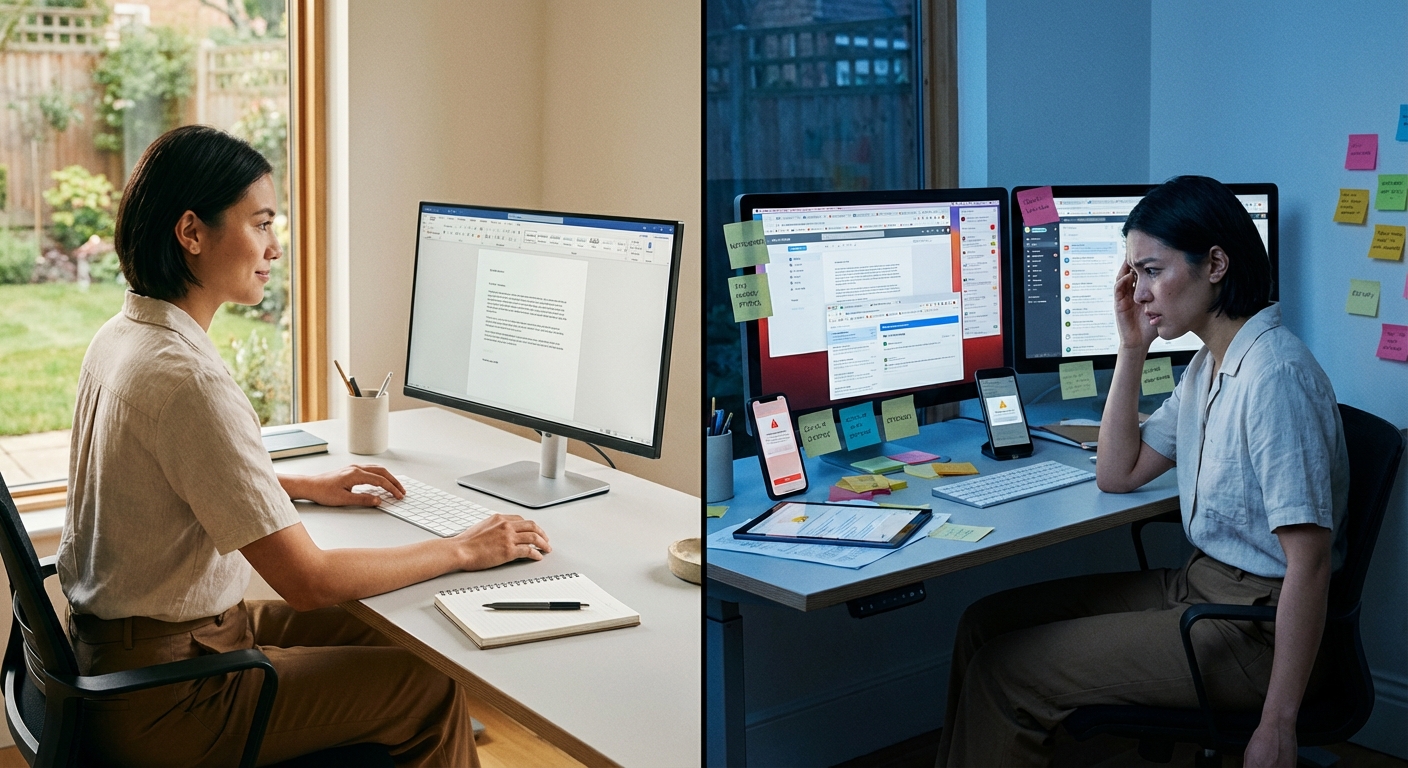
You’re not burned out in the traditional sense. You haven’t been grinding sixteen-hour days or running on four hours of sleep. You take weekends off. You even exercise. But by 2 PM on a Tuesday, your brain feels like it’s been through a blender. You can’t hold a thought. You reread the same paragraph three times. You open your laptop to do something specific, and thirty seconds later you’ve forgotten what it was. You’re not lazy. You’re not depressed. You’re cognitively overloaded, and in 2026, it’s becoming the dominant form of professional exhaustion.
Traditional burnout, the kind described by psychologist Christina Maslach, comes from sustained emotional and physical depletion, usually from overwork, lack of control, or insufficient reward. Cognitive overload is different. It comes from the sheer volume of information, decisions, and context-switches your brain processes in a single day, regardless of how many hours you actually work. You can work a reasonable schedule and still end the day with nothing left in the tank, because the problem isn’t the number of hours. It’s the number of times your attention gets fragmented within those hours.
Your Attention Is Shorter Than You Think
Gloria Mark, a professor of informatics at the University of California, Irvine, has spent over two decades studying how people use their attention in real work environments. Her research, compiled in her book Attention Span, documents a decline that should concern anyone who works with a screen.
In 2004, Mark and her colleagues found that the average person spent about two and a half minutes on a given task before switching to something else. That was already short. By 2012, the number had dropped to 75 seconds. In studies conducted between 2016 and 2020, the average time on a single screen before switching had fallen to roughly 47 seconds. Not 47 minutes. Forty-seven seconds. That means in a typical workday, your brain is performing hundreds of micro-switches, reorienting itself to new contexts, new demands, and new cognitive frameworks.
Each of those switches carries a cost. Mark’s research found that after an interruption, it takes an average of 23 minutes and 15 seconds to fully return to the original task. Not to start working on it again, you might return to it in seconds, but to reach the same depth of focus you had before the interruption. Think about what that means for a workday filled with Slack messages, email notifications, brief meetings, and ambient phone alerts. You’re not just losing the seconds of the interruption itself. You’re losing the cognitive runway needed to get back to depth.
The Hidden Tax of Attention Residue
The mechanism behind this cost has a name: attention residue. Sophie Leroy, a professor at the University of Washington’s School of Business, coined the term in her 2009 research published in Organizational Behavior and Human Decision Processes. Attention residue describes what happens when you switch from Task A to Task B before Task A is finished: part of your cognitive processing remains stuck on Task A, even as you try to engage with something new.
Leroy’s experiments demonstrated that people who switched tasks while the previous task was unfinished performed significantly worse on the new task compared to people who had completed their first task before switching. The residue from the unfinished work clouded their thinking, consumed working memory, and reduced the quality of their output. And critically, the participants weren’t aware of the degradation. They felt like they were working normally. They just weren’t.
This finding has profound implications for modern work culture. Most knowledge workers don’t complete one task before starting another. They operate in a constant state of partial attention, with three open tabs, two ongoing message threads, a meeting in fifteen minutes, and a half-written email from this morning still pinging their subconscious. Each unfinished task leaves its residue. By mid-afternoon, you’re not working with a fresh mind. You’re working with a mind carrying the cognitive debris of every unfinished task from the day, and that accumulation is what produces the blender-brain feeling you can’t seem to shake.
If you’ve noticed that deep work feels increasingly impossible even when you protect time for it, attention residue is likely a contributing factor. The time block is there, but your mind isn’t fully in it because it’s still processing the fragments of everything that came before.
Why Your Body Knows Before You Do
Cognitive overload isn’t just a mental phenomenon. It registers in the body. Mark’s research found that task-switching increases both systolic and diastolic blood pressure. The stress response is measurable and cumulative. Your body doesn’t distinguish between “I have a deadline and my manager is upset” and “I’ve switched contexts fourteen times in the last hour.” Both activate the same fight-or-flight circuitry. Both deplete the same reserves.
This is why cognitive overload often doesn’t feel like a dramatic crisis. It feels like a slow drain. You’re not panicking. You’re just tired in a way that sleep doesn’t fully fix, because the exhaustion isn’t physical. It’s neural. Your prefrontal cortex, the brain region responsible for executive function, decision-making, and focus, has a limited daily budget. Every context-switch draws from that budget. Spend it all on fragmented attention, and you have nothing left for the thinking that actually matters.

The American Psychological Association has documented the broader productivity costs of this pattern. Their research on multitasking suggests that shifting between tasks can cost as much as 40% of productive time, not because people are working less, but because they’re working less effectively. The feeling of busyness, the packed calendar, the constant responsiveness, masks a deeper inefficiency: you’re working harder to produce less, and your nervous system is paying the tax.
The 60-Second Reset That Actually Works
Knowing the problem is only useful if you can do something about it. And the most effective intervention researchers have found doesn’t require a meditation retreat or a digital detox. It takes about 60 seconds.
Andrew Huberman, a neuroscientist at Stanford University, has studied a breathing technique called the physiological sigh, a pattern your body already uses involuntarily when you’re crying or falling asleep. The technique is simple: two quick inhales through the nose (the second one filling the lungs completely), followed by one long, slow exhale through the mouth. That’s it.
In a randomized controlled trial published in Cell Reports Medicine, Huberman and his colleagues found that five minutes of daily cyclic sighing, the structured version of this breathing pattern, produced greater improvements in mood and greater reductions in physiological arousal than mindfulness meditation. The sighing group showed measurable decreases in respiratory rate and heart rate, alongside significant improvements in positive affect. The researchers described it as the fastest known method to shift the autonomic nervous system from sympathetic activation (fight-or-flight) toward parasympathetic calm.
You don’t need five minutes. Even one to three physiological sighs can interrupt the stress cascade of a fragmented workday. Use them between tasks, before a meeting, or in the moment you notice that your thoughts are scattered and your body is tense. This isn’t a productivity hack. It’s a neurological reset that gives your prefrontal cortex a chance to come back online.
Protecting Your Bandwidth Before It’s Gone
The physiological sigh handles the acute stress of cognitive overload. But the longer-term solution is structural. You have to reduce the number of context-switches your brain performs, or at minimum, make the transitions less costly.
Batch your attention. Instead of responding to messages as they arrive, designate two or three check-in windows per day. This sounds basic, and it is. But it’s the single highest-impact change most people can make. Every time you check Slack or email reactively, you’re performing a context-switch. Batch those switches, and you dramatically reduce the total cognitive tax. If you’ve been experimenting with reclaiming your attention from digital noise, batching is the structural backbone that makes it sustainable.
Finish before you switch. Leroy’s attention residue research points to a clear principle: when possible, complete a task before moving to the next one. When that isn’t possible, because the task is too large or an interruption is unavoidable, create a “ready to resume” note. Write down exactly where you left off and what the next step is. This reduces residue by giving your brain a sense of closure, a signal that the open loop has been captured and can be safely released.
Build transitions between cognitive modes. Instead of jumping directly from a meeting into focused work, take a 60-second pause. Do the physiological sigh. Walk to get water. Let your brain process the previous context before loading a new one. Cal Newport calls these “shutdown rituals,” small buffers between tasks that signal to your brain that one cognitive chapter has ended and another is beginning. The buffer doesn’t need to be long. It just needs to exist.
The principles of slow productivity aren’t just philosophical preferences. They’re cognitive necessities. Working on fewer things with greater depth isn’t a luxury. It’s how your brain is designed to function.

Your Next Move
You probably can’t eliminate context-switching from your workday. But you can stop treating it as free. Every switch has a cost, and once you start accounting for that cost, your decisions about how you structure your day change. You stop saying yes to the quick meeting that interrupts your focus block. You close the tab that’s open “just in case.” You let the notification wait.
Cognitive overload isn’t a character flaw. It’s a design problem. Your brain was built for sustained attention in a world that now demands constant fragmentation. The fix isn’t willpower. It’s architecture: designing your days, your tools, and your environments to protect the resource that everything else depends on.
Start with one day this week. Batch your messages into two windows. Use the physiological sigh between transitions. Finish one task before starting the next. Notice how your 2 PM brain feels compared to the version that was drowning in fragments. That difference isn’t motivation. It’s bandwidth, reclaimed.
Sources
- Mark, G. Attention Span: A Groundbreaking Way to Restore Balance, Happiness, and Productivity. Hanover Square Press, 2023.
- Leroy, S. “Why Is It So Hard to Do My Work? The Challenge of Attention Residue When Switching Between Work Tasks.” Organizational Behavior and Human Decision Processes, 2009.
- Balban, M.Y., Neri, E., Kogon, M.M., Weed, L., Nourber, B., Jo, B., Holl, G., Zeitzer, J.M., Spiegel, D., and Huberman, A.D. “Brief Structured Respiration Practices Enhance Mood and Reduce Physiological Arousal.” Cell Reports Medicine, 2023.
- American Psychological Association. “Multitasking: Switching Costs.” APA.