
You made a mistake at work. Maybe it was visible to others, maybe you caught it before anyone noticed, but you know what happened. Now you have a choice in how you respond. One voice, the one most of us know intimately, launches into criticism: you should have known better, you’re not as competent as you pretend to be, other people wouldn’t have made such a stupid error.
Another response is possible, though for many of us it feels foreign, almost uncomfortable. This response acknowledges the mistake without amplifying it. It recognizes that everyone fails sometimes, that imperfection is part of being human, that harsh self-criticism probably won’t prevent future mistakes but will definitely make you feel terrible right now.
This second response is self-compassion, and after more than two decades of rigorous research, the science is clear: it’s not a weakness, not self-indulgence, and not a path to complacency. It’s one of the most powerful predictors of psychological well-being, resilience, and, perhaps surprisingly, motivation and achievement.
What Self-Compassion Actually Is
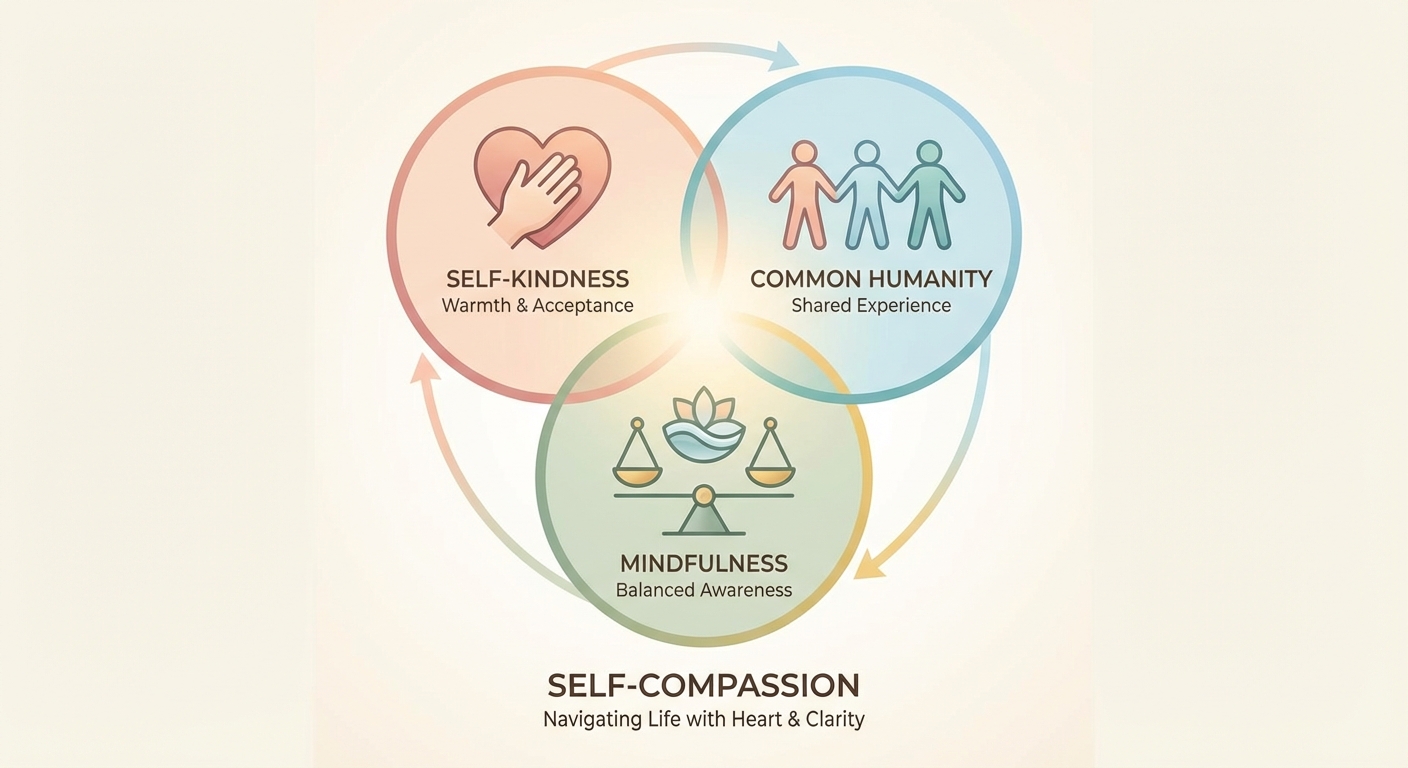
Kristin Neff, a psychology professor at the University of Texas at Austin, pioneered the scientific study of self-compassion over twenty years ago. Her work, which has now been cited by more than 77,000 researchers, defines self-compassion through three interconnected components.
The first is self-kindness versus self-judgment: treating yourself with warmth and understanding when you suffer, fail, or feel inadequate, rather than attacking yourself with harsh criticism. This doesn’t mean ignoring problems or pretending everything is fine. It means responding to difficulty the way you might respond to a good friend going through the same thing.
The second is common humanity versus isolation: recognizing that suffering and personal failure are part of the shared human experience, not evidence that something is uniquely wrong with you. When you’re struggling, self-compassion reminds you that everyone struggles. The feeling of “I’m the only one who can’t get it together” is itself a form of suffering, one that compounds whatever you’re already dealing with.
The third is mindfulness versus over-identification: holding painful thoughts and feelings in balanced awareness rather than suppressing them or becoming completely consumed by them. You can acknowledge that something is difficult without letting it define your entire experience or predict your entire future.
The Research That Surprised Everyone
When Neff began studying self-compassion, many psychologists assumed that self-criticism was necessary for motivation. The reasoning seemed intuitive: if you’re too easy on yourself, you’ll become complacent and stop trying to improve. Fear of your own harsh judgment keeps you in line.
The research has consistently shown the opposite. According to findings reviewed in the Annual Review of Psychology, self-compassion is strongly associated with psychological well-being. Higher levels of self-compassion are linked to increased happiness, optimism, curiosity, and connectedness, as well as decreased anxiety, depression, rumination, and fear of failure.
But here’s what surprised many researchers: self-compassion is also associated with greater motivation, not less. When you’re not afraid of crushing self-criticism after every setback, you’re more willing to try challenging things, to acknowledge mistakes and learn from them, to persist in the face of difficulty. Harsh self-judgment, it turns out, often leads to avoidance, procrastination, and giving up, precisely the outcomes people fear self-compassion would produce.
Research published by the University of Rochester Medical Center in 2025 reinforces these findings. People who are kinder to themselves are less likely to experience anxiety, stress, and depression. Self-compassion helps regulate emotions, reduce symptoms of stress and PTSD, and build the psychological resilience that allows people to bounce back from adversity.
Self-Compassion Versus Self-Esteem
For decades, self-esteem dominated discussions of psychological health. We were told to build children’s self-esteem, to cultivate our own, to believe in ourselves. But research has increasingly revealed problems with the self-esteem approach.
Self-esteem is often contingent: it rises when we succeed and crashes when we fail. It depends on feeling special, above average, better than others. This creates fragility, because any threat to our specialness becomes a threat to our self-worth. It also contributes to narcissism, defensiveness, and the distortion of reality to protect a positive self-image.
Self-compassion offers something different. According to Neff’s research, self-compassion produces psychological benefits without the negative effects associated with self-esteem. When compared to self-esteem, self-compassion was associated with more stable feelings of self-worth over time. It provided stronger protection against social comparison, public self-consciousness, self-rumination, anger, and closed-mindedness.
The difference is subtle but profound. Self-esteem says “I’m great.” Self-compassion says “I’m human, and that’s okay.” One depends on performance and comparison; the other is unconditional. One is easily threatened; the other remains stable through success and failure alike.

The Myths That Hold Us Back
Despite the robust evidence, self-compassion faces persistent resistance. Many people believe, often without examining the belief, that treating themselves kindly would be dangerous. Understanding why these myths are wrong can help unlock the benefits self-compassion offers.
Myth: Self-compassion is self-pity. Self-pity involves becoming absorbed in your own problems and forgetting that others also suffer. It’s isolating and tends to magnify distress. Self-compassion, by contrast, explicitly includes the recognition of common humanity. It contextualizes your suffering within the larger human experience, which actually reduces the sense that your problems are uniquely terrible.
Myth: Self-compassion is self-indulgent. Self-indulgence typically means doing whatever feels good in the moment without regard for long-term well-being, like eating junk food or avoiding necessary tasks. Self-compassion is actually oriented toward your well-being, which sometimes means doing difficult things. A self-compassionate response to struggling at work isn’t “I deserve to quit and watch Netflix.” It’s “This is hard, and I’m going to take care of myself while I figure out how to move forward.”
Myth: Self-compassion undermines motivation. This is perhaps the most common concern, and the research addresses it directly. Self-compassionate people are more motivated to improve after failure, more willing to acknowledge their weaknesses, and more likely to try again after setbacks. Harsh self-criticism triggers the threat-defense system, which often leads to avoidance, denial, or giving up. Self-compassion activates the care system, which supports approach, engagement, and persistence.
Myth: Self-compassion is weak. Research shows the opposite. Self-compassion is associated with greater psychological resilience, defined as the ability to cope with adversity and bounce back from difficult experiences. When you’re not wasting energy attacking yourself, you have more resources available for actually dealing with problems.
How Self-Compassion Works in Practice
Neff and her colleague Christopher Germer developed an empirically supported program called Mindful Self-Compassion (MSC) that teaches specific practices for cultivating self-compassion. While the full program involves weeks of training, some core practices can be applied immediately.
The self-compassion break is one of the simplest. When you’re struggling, you pause and acknowledge three things, each corresponding to one of the components of self-compassion. First, name what’s happening: “This is a moment of suffering” or “This is really hard right now.” Second, remind yourself of common humanity: “Everyone struggles sometimes” or “I’m not alone in feeling this way.” Third, offer yourself kindness: “May I be kind to myself” or physically placing your hand over your heart.
This might feel awkward at first, especially if self-criticism has been your default for years. That’s normal. The inner critic has often had decades of practice; the self-compassionate voice needs time to develop strength and fluency.

When Self-Compassion Is Hard
For some people, self-compassion doesn’t just feel unfamiliar; it feels threatening. This is particularly common among those who grew up in environments where self-criticism was modeled as the path to success, or where any hint of self-acceptance was labeled as arrogance or laziness.
Research has identified what’s called “backdraft,” a phenomenon where initially practicing self-compassion brings up difficult emotions. This can happen because treating yourself kindly highlights the contrast with years of self-attack. It can also trigger grief for the kindness you didn’t receive from others. This isn’t a sign that self-compassion is wrong for you; it’s a sign that there’s healing to be done, and that self-compassion is touching something real.
If self-compassion brings up overwhelming emotions, it’s worth working with a therapist who can provide support. Compassion-focused therapy (CFT), developed by psychologist Paul Gilbert, specifically addresses the blocks that prevent people from accessing self-compassion.
For most people, though, the resistance is milder, more like discomfort than distress. The practice is simply unfamiliar, like any new skill. With repetition, it becomes more natural. The self-compassionate response eventually becomes available alongside the self-critical one, giving you a choice in how to respond to your own struggles.

Your Invitation
Here’s an experiment: the next time you catch yourself in harsh self-criticism, pause. Notice what you’re saying to yourself, the tone of voice, the underlying assumptions. Then ask: would I say this to a friend going through the same thing? If not, why not?
This isn’t about excusing genuine wrongdoing or pretending you don’t have areas for growth. It’s about questioning whether brutal self-attack is really the most effective way to motivate change. The research says it isn’t. Kindness, understanding, and recognition of shared humanity are more effective at supporting the growth you’re actually seeking.
You don’t have to be perfect at self-compassion. You don’t have to banish self-criticism entirely or feel warm and fuzzy about every failure. You can start simply by noticing when you’re being harsh with yourself and offering, even briefly, another possibility.
The voice of self-compassion might feel weak at first, drowned out by years of practiced criticism. But it gets stronger with use. And the research is overwhelming: this voice, the one that treats you like someone worthy of kindness, is the voice that will actually help you become who you want to be.
Asking for help when you need it, giving yourself permission to rest, acknowledging that you’re doing the best you can while also wanting to grow, these are all expressions of self-compassion. They’re not the opposite of achievement; they’re the foundation for sustainable achievement.
What would it be like to go through one day, just one, treating yourself the way you’d treat a good friend? Not indulgently, not ignoring real problems, but with the basic kindness and understanding that everyone deserves, including you. That’s the invitation. The research says it’s worth accepting.
Sources: Annual Review of Psychology, University of Rochester Medical Center, Kristin Neff (University of Texas at Austin) on self-compassion, Christopher Germer on Mindful Self-Compassion, Paul Gilbert on compassion-focused therapy.