
You’ve probably already written off this year. December feels like a holding pattern, a waiting room before the “real” change begins on January 1st. The gym can wait. The career pivot can wait. The relationship conversation can wait. Everything important gets mentally postponed to that magical date when transformation supposedly becomes possible.
But here’s what behavioral scientists have discovered: you’re sitting on one of the most psychologically powerful fresh start opportunities of the entire year, and it’s not January 1st. It’s right now.
The research on temporal landmarks reveals something counterintuitive about human motivation. Those arbitrary dates we assign significance to, the first of the month, the start of a semester, a birthday, the winter solstice, they aren’t just calendar curiosities. They fundamentally reshape how we see ourselves and what we believe we’re capable of achieving. And the fresh start you’re postponing until New Year’s? You could activate it today with a deeper understanding of your own psychology.
The Science of Temporal Landmarks
In 2014, researchers Hengchen Dai, Katherine Milkman, and Jason Riis published a groundbreaking paper in Management Science that changed how behavioral scientists understand motivation. They analyzed millions of data points, from Google searches for “diet” to gym attendance records to commitment contracts on goal-setting platforms, and found a striking pattern: aspirational behavior spikes dramatically at temporal landmarks.
The numbers are remarkable. People are 33 percent more likely to exercise at the start of a new week compared to mid-week. Gym attendance jumps 47 percent at the beginning of a new semester. Searches for diet-related information surge at the start of each month. And New Year’s? That’s when goal-related behavior reaches its annual peak.
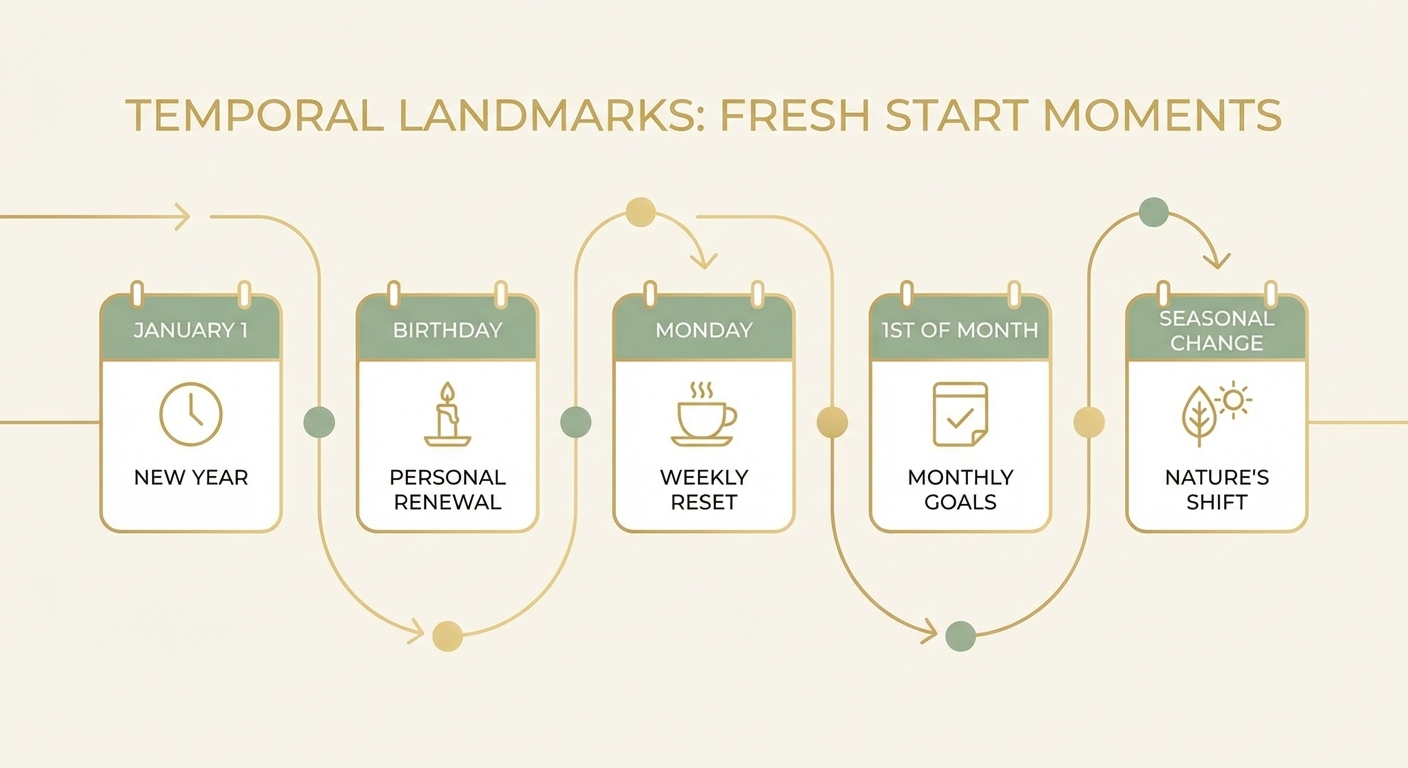
But the most important finding wasn’t about when people attempt change. It was about why. The researchers discovered that temporal landmarks create what they called “psychological separation from past failures.” When you cross a temporal landmark, your brain treats your past self and your future self as different people. The person who failed at the diet, who skipped the gym, who avoided the difficult conversation, that was the old you. The person on this side of the landmark? That’s someone new.
Dr. Katherine Milkman, now a professor at Wharton and author of How to Change, explains the mechanism simply: “Those failures are the old you, and this is the new you.” This isn’t just positive thinking. It’s a measurable shift in how people process their personal history and evaluate their future potential.
Why December 22nd Is Secretly Powerful
The winter solstice occupies a unique position in the calendar of temporal landmarks. It’s the shortest day of the year, the moment when darkness peaks and daylight begins its slow return. For thousands of years, cultures around the world have recognized this transition as a threshold moment, a time when one phase ends and another begins.
From a psychological perspective, the solstice functions as what researchers call a “natural” temporal landmark, distinct from the “social” landmarks we’ve constructed around New Year’s. Natural landmarks carry their own weight. They’re rooted in observable reality, the actual turning of seasons, rather than the arbitrary placement of dates on a calendar.
This matters because not all fresh starts are created equal. Research on temporal landmarks shows that the most powerful ones combine multiple psychological triggers. The solstice offers at least three: it marks a seasonal transition, it falls near the year’s end, and it carries cultural and symbolic significance across traditions. For those paying attention, it provides all the psychological machinery of a fresh start without the pressure and noise that surrounds January 1st.

There’s another advantage to claiming your fresh start now: you’re working against the grain. While everyone else is in holiday holding patterns, mentally checked out until January, you have the psychological space to actually begin. Research from Harvard Business Review confirms that periods of reflection improve long-term results and innovation. When you slow down to evaluate what worked and what didn’t, your brain consolidates learning in ways that strengthen the connection between intention and behavior.
The Mechanics of a Fresh Start
Understanding why temporal landmarks work is only half the equation. The other half is knowing how to harness their power deliberately. Dr. Gail Matthews at Dominican University conducted research showing that people who write down their goals are 42 percent more likely to achieve them. But the fresh start effect suggests that when you write those goals matters nearly as much as the act of writing itself.
The psychological separation that temporal landmarks create opens a window of heightened motivation. During this window, people naturally take what researchers call a “big-picture view” of their lives. They see themselves from a distance, evaluating patterns and possibilities rather than getting lost in daily details. This expanded perspective makes it easier to identify what actually matters and to commit to changes that align with deeper values.
But the window doesn’t stay open forever. Studies on the fresh start effect show that the motivational boost peaks immediately after a landmark and then gradually fades. This is why so many New Year’s resolutions fail by February, not because the resolutions were wrong, but because the psychological momentum dissipated before new behaviors could become habits.

The implication is practical: if you want to maximize the power of a fresh start, you need to act quickly after recognizing the landmark and build structures that sustain motivation after the initial surge fades. This might mean making a commitment you can’t easily back out of, telling someone about your intention, scheduling specific actions, or creating environmental cues that make the new behavior easier than the old one.
Anticipating Your Future Self
Recent research has added another dimension to our understanding of fresh starts. Psychologists have found that not only does experiencing a temporal landmark boost motivation, but so does anticipating one. When you’re reminded of an upcoming landmark and connect it to your ideal future self, your current motivation increases even before the landmark arrives.
Dr. Laura King’s research on “possible selves” demonstrates that writing about your ideal future self can increase motivation, improve mood, and even enhance immune function. The fresh start effect amplifies this process. When you anticipate a temporal landmark as the beginning of a new chapter, you create a psychological bridge between who you are now and who you want to become.
This is where the week between the solstice and New Year’s becomes especially valuable. You’re positioned between two temporal landmarks, with the psychological momentum of one feeding into the anticipation of the other. It’s a window within a window, a time when the conditions for meaningful change are unusually favorable.
The research suggests using this period deliberately. Rather than treating it as dead time between holidays, recognize it as one of the few moments each year when your brain is primed for transformation. Write about the person you want to be on the other side. Identify specific behaviors that align with that vision. And make at least one concrete commitment, something observable and measurable, that you can begin before January arrives.
When Fresh Starts Backfire
It would be dishonest to present temporal landmarks as a psychological panacea. The same research that reveals their power also identifies conditions under which they can backfire. Fresh starts work best for people who haven’t accumulated too much psychological baggage around the goal in question. If you’ve tried and failed to quit smoking every New Year’s for a decade, another January 1st attempt might actually undermine rather than boost your confidence.
There’s also a phenomenon researchers call “licensing,” the tendency to give yourself permission for indulgence before a fresh start arrives. Studies have shown that people sometimes behave worse in the days before a temporal landmark, mentally excusing their actions because real change is just around the corner. If you’ve ever eaten an entire pizza on December 30th with the logic that your diet starts in two days, you’ve experienced licensing firsthand.
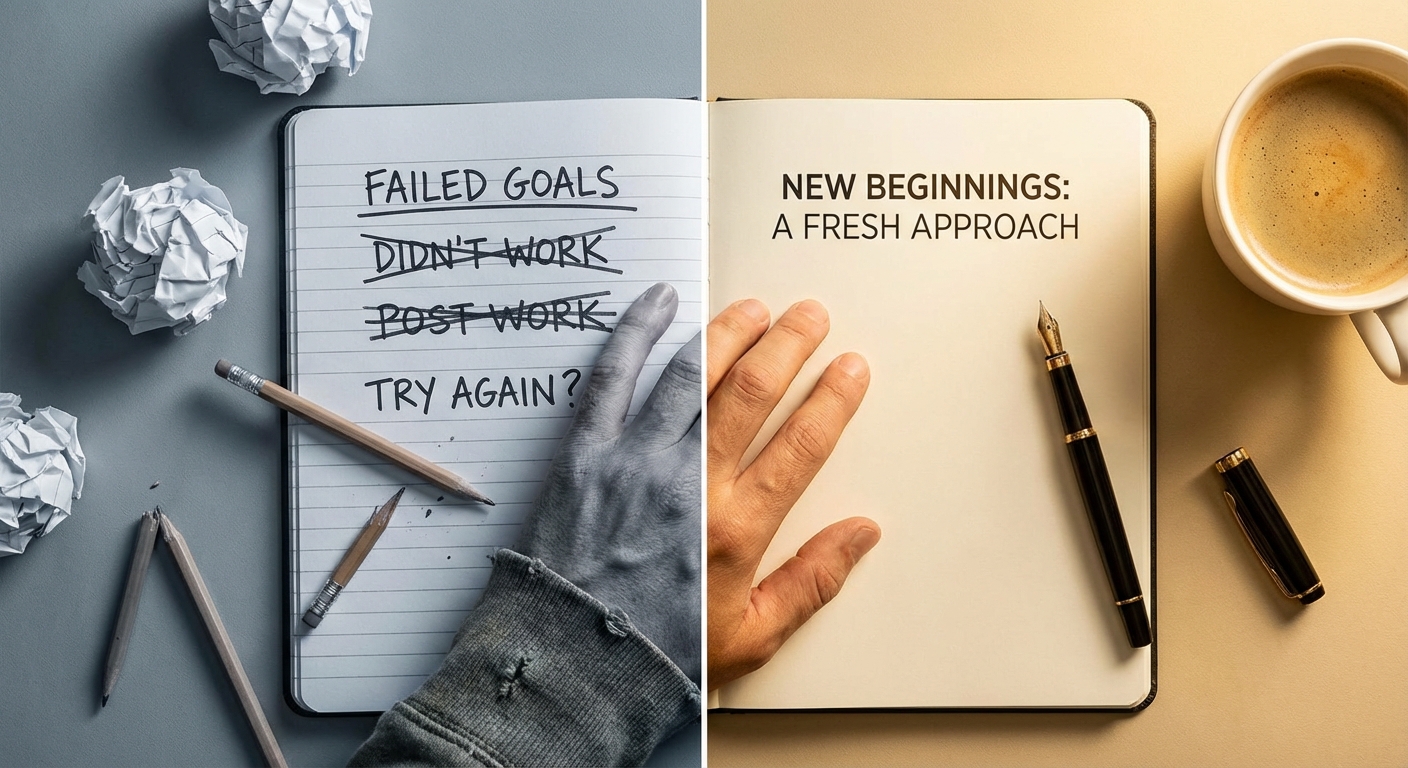
The research offers a clear corrective: fresh starts should signal a change in approach, not just a change in timing. If you’re attempting the same goal you’ve failed at before, the temporal landmark needs to coincide with a genuinely different strategy. The psychological separation from your past self works best when your future self is actually doing something new, not repeating the same patterns with a new start date.
Your Invitation
The science is clear: temporal landmarks create real psychological shifts that influence behavior. The question isn’t whether the fresh start effect exists, it’s whether you’ll use it intentionally or let it pass unnoticed.
This week offers something rare. The winter solstice provides a natural fresh start, grounded in the actual turning of seasons rather than arbitrary calendar conventions. The period between solstice and New Year’s creates a psychological runway, a time when your brain is primed for reflection and resolution. And the relative quiet of this week, before the pressure of January resolutions and the judgment of gym-crowded January, gives you space to begin on your own terms.
You don’t have to wait for January 1st to become someone new. The research confirms what cultures around the world have intuited for millennia: this threshold, this turning point, this moment when darkness peaks and light begins its return, is a time of genuine psychological power.
The old you is already receding. The question is what the new you will decide to do with this second chance season.
Sources: The Fresh Start Effect (Management Science), Milkman “How to Change” (2021), Dominican University Goal Research, Psychology Today: Fresh Starts.